



Page 61
Page 61

Progress in Cryptology – Mycrypt 2005 ; 1st International Conference on Cryptology in Malaysia, Kuala Lumpur, Malaysia, September 28-30, 2005, Proceedings
The conference was co-organized by the Information Security Research Lab at Swinburne University of Technology (Sarawak Campus), NISER (National ICT Security and Emergency Response Centre) and INSPEM (Ins- tute for Mathematical Research)at UPM (University Putra Malaysia).Mycrypt 2005 was held in Kuala Lumpur, Malaysia during September 28-30 2005, in conjunction with the e-Secure Malaysia 2005 convention. Therewere90paper submissionsfrom23 countriescoveringall areasof cr- tologic research, from which 19 were accepted. We would like to extend our thanks to all authors who submitted papers to Mycrypt 2005. Each paper was sent an onymously to at least 3 members of the International Program Committee for reviews and comments. The review comments were then followed by disc- sions among the Program Committee. A recipient of the Best Paper Award was also selected after voting among Program Committee members. . These proceedings contain revised versions of all the accepted papers.

Progress in Cryptology - AFRICACRYPT 2020 ; 12th International Conference on Cryptology in Africa, Cairo, Egypt, July 20 – 22, 2020, Proceedings
This book constitutes the refereed proceedings of the 12th International Conference on the Theory and Application of Cryptographic Techniques in Africa, AFRICACRYPT 2020, held in Cairo, Egypt, in July 2020. The 21 papers presented in this book were carefully reviewed and selected from 49 submissions. The papers are organized in topical sections on zero knowledge, symmetric key cryptography, elliptic curves, post quantum cryptography, lattice based cryptography, side channel attacks, cryptanalysis and new algorithms and schemes. AFRICACRYPT is a major scientific event that seeks to advance and promote the field of cryptology on the African continent. The conference has systematically drawn some excellent contributions to the field. The conference has always been organized in cooperation with the International Association for Cryptologic Research (IACR).

Programming Multi-Agent Systems ; Vol. 3346 : 2nd International Workshop ProMAS 2004, New York, NY, July 20, 2004, Selected Revised and Invited Papers
Focusses on a principled way to combine the two dominant paradigms for building multiagent team plans, namely the “belief-desire-intention” (BDI) approach and distributed POMDPs. In this hybrid BDI-POMDP approach, BDI team plans are exploited to improve distributed POMDP tractability and distributed POMDP-based analysis improves BDI team plan performance. Concretely, we focus on role allocation, a fundamental problem in BDI teams – which agents to allocate to the different roles in the team. The hybrid BDI-POMDP approach provides three key contributions. First, unlike prior work in multiagent role allocation, we describe a role allocation technique that takes into account future uncertainties in the domain. The second contribution is a novel decomposition technique, which exploits the structure in the BDI team plans to significantly prune the search space of combinatorially many role allocations. Our third key contribution is a significantly faster policy evaluation algorithm suited for our BDI-POMDP hybrid approach. Finally, we also present experimental results from two domains: mission rehearsal simulation and RoboCupRescue disaster rescue simulation. In the RoboCupRescue domain, we show that the role allocation technique presented in this paper is capable of performing at human expert levels by comparing with the allocations chosen by humans in the actual RoboCupRescue simulation environment.

Programming Multi-Agent Systems ; 5th International Workshop, ProMAS 2007 Honolulu, HI, USA, May 15, 2007 Revised and Invited Papers
The aim of the ProMAS workshop series is to promote and contribute to the establishment of MAS as a mainstream approach to the development of industrial-strength software. In particular, ProMAS aims to address the technologies that are required for - plementing multi-agentsystems designs or specifications efiectively

Programming Languages and Systems ; 6th Asian Symposium, APLAS 2008, Bangalore, India, December 9-11, 2008. Proceedings
The symposium is devoted to all topics ranging from foundational to practical issues in programming languages and systems. The papers cover topics such as semantics, logics, foundational theory, type systems, language design, program analysis, optimization, transformation, software security, safety, verification, compiler systems, interpreters, abstract machines, domain-specific languages and systems, as well as programming tools and environments.

Programming languages and systems ; 31st European symposium on programming, ESOP 2022, Held as Part of the European Joint Conferences on theory and practice of software, ETAPS 2022, Munich, Germany, April 2–7, 2022, Proceedings
This book constitutes the proceedings of the 31st European Symposium on Programming, ESOP 2022, which was held during April 5-7, 2022, in Munich, Germany, as part of the European Joint Conferences on Theory and Practice of Software, ETAPS 2022. The 21 regular papers presented in this volume were carefully reviewed and selected from 64 submissions. They deal with fundamental issues in the specification, design, analysis, and implementation of programming languages and systems.

Programming Languages and Systems ; 30th European Symposium on Programming, ESOP 2021, Held as Part of the European Joint Conferences on Theory and Practice of Software, ETAPS 2021, Luxembourg City, Luxembourg, March 27 – April 1, 2021, Proceedings
This book constitutes the proceedings of the 30th European Symposium on Programming, ESOP 2021, which was held during March 27 until April 1, 2021, as part of the European Joint Conferences on Theory and Practice of Software, ETAPS 2021. The conference was planned to take place in Luxembourg and changed to an online format due to the COVID-19 pandemic.

Programming languages and systems ; 29th European Symposium on Programming, ESOP 2020, Held as part of the European Joint Conferences on theory and practice of software, ETAPS 2020, Dublin, Ireland, April 25–30, 2020, Proceedings
This book constitutes the proceedings of the 29th European Symposium on Programming, ESOP 2020, which took place in Dublin, Ireland, in April 2020, and was held as Part of the European Joint Conferences on Theory and Practice of Software, ETAPS 2020.

Programming Languages and Systems ; 28th European Symposium on Programming, ESOP 2019, Held as Part of the European Joint Conferences on Theory and Practice of Software, ETAPS 2019, Prague, Czech Republic, April 6–11, 2019, Proceedings
It is devoted to fundamental issues in the specification, design, analysis, and implementation of programming languages and systems.
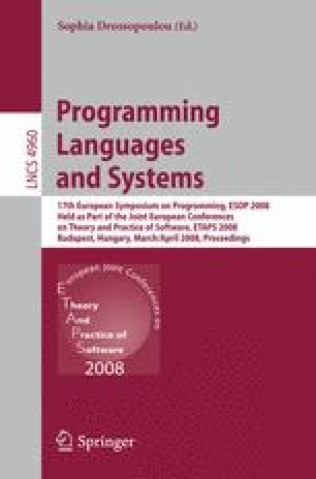
Programming Languages and Systems ; 17th European Symposium on Programming, ESOP 2008, Held as Part of the Joint European Conferences on Theory and Practice of Software, ETAPS 2008, Budapest, Hungary, March 29-April 6, 2008. Proceedings
This book presented together with the abstract of one invited talk and two tool presentations were carefully reviewed and selected from 104 submissions and address fundamental issues in the specification, analysis, and implementation of programming languages and sytems. The papers are organized in topical sections on static analysis, security, concurrency and program verification.

Programming languages and systems : 32nd European Symposium on Programming, ESOP 2023, Held as Part of the European Joint Conferences on Theory and Practice of Software, ETAPS 2023, Paris, France, April 22–27, 2023, Proceedings
Contains the papers accepted at the 32nd European Symposium on Programming(ESOP 2023), held during April 22–27, 2023, in Paris, France. ESOP is oneof the European Joint Conferences on Theory and Practice of Software (ETAPS); it isdedicated to fundamental issues in the specification, design, analysis, and implementationof programming languages and systems.

Programming Languages and Systems ; 27th European Symposium on Programming, ESOP 2018, Held as Part of the European Joint Conferences on Theory and Practice of Software, ETAPS 2018, Thessaloniki, Greece, April 14-20, 2018, Proceedings
Contains the papers presented at the 27th European Symposium on Pro-gramming (ESOP 2018) held 2018, in Thessaloniki, Greece. ESOP is one of the European Joint Conferences on Theory and Practice of Software (ETAPS). It is devoted to fundamental issues in the specification, design, analysis, and implementa- tion of programming languages and systems. The 36 papers in this volume were selected from 114 submissions based on origi-nality and quality.

Programming for Computations - Python : A Gentle Introduction to Numerical Simulations with Python 3.6
This book presents computer programming as a key method for solving mathematical problems. This second edition of the well-received book has been extensively revised: All code is now written in Python version 3.6 (no longer version 2.7). In addition, the two first chapters of the previous edition have been extended and split up into five new chapters, thus expanding the introduction to programming from 50 to 150 pages. Throughout the book, the explanations provided are now more detailed, previous examples have been modified, and new sections, examples and exercises have been added. Also, a number of small errors have been corrected.

Programming for Computations - Python : A Gentle Introduction to Numerical Simulations with Python
This book presents computer programming as a key method for solving mathematical problems. There are two versions of the book, one for MATLAB and one for Python. The book was inspired by the Springer book TCSE 6: A Primer on Scientific Programming with Python (by Langtangen), but the style is more accessible and concise, in keeping with the needs of engineering students. The book outlines the shortest possible path from no previous experience with programming to a set of skills that allows the students to write simple programs for solving common mathematical problems with numerical methods in engineering and science courses. The emphasis is on generic algorithms, clean design of programs, use of functions, and automatic tests for verification.

Programming for Computations - MATLAB/Octave : A Gentle Introduction to Numerical Simulations with MATLAB/Octave
This book presents computer programming as a key method for solving mathematical problems. There are two versions of the book, one for MATLAB and one for Python. The book was inspired by the Springer book TCSE 6: A Primer on Scientific Programming with Python (by Langtangen), but the style is more accessible and concise, in keeping with the needs of engineering students. The book outlines the shortest possible path from no previous experience with programming to a set of skills that allows the students to write simple programs for solving common mathematical problems with numerical methods in engineering and science courses. The emphasis is on generic algorithms, clean design of programs, use of functions, and automatic tests for verification.

Production Planning in Production Networks : Models for Medium and Short-term Planning
Production Planning in Production Networks addresses production planning problems in distributed manufacturing networks from strategic, tactical, organisational and operative perspectives. New methodologies for capacity negotiation, allocation and workload assignment in production networks are presented. Specifically, three main problems are focussed on: how to negotiate production capacity availability in the long-term; how to allocate production capacity in medium-term planning; and, how to assign workloads in the short-term. The proposed approaches are based on negotiation algorithms in multi-agent networks. These approaches are compared with classical centralised approaches using discrete event simulation methodologies. Benchmark analysis is provided to understand the effectiveness and efficiency of the proposed approaches.

Production Planning by Mixed Integer Programming
This textbook provides a comprehensive modeling, reformulation and optimization approach for solving production planning and related supply chain planning problems, covering topics from a basic introduction to planning systems, mixed integer programming (MIP) models and algorithms through the advanced description of mathematical results in polyhedral combinatorics required to solve these problems. This book addresses the solution of real life or industrial production planning problems (involving complex production structures with multiple production stages) using a MIP modeling and reformulation approach. It is based on close to twenty years of research in which the authors have played a significant role. One of the goals of this book is to allow non-expert readers, students in business, engineering, applied mathematics and computer science to solve such problems using standard modeling tools and MIP software. To achieve this the book provides a unique collection of reformulation results, integrating them into a comprehensive modeling and reformulation approach, as well as an easy to use problem-solving library. Moreover this approach is demonstrated through a series of real life case studies, exercises and detailed illustrations.

Production Economics : Integrating the Microeconomic and Engineering Perspectives
A production economist focuses on assessment, and will use an aggregate description of technology to answer such questions as: How does the firm compare to its competitors? Has the firm improved its production capabilities? A production engineer focuses on optimizing resources, and will use a detailed description of technology to answer a completely different set of questions: Which operations or plants should produce which products at what time? Should resource capacity be expanded and, if so, which resources should be acquired? Each group could benefit from the other group's perspective. This book offers a unified, integrated point of view that bridges the gap between these two historically distinct perspectives.

Product-Focused Software Process Improvement ; 9th International Conference, PROFES 2008 Monte Porzio Catone, Italy, June 23-25, 2008 Proceedings
The papers address different development modes, roles in the value chain, stakeholders’ viewpoints, collaborative development, as well as economic and quality aspects. The papers are organized in topical sections on quality and measurement, cost estimation, capability and maturity models, systems and software quality, software process improvement, lessons learned and best practices, and agile software development.

Product-Focused Software Process Improvement ; 7th International Conference, PROFES 2006, Amsterdam, The Netherlands, June 12-14, 2006, Proceedings
Brought together researchers and industrial practitioners for reporting new research results and exchanging experiences and findings in the area of process and product improvement. The focus of the conference was on understanding, evaluating, controlling, and improving the relationship between process improvement activities (such as the deployment of innovative defect detection processes) and their effects on products (such as improved product reliability and safety). Consequently, major topics of the conference included the evaluation of existing software process improvement (SPI) approaches in different contexts, the presentation of new or modified SPI approaches, and the relation between SPI and new development techniques or emerging application domains. The need for SPI is being widely recognized.
