



Page 5
Page 5

Handbook of Fractional Calculus for Engineering and Science
Provides reliable methods for solving fractional-order models in science and engineering. Contains efficient numerical methods and algorithms for engineering-related equations. Contains comparison of various methods for accuracy and validity. Demonstrates the applicability of fractional calculus in science and engineering. Examines qualitative as well as quantitative properties of solutions of various types of science- and engineering-related equations.

Groundwater Geochemistry : A Practical Guide to Modeling of Natural and Contaminated Aquatic Systems
Numerical groundwater flow, transport, and geochemical models are important tools besides classical deterministic and analytical approaches. Solving complex linear or non-linear systems of equations, commonly with hundreds of unknown parameters, is a routine task for a PC. Modeling hydrogeochemical processes requires a detailed and accurate water analysis, as well as thermodynamic and kinetic data as input. Thermodynamic data, such as complex formation constants and solubility-products, are often provided as databases within the respective programs. However, the description of surface-controlled reactions (sorption, cation exchange, surface complexation) and kinetically controlled reactions requires additional input data. Unlike groundwater flow and transport models, thermodynamic models, in principal, do not need any calibration.

Grid-based problem solving environments ; IFIP TC2/WG2.5 Working Conference on Grid-based problem solving environments : Implications for development and deployment of numerical software, July 17-21, 2006, Prescott, Arizona, USA
The IFIP series publishes state-of-the-art results in the sciences and technologies of information and communication. The principal aim of the IFIP series is to encourage education and the dissemination and exchange of information about all aspects of computing.
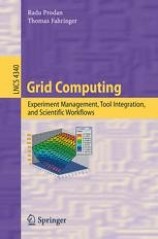
Grid computing : Experiment management, Tool Integration, and Scientific Workflows
Grid computing has become a topic of significant interest in the scientific community as a means of enabling application developers to aggregate resources scattered around the globe for solving large-scale scientific problems. This monograph addresses four critical software development aspects for the engineering and execution of applications on parallel and Grid architectures.

Graphs, Dioids and Semirings : New Models and Algorithms
The primary objectives of GRAPHS, DIOÏDS AND SEMIRINGS: New Models and Algorithms are to emphasize the deep relations existing between the semiring and dioïd structures with graphs and their combinatorial properties, while demonstrating the modeling and problem-solving capability and flexibility of these structures. In addition the book provides an extensive overview of the mathematical properties employed by "nonclassical" algebraic structures, which either extend usual algebra (i.e., semirings), or correspond to a new branch of algebra (i.e., dioïds), apart from the classical structures of groups, rings, and fields.

Graph theory and combinatorial optimization
Graph theory is very much tied to the geometric properties of optimization and combinatorial optimization. Moreover, graph theory's geometric properties are at the core of many research interests in operations research and applied mathematics. Its techniques have been used in solving many classical problems including maximum flow problems, independent set problems, and the traveling salesman problem. Graph Theory and Combinatorial Optimization explores the field's classical foundations and its developing theories, ideas and applications to new problems. The book examines the geometric properties of graph theory and its widening uses in combinatorial optimization theory and application.

Global optimization and constraint satisfaction ; 2nd International Workshop, COCOS 2003, Lausanne, Switzerland, Nevember 18-21, 2003, Revised Selected Papers
Theformulationofmanypracticalproblemsnaturallyinvolvesconstraintsonthe variables entering the mathematical model of a real-life situation to be analyzed. It is of great interest to ?nd the possible scenarios satisfying all constraints, and, iftherearemanyofthem,eitherto?ndthebestsolution,ortoobtainacompact, explicit representation of the whole feasible set. The 2nd Workshop on Global Constrained Optimization and Constraint S- isfaction, COCOS 2003, which took place during November 18–21, 2003 in L- sanne, Switzerland, was dedicated to theoretical, algorithmic, and application oriented advances in answering these questions. Here global optimization refers to ?nding the absolutely best feasible point, while constraint satisfaction refers to?ndingallpossiblefeasiblepoints.AsinCOCOS2002,the?rstsuchworkshop (see the proceeedings [1]), the emphasis was on complete solving techniques for problems involving continuous variables that provide all solutions with full rigor, and on applications which, however, were allowed to have relaxed standards of rigor.

Global Conflict Resolution Through Positioning Analysis
Positioning analysis penetrates beneath surface issues to their underlying psychological causes and social effects, with the intention of defusing conflict and preventing existing conflict from escalating. As the growing literature shows, positioning analysis methods are not only effective in interpersonal and intergroup problems, but have considerable potential for resolving disputes on the world stage. Global Conflict Resolution through Positioning Analysis starts with the daily disputes that result from our multiple social identities and evolving self-definitions, offers a new framework for understanding historical conflict, and brings vital new perspectives to current political and ideological battles. Twenty expert contributors examine scenarios as simple as a committee meeting of four people, as complicated as centuries-old social movements and the shifting tensions in the Middle East.

Geotechnics of Roads : Advanced Analysis and Modeling
Develops 23 extended examples that cover most of the theoretical aspects presented in the book Geotechnics of Roads: Fundamentals. Moreover, for most examples, Volume 2 describes algorithms for solving complex problems and provides Matlab® scripts for their solution.

Geometry for Computer Graphics : Formulae, Examples and Proofs
Geometry is the cornerstone of computer graphics and computer animation, and provides the framework and tools for solving problems in two and three dimensions. This may be in the form of describing simple shapes such as a circle, ellipse, or parabola, or complex problems such as rotating 3D objects about an arbitrary axis. Geometry for Computer Graphics draws together a wide variety of geometric information that will provide a sourcebook of facts, examples, and proofs for students, academics, researchers, and professional practitioners.

Geometric Modeling and Algebraic Geometry
The two ?elds of Geometric Modeling and Algebraic Geometry, though closely - lated, are traditionally represented by two almost disjoint scienti?c communities. Both ?elds deal with objects de?ned by algebraic equations, but the objects are studied in different ways. While algebraic geometry has developed impressive - sults for understanding the theoretical nature of these objects, geometric modeling focuses on practical applications of virtual shapes de?ned by algebraic equations. Recently, however, interaction between the two ?elds has stimulated new research. For instance, algorithms for solving intersection problems have bene?ted from c- tributions from the algebraic side.

Genetic Systems Programming : Theory and Experiences
This book is devoted to reporting innovative and significant progress about the contribution of genetic programming in systems programming. The contributions of this book clearly demonstrate that genetic programming is very effective in solving hard and yet-open problems in systems programming. Followed by an introductory chapter, in the remaining contributed chapters, the reader can easily learn about systems where genetic programming can be applied successfully. These include but are not limited to, information security systems, compilers, data mining systems, stock market prediction systems, robots and automatic programming.

Genetic rogramming ; Vol. 3447 : 8th European conference, EuroGP 2005, Lausanne, Switzerland, March 30-April 1, 2005, Proceedings
In this volume we present the contributions for the 18th European Conference on Genetic Programming (EuroGP 2005). The conference took place from 30 March to 1 April in Lausanne, Switzerland. EuroGP is a well-established conf- ence and the only one exclusively devoted to genetic programming. All previous proceedings were published by Springer in the LNCS series. From the outset, EuroGP has been co-located with the EvoWorkshops focusing on applications of evolutionary computation. Since 2004, EvoCOP, the conference on evolutionary combinatorial optimization, has also been co-located with EuroGP, making this year’s combined events one of the largest dedicated to evolutionary computation in Europe. Genetic programming (GP) is evolutionary computation that solves complex problems or tasks by evolving and adapting a population of computer programs, using Darwinian evolution and Mendelian genetics as its sources of inspiration. Some of the 34 papers included in these proceedings address foundational and theoretical issues and there is also a wide variety of papers dealing with di?erent application areas, such as computer science, engineering, language processing, biology and computational design, demonstrating that GP is a powerful and practical problem-solving paradigm.

Genetic programming : Theory and practice II
This volume explores the emerging interaction between theory and practice in the cutting-edge, machine learning method of Genetic Programming (GP). The contributions developed from a second workshop at the University of Michigan's Center for the Study of Complex Systems where leading international genetic programming theorists from major universities and active practitioners from leading industries and businesses met to examine how GP theory informs practice and how GP practice impacts GP theory. Chapters include such topics as financial trading rules, industrial statistical model building, population sizing, the roles of structure in problem solving by computer, stock picking, automated design of industrial-strength analog circuits, topological synthesis of robust systems, algorithmic chemistry, supply chain reordering policies, post docking filtering, an evolved antenna for a NASA mission and incident detection on highways.

Fuzzy sets and their extensions : Representation, aggregation and models : Intelligent systems from decision making to data mining, web intelligence and computer vision
This book presents an up-to-date state of current research in the use of fuzzy sets and their extensions, paying attention to foundation issues and to their application to four important areas where fuzzy sets are seen to be an important tool for modelling and solving problems.

Fuzzy Modeling with Spatial Information for Geographic Problems
This book focuses on research advances in approaches for incorporating explicit handling of uncertainty, especially by fuzzy sets, to address geographic problems. It has two aims: to stimulate research in the theory and application of fuzzy sets to spatial information management and geographic problem solving; and to highlight advances that have matured so much that geoscientists, computer scientists, geographers, et al. use fuzzy modeling. The book includes examples of the use of fuzzy sets in representational issues such as terrain features, landscape morphology, spatial extents and approaches for spatial interpolation, plus applications using fuzzy sets covering data mining, spatial decision making, ecological simulation, and reliability in GIS.

Fuzzy Logic : A Spectrum of Theoretical & Practical Issues
This book exclusively surveys the active on-going research of the current maturity of fuzzy logic over the last four decades. Many world leaders of fuzzy logic have enthusiastically contributed their best research results into five theoretical, philosophical and fundamental sub areas and nine distinctive applications, including two PhD dissertations from two world class universities dealing with cutting-edge research areas of bioinformatics and geological science. Beyond the scope of survey and collection of the book, one important spin off is the emerging and recognition of a major scientific paradigm shift from the conventional mathematics to the mathematics of uncertainty, which arguably holds the key to solving very difficult and complex problems in biological and social sciences alike. The book, loaded with historical perspective, creative thinking, critical reviewing, and uniquely constructed strategy for future growth of this dynamic research area, is an invaluable resource for active researchers at all levels, university administrators, foundation directors, funding agency program chiefs, research & development planners and technological assessors.

Fundamentals of Food Process Engineering
While continuing the tradition of expansive coverage, Fundamentals of Food Process Engineering, Third Edition, has been fully updated and revised. The new edition of this classic text emphasizes problem solving, including technological principles that form the basis for a process so that the process can be better understood and the selection of processing parameters to maximize product quality and safety can be made more effective. In addition, the book contains new, hard-to-find data needed to conduct food process engineering calculations.

Fundamentals of analytical chemistry ; 10th ed.
Presents the latest developments in analytical chemistry today using a reader-friendly yet systematic and thorough approach. Each chapter begins with a compelling story and stunning visuals. Dynamic photos from renowned chemistry photographer Charlie Winters capture attention while reinforcing key principles. New features highlight chemistry-related careers. You also learn how to use Excel 2019 as a problem-solving tool in analytical chemistry with new exercises, examples and a no-cost supplement by the text authors. OWLv2 online homework tool is also available to help you master the principles of analytical chemistry today.

Functional Identities
The theory of functional identities (FIs) is a relatively new one - the first results were published at the beginning of the 1990s, and this is the first book on this subject. An FI can be informally described as an identical relation involving arbitrary elements in an associative ring together with arbitrary (unknown) functions. The goal of the general FI theory is to describe these functions, or, when this is not possible, to describe the structure of the ring admitting the FI in question. This abstract theory has turned out to be a powerful tool for solving a variety of problems in ring theory, Lie algebras, Jordan algebras, linear algebra, and operator theory.
