



Page 5
Page 5

Fuzzy systems and knowledge discovery ; Vol. 3614 ; 2nd International Conference, FSKD 2005, Changsha, China, August 27-29, 2005, Proceedings, Part II
This book and its sister volume, LNAI 3613 and 3614, constitute the proce- ings of the Second International Conference on Fuzzy Systems and Knowledge Discovery (FSKD 2005), jointly held with the First International Conference on Natural Computation (ICNC 2005, LNCS 3610, 3611, and 3612) from - gust 27–29, 2005 in Changsha, Hunan, China. FSKD 2005 successfully attracted 1249 submissions from 32 countries/regions (the joint ICNC-FSKD 2005 received 3136 submissions). After rigorous reviews, 333 high-quality papers, i. e. , 206 long papers and 127 short papers, were included in the FSKD 2005 proceedings, r- resenting an acceptance rate of 26. 7%. The ICNC-FSKD 2005 conference featured the most up-to-date research - sults in computational algorithms inspired from nature, including biological, e- logical, and physical systems. It is an exciting and emerging interdisciplinary area in which a wide range of techniques and methods are being studied for dealing with large, complex, and dynamic problems. The joint conferences also promoted cross-fertilization over these exciting and yet closely-related areas, which had a signi?cant impact on the advancement of these important technologies. Speci?c areas included computation with words, fuzzy computation, granular com- tation, neural computation, quantum computation, evolutionary computation, DNA computation, chemical computation, information processing in cells and tissues, molecular computation, arti?cial life, swarm intelligence, ants colony, arti?cial immune systems, etc. , with innovative applications to knowledge d- covery, ?nance, operations research, and more.
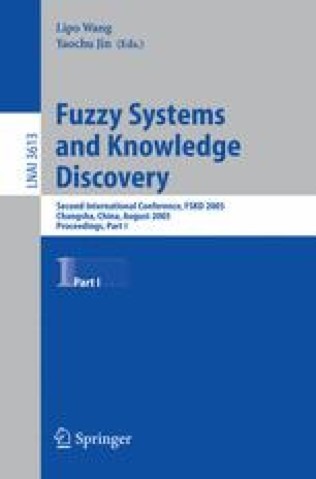
Fuzzy systems and knowledge discovery ; Vol. 3613 ; 2nd International Conference, FSKD 2005, Changsha, China, August 27-29, 2005, Proceedings, Part I
This book and its sister volume, LNAI 3613 and 3614, constitute the proce- ings of the Second International Conference on Fuzzy Systems and Knowledge Discovery (FSKD 2005), jointly held with the First International Conference on Natural Computation (ICNC 2005, LNCS 3610, 3611, and 3612) from - gust 27–29, 2005 in Changsha, Hunan, China. FSKD 2005 successfully attracted 1249 submissions from 32 countries/regions (the joint ICNC-FSKD 2005 received 3136 submissions). After rigorous reviews, 333 high-quality papers, i. e. , 206 long papers and 127 short papers, were included in the FSKD 2005 proceedings, r- resenting an acceptance rate of 26. 7%. The ICNC-FSKD 2005 conference featured the most up-to-date research - sults in computational algorithms inspired from nature, including biological, e- logical, and physical systems. It is an exciting and emerging interdisciplinary area in which a wide range of techniques and methods are being studied for dealing with large, complex, and dynamic problems. The joint conferences also promoted cross-fertilization over these exciting and yet closely-related areas, which had a signi?cant impact on the advancement of these important technologies. Speci?c areas included computation with words, fuzzy computation, granular com- tation, neural computation, quantum computation, evolutionary computation, DNA computation, chemical computation, information processing in cells and tissues, molecular computation, arti?cial life, swarm intelligence, ants colony, arti?cial immune systems, etc. , with innovative applications to knowledge d- covery, ?nance, operations research, and more.

Fuzzy Logic and Applications ; Vol. 3849 ; 6th International Workshop, WILF 2005, Crema, Italy, September 15-17, 2005, Revised Selected Papers
This volume contains the proceedings of the 6th International Workshop on Soft Computing and Applications (WILF 2005), which took place in Crema, Italy, on September 15–17, 2005, continuing an established tradition of biannual meetings among researchers and developers from both academia and industry to report on the latest scienti?c and theoretical advances, to discuss and debate major issues, and to demonstrate state-of-the-art systems. This edition of the workshop included two special sessions, sort of subwo- shops, focusing on the application of soft computing techniques (or compu- tional intelligence) to image processing (SCIP) and bioinformatics (CIBB).

Fuzzy Logic : A Spectrum of Theoretical & Practical Issues
This book exclusively surveys the active on-going research of the current maturity of fuzzy logic over the last four decades. Many world leaders of fuzzy logic have enthusiastically contributed their best research results into five theoretical, philosophical and fundamental sub areas and nine distinctive applications, including two PhD dissertations from two world class universities dealing with cutting-edge research areas of bioinformatics and geological science. Beyond the scope of survey and collection of the book, one important spin off is the emerging and recognition of a major scientific paradigm shift from the conventional mathematics to the mathematics of uncertainty, which arguably holds the key to solving very difficult and complex problems in biological and social sciences alike. The book, loaded with historical perspective, creative thinking, critical reviewing, and uniquely constructed strategy for future growth of this dynamic research area, is an invaluable resource for active researchers at all levels, university administrators, foundation directors, funding agency program chiefs, research & development planners and technological assessors.

Fungal Genomics
Presents an overview on mutualistic and pathogenic interactions between fungi and plants. This book offers reviews on fungal lifestyles, mechanisms of their interactions with their host plants, signal perception and transduction, and plant defense responses directed against attack by fungal pathogens. It is suitable for students in microbiology.

Fundamentals of Clinical Data Science
This book comprehensively covers the fundamentals of clinical data science, focusing on data collection, modelling and clinical applications. Topics covered in the first section on data collection include: data sources, data at scale (big data), data stewardship (FAIR data) and related privacy concerns. Aspects of predictive modelling using techniques such as classification, regression or clustering, and prediction model validation will be covered in the second section. The third section covers aspects of (mobile) clinical decision support systems, operational excellence and value-based healthcare.
Frontiers of high performance computing and networking – ISPA 2007 workshops ; ISPA 2007 International workshops, SSDSN, UPWN, WISH, SGC, ParDMCom, HiPCoMB, and IST-AWSN, Niagara Falls, Canada, August, 28-September 1, 2007, Proceedings
This book constitutes the refereed joint proceedings of seven international workshops held in conjunction with the 5th International Symposium on Parallel and Distributed Processing and Applications, ISPA 2007, held in Niagara Falls, Canada in August 2007.
Frontiers in Biochip Technology
This comprehensive collection covers emerging technologies and cutting –edge research in the field of biochip technology, with all chapters written by the international stars of this evolving field. Key topics and current trends in biochip technology covered include: -microarray technology and its applications - microfluidics - drug discovery - detection technology - lab-on-chip technology and bioinformatics.

Frontiers in Algorithmics ; 2nd Annual International Workshop, FAW 2008, Changsha, China, June 19-21, 2008, Proceeedings
This book constitutes the refereed proceedings of the Second International Frontiers of Algorithmics Workshop, FAW 2008, held in Changsha, China, in June 2008.The 33 revised full papers presented together with the abstracts of 3 invited talks were carefully reviewed and selected from 80 submissions. The papers were selected for 9 special focus tracks in the areas of biomedical informatics, discrete structures, geometric information processing and communication, games and incentive analysis.

Frontiers in Algorithmics ; 1st Annual International Workshop, FAW 2007, Lanzhou, China, August 1-3, 2007, Proceedings
This book constitutes the refereed proceedings of the First Annual International Frontiers of Algorithmics Workshop, FAW 2007, held in Lanzhou, China in August 2007. The 33 revised full papers presented were carefully reviewed and selected from 141 submissions.

From Data and Information Analysis to Knowledge Engineering ; Proceedings of the 29th Annual Conference of the Gesellschaft für Klassifikation e.V., University of Magdeburg, March 9-11, 2005
The volume contains revised versions of selected papers presented during the 29th Annual Conference of the Gesellschaft für Klassifikation (GfKl), the German Classification Society, held at the Otto-von-Guericke-University of Magdeburg, Germany, in March 2005. In addition to papers on the traditional subjects Classification, Clustering, and Data Analysis, there are many papers on a wide range of topics with a strong relation to Computer Science. Examples are Text Mining, Web Mining, Fuzzy Data Analysis, IT Security, Adaptivity and Personalization, and Visualization. Application-oriented topics include Economics, Marketing, Banking and Finance, Medicine, Bioinformatics, Biostatistics, and Music Analysis.

Formal Methods in Systems Biology ; 1st International Workshop, FMSB 2008, Cambridge, UK, June 4-5, 2008. Proceedings
This book constitutes the refereed proceedings of the First International Workshop on Formal Methods in Systems Biology, FMSB 2008, held in Cambridge, UK, in June, 2008.The 9 revised full papers presented were carefully reviewed and selected from the workshop lectures that all were invited contributions. The purpose of this meeting was to identify techniques for the specification, development and verification of biological models. It also focused on the design of tools to execute and analyze biological models that can significantly advance our understanding of biological systems.

Food allergens : methods and protocols
Provides a comprehensive collection of methods and protocols in food allergy and food allergens studies. The selected protocols explore the study of food allergens, from recombinant production, purification procedures, IgE and T cell epitopes characterization, to allergen structure description, cellular responses, and tolerance induction, through a variety of techniques and animal models.

Evolving methods for macromolecular crystallography : The structural path to the understanding of the mechanism of action of CBRN agents
This volume comprises papers presented at the 2005 edition of the “Crystallography of Molecular Biology” courses that have been held since 1976 at the Ettore Majorana Centre for Scientific Culture in Erice, Italy. The papers span the breadth of material presented in the course, which emphasized the practical aspects of modern macromolecular crystallography and its applications.

Evolving Connectionist Systems : The Knowledge Engineering Approach
Evolving Connectionist Systems is aimed at all those interested in developing and using intelligent computational models and systems to solve challenging real world problems in computer science, engineering, bioinformatics and neuroinformatics. The book challenges scientists and practitioners with open questions about future creation of new information models inspired by Nature. This edition includes new methods for adaptive, knowledge-based learning, such as online incremental feature selection, spiking neural networks, transductive neuro-fuzzy inference, adaptive data and model integration, cellular automata and artificial life systems, particle swarm optimisation, ensembles of evolving systems, and quantum inspired neural networks. New applications to gene and protein interaction modelling, brain data analysis and brain model creation, computational neuro-genetic modelling, adaptive speech, image and multimodal recognition, language modelling, adaptive robotics, modelling dynamic financial and socio-economic systems, and ecological modelling, are covered. An important new feature of the book is the attempt to connect different structural and functional levels of a complex, intelligent system, looking for inspiration from functional relationships in natural systems, such as the genetic and the brain activity.

Evolvable systems : From biology to hardware ; 7th International Conference, ICES 2007, Wuhan, China, September 21-23, 2007, Proceedings
The 41 revised full papers collected in this volume are organized in topical sections on digital hardware evolution, analog hardware evolution, bio-inspired systems, mechanical hardware evolution, evolutionary design, evolutionary algorithms in hardware design, and hardware implementation of evolutionary algorithms.

Evolvable systems : From biology to hardware ; 6th International Conference, ICES 2005, Sitges, Spain, September 12-14, 2005, Proceedings
The flying machines proposed by Leonardo da Vinci in the fifteenth century, the se- reproducing automata theory proposed by John von Neumann in the middle of the twentieth century and the current possibility of designing electronic and mechanical systems using evolutionary principles are all examples of the efforts made by humans to explore the mechanisms present in biological systems that permit them to tackle complex tasks. These initiatives have recently given rise to the emergent field of b- inspired systems and evolvable hardware. The inaugural workshop, Towards Evolvable Hardware, took place in Lausanne in October 1995, followed by the successive events of the International Conference on Evolvable Systems: From Biology to Hardware, held in Tsukuba (Japan) in October 1996, in Lausanne (Switzerland) in September 1998, in Edinburgh (UK) in April 2000, in Tokyo (Japan) in October 2001, and in Trondheim (Norway) in March 2003. Following the success of these past events the sixth international conference was aimed at presenting the latest developments in the field, bringing together researchers who use biologically inspired concepts to implement real systems in artificial intelligence, artificial life, robotics, VLSI design, and related domains. The sixth conference consolidated this biennial event as a reference meeting for the community involved in bio-inspired systems research. All the papers received were reviewed by at least three independent reviewers, thus guaranteeing a high-quality bundle for ICES 2005.

Evolutionary Genomics : Statistical and Computational Methods
This book addresses the challenge of analyzing and understanding the evolutionary dynamics of complex biological systems at the genomic level, and elaborates on some promising strategies that would bring us closer to uncovering of the vital relationships between genotype and phenotype. After a few educational primers, the book continues with sections on sequence homology and alignment, phylogenetic methods to study genome evolution, methodologies for evaluating selective pressures on genomic sequences as well as genomic evolution in light of protein domain architecture and transposable elements, population genomics and other omics, and discussions of current bottlenecks in handling and analyzing genomic data. Written for the highly successful Methods in Molecular Biology series, chapters include the kind of detail and expert implementation advice that lead to the best results.
Evolutionary computation, machine learning and data mining in bioinformatics ; 6th European Conference, EvoBIO 2008, Naples, Italy, March 26-28, 2008. Proceedings
The feld of bioinformatics has two main objectives: the creation and main- nance of biological databases, and the discovery of knowledge from life sciences data in order to unravel the mysteries of biological function, leading to new drugs and therapies for human disease. Life sciences data come in the form of biological sequences, structures, pathways, or literature. One major aspect of discovering biological knowledge is to search, predict, or model specifc infortioninagivendatasetinorderto generate new in teresting knowledge.Computer science methods such as evolutionary computation, machine learning, and data mining all have a great deal to ofer the feld of bioinformatics.

Evolutionary computation, machine learning and data mining in bioinformatics ; 5th European Conference, EvoBIO 2007, Valencia, Spain, April 11-13, 2007, Proceedings
This book Covers brings together experts in computer science with experts in bioinformatics and the biological sciences. It presents contributions on fundamental and theoretical issues along with papers dealing with different applications areas.
