



Page 5
Page 5

Coordination models and languages ; Vol.3454 : 7th international conference, COORDINATION 2005, Namur, Belgium, April 20-23, 2005, Proceedings
This book constitutes the refereed proceedings of the 7th International Conference on Coordination Models and Languages, COORDINATION 2005, held in Namur, Belgium in April 2005. The 19 revised full papers presented were carefully reviewed and selected from 88 submissions. Among the topics addressed are Web services, safe ambients, process calculus, abstract verification, role-based software, delegation modeling, distributed information flow, adaptive Web content provision, global computing, mobile agents, mobile computing, multithreaded code generation, shared data space coordination languages, automata specifications, time aware coordination, and service discovery.

Coordination models and languages ; 10th International Conference, COORDINATION 2008, Oslo, Norway, June 4-6, 2008. Proceedings
This book constitutes the refereed proceedings of the 10th International Conference on Coordination Models and Languages, COORDINATION 2008, held in Oslo, Norway, in June 2008, as one of the federated conferences on Distributed Computing Techniques, DisCoTec 2008.

Controlled Synthesis of Nanoparticles in Microheterogeneous Systems
contains descriptions of one of the most powerful bottom-up methods of synthesizing size controlled and stable nanoparticles. This method is based on the use of surfactant-containing microheterogeneous systems: liquid crystals, monolayers and multilayers, solutions of direct and reversed micelles, direct and reversed vesicles, and water-in-oil and oil-in-water microemulsions. The author is prominent in the field of physico-chemical characterization of microheterogeneous systems and their use as ideal solvent and reaction media for the production and long-term storage of nanomaterials. This is the first book that attempts to unify the knowledge necessary for judicious manipulation of surfactant-based systems and a fine tuning of geometric and physico-chemical properties of nanoparticles of a wide variety of substances

Conceptual Modeling - ER 2007 ; 26th International Conference on Conceptual Modeling, Auckland, New Zealand, November 5-9, 2007, Proceedings
Conceptual modeling is fundamental to the development of complex systems, because it provides the key communication means between systems developers, end-users and customers.Conceptua lmodeling provides languages,methods and tools to understand and represent the application domain;to elicitate,concepalize and formalize system requirements and user needs;to communicate systems designs to all stakeholders; to formally verify and validate system designs on high levels of abstractions; and to minimize ambiguities in system development. Initially, conceptual modeling mainly addressed data-intensive information s- tems and contributed to data modeling and database application engineering. The area of conceptual modeling has now matured to encompass all kinds of application areas such as e-applications (including e-business and e-learning), web-based systems (including the semantic web and ubiquitous systems), life science and geographic applications.

Computer Supported Cooperative Work in Design III ; 10th International Conference, CSCWD 2006, Nanjing, China, May 3-5, 2006, Revised Selected Papers
The design of complex artifacts and systems requires the cooperation of multidiscip- nary design teams using multiple commercial and proprietary engineering software tools (e.g., CAD, modeling, simulation, visualization, and optimization), engineering databases, and knowledge-based systems. Individuals or individual groups of mult- isciplinary design teams usually work in parallel and separately with various en- neering software tools which are located at different sites. In addition, individual members may be working on different versions of a design or viewing the design from different perspectives, at different levels of detail. In order to accomplish the work, it is necessary to have effective and efficient c- laborative design environments. Such environments should not only automate in- vidual tasks, in the manner of traditional computer-aided engineering tools, but also enable individual members to share information, collaborate, and coordinate their activities within the context of a design project. CSCW (computer-supported coope- tive work) in design is concerned with the development of such environments.

Computer Supported Cooperative Work in Design I
The design of complex artifacts and systems requires the cooperation of multidisciplinary design teams using multiple commercial and non-commercial engineering tools such as CAD tools, modeling, simulation and optimization software, engineering databases, and knowledge-based systems. Individuals or individual groups of multidisciplinary design teams usually work in parallel and separately with various engineering tools, which are located on different sites, often for quite a long time. At any moment, individual members may be working on different versions of a design or viewing the design from various perspectives, at different levels of detail. In order to meet these requirements, it is necessary to have effective and efficient collaborative design environments. These environments should not only automate individual tasks, in the manner of traditional computer-aided engineering tools, but also enable individual members to share information, collaborate and coordinate their activities within the context of a design project. CSCW (computer-supported cooperative work) in design is concerned with the development of such environments.

Computer safety, reliability, and security ; 27th International Conference, SAFECOMP 2008 Newcastle upon Tyne, UK, September 22-25, 2008 Proceedings
This book constitutes the refereed proceedings of the 27th International Conference on Computer Safety, Reliability, and Security, SAFECOMP 2008, held in Newcastle upon Tyne, UK, in September 2008.

Computer safety, reliability, and security ; 26th International Conference, SAFECOMP 2007, Nurmberg, Germany, September 18-21, 2007, Proceedings
It' s important to improving the state of the art of highly depe- able computer-based systems, since then increasingly applied to safety-relevant industrial domains.This book included a considerable number of contributions addressing technical problems and engineering solutions across the border between safety-related and securi- related concerns.

Computer And Computing Technologies In Agriculture, Vol. II ; 1st IFIP TC 12 International Conference on Computer and Computing Technologies in Agriculture (CCTA 2007), Wuyishan, China, August 18-20, 2007
The IFIP series publishes state-of-the-art results in the sciences and technologies of information and communication. The principal aim of the IFIP series is to encourage education and the dissemination and exchange of information about all aspects of computing.

Computer And Computing Technologies In Agriculture, Vol. I ; 1st IFIP TC 12 International Conference on Computer and Computing Technologies in Agriculture (CCTA 2007), Wuyishan, China, August 18-20, 2007
The IFIP series publishes state-of-the-art results in the sciences and technologies of information and communication. The principal aim of the IFIP series is to encourage education and the dissemination and exchange of information about all aspects of computing.

Computational logic in multi-agent systems ; Vol. 3487 ; 5th International Workshop, CLIMA V, Lisbon, Portugal, September 29-30, 2004, Revised Selected and Invited Papers
The notion of agency has recently increased its in?uence in the research and - velopment of computational logic based systems, while at the same time sign- cantly gaining from decades of research in computational logic. Computational logic provides a well-de?ned, general, and rigorous framework for studying s- tax, semantics and procedures, for implementations, environments, tools, and standards, facilitating the ever important link between speci?cation and ver- cation of computational systems. The purpose of the Computational Logic in Multi-agent Systems (CLIMA) international workshop series is to discuss techniques, based on computational logic, for representing, programming, and reasoning about multi-agent systems in a formal way. Former CLIMA editions were conducted in conjunction with other major computational logic and AI events Thesubmittedpapersshowedthatthelogicalfoundationsofmulti-agent systems are felt by a large community to be a very important research topic, upon which classical AI and agent-related issues are to be addressed.

Computational intelligence for agent-based systems
In these last years the digital technology explosion has spawned so many new lifestyle models that the boundaries between "real" and "digital" are fiercely debated. This scenario has deeply changed the viewpoint about computer applications: computers become smaller, cheapest and hugely distributed in wired or unwired networks, applications become so flexible and intelligent as to tailor its communication facilities in order to increase the usability of the system. Such data-intensive, unstructured spaces featured by minimal or no centralized control flow, present a challenge for traditional methods of analysis, design and integration of advanced, distributed and intelligent computer systems. Within this challenge, an important role is played by two important research areas : Fuzzy Technology, thanks to its ability to exploit the tolerance for imprecision to achieve tractability and Agent Technology, thanks to its nature to employ agent-wise communities to carry out complex goals by means of smart interaction, cooperation, and pro-activeness.

Collaborative and Distributed Chemical Engineering : From Understanding to Substantial Design Process Support; Results of the IMPROVE Project
The focus of IMRPOVE is on understanding, formalizing, evaluating, and, consequently, improving design processes in chemical engineering. In particular, IMPROVE focuses on conceptual design and basic engineering, where the fundamental decisions concerning the design or redesign of a chemical plant are undertaken.

Mathematical foundations of computer science 2006 ; 31st International Symposium, MFCS 2006, Stará Lesná, Slovakia, August 28-September 1, 2006, Proceedings
This book constitutes the refereed proceedings of the 31st International Symposium on Mathematical Foundations of Computer Science, MFCS 2006, held in Stará Lesná, Slovakia in August/September 2006. The 62 revised full papers presented together with the full papers or abstracts of 7 invited talks were carefully reviewed and selected from 174 submissions. All current aspects in theoretical computer science and its mathematical foundations are addressed, ranging from algorithms and data structures, to complexity, automata, semantics, logic, formal specifications, models of computation, concurrency theory, computational geometry, parallel and distributed computing, networks, bioinformatics, quantum computing, cryptography, knowledge-based systems, and artificial intelligence.

Logical Foundations for Rule-Based Systems
Presents logical foundations for rule-based systems, as seen by the Author. An attempt has been made to provide an in-depth discussion of logical and other aspects of such systems, including languages for knowledge representation, inference mechanisms, inference control, design and verification.

Logic, Language, and Computation ; 6th International Tbilisi Symposium on Logic, Language, and Computation. Batumi, Georgia, September 12-16, 2005, Revised Selected Papers
Edited in collaboration with FoLLI, the Association of Logic, Language and Information, this book constitutes the second volume of the FoLLI LNAI subline. It represents the thoroughly refereed post-proceedings of the 6th International Tbilisi Symposium on Logic, Language, and Computation, TbiLLC 2005, held in Batumi, Georgia, in September 2005.

Logic Programming and Nonmonotonic Reasoning ; 8th International Conference, LPNMR 2005, Diamante, Italy, September 5-8, 2005, Proceedings
Thesearetheproceedingsofthe8thInternational Conference on Logic Progr- mingandNonmonotonicReasoning (LPNMR2005).Followingthepreviousones held in Washington, DC, USA (1991), Lisbon, Portugal (1993), Lexington, KY, USA(1995), Dagstuhl, Germany(1997), ElPaso, TX, USA(1999), Vienna, A- tria (2001) and Ft. Lauderdale, FL, USA (2004), the eighth conference was held in Diamante, Italy, from 5th to 8th of September 2005. TheaimoftheLPNMRconferencesistobringtogetherandfacilitateinter- tions between active researchers interested in all aspects concerning declarative logic programming, nonmonotonic reasoning, knowledge representation, and the design of logic-based systems and database systems. LPNMR strives to enc- pass theoretical and experimental studies that lead to the implementation of practi...
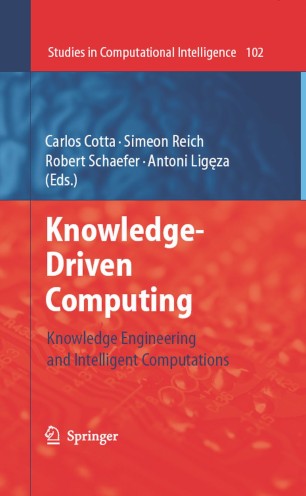
Knowledge-Driven Computing : Knowledge Engineering and Intelligent Computations
Knowledge-Driven Computing constitutes an emerging area of intensive research located at the intersection of Computational Intelligence and Knowledge Engineering with strong mathematical foundations. It embraces methods and approaches coming from diverse computational paradigms, such as evolutionary computation and nature-inspired algorithms, logic programming and constraint programming, rule-based systems, fuzzy sets and many others. The use of various knowledge representation formalisms and knowledge processing and computing paradigms is oriented towards the efficient resolution of computationally complex and difficult problems.

Knowledge-Based Virtual Education : User-Centred Paradigms
The book covers a multitude of important issues on the subject of "Innovations in Knowledge-Based Virtual Education ", aiming at researchers and practitioners from academia, industry, and government. The carefully selected contributions report on research, development and real-world experiences of virtual education.

Knowledge science, engineering and management; 13th International Conference, KSEM 2020, Hangzhou, China, August 28–30, 2020, Proceedings, Part I
Constitutes the refereed proceedings of the 13th International Conference on Knowledge Science, Engineering and Management, KSEM 2020, held in Hangzhou, China, in August 2020.* The 58 revised full papers and 27 short papers were carefully reviewed and selected from 291 submissions. The papers of the first volume are organized in the following topical sections: knowledge graph; knowledge representation; knowledge management for education; knowledge-based systems; and data processing and mining. The papers of the second volume are organized in the following topical sections: machine learning; recommendation algorithms and systems; social knowledge analysis and management; text mining and document analysis; and deep learning.
