



Page 48
Page 48
Advanced groundwater remediation : Active and passive technologies
Increasing efforts were made towards containing and cleaning contaminated groundwater. A number of techniques can be used to achieve such goals, traditionally either by treating or isolating the soil in situ, or by removing it for washing or disposal. However, such technologies tend to be accompanied by high energy consumption, and can lead to new environmental problems. Therefore, more efficient and economical techniques are needed to remediate contaminated soil and groundwater.
Advanced Environmental Monitoring
This book deals with recent developments and applications of environmental monitoring technologies, with emphasis on optical and biological methods that are rapidly progressing through the integration of emerging technologies from various disciplines.

Advanced Data Warehouse Design : From Conventional to Spatial and Temporal Applications
This book serves as an introduction to the state of the art on data warehouse design, with many references to more detailed sources. Providing a clear and a concise presentation of the major concepts and results of data warehouse design, it can also be used as the basis of a graduate or advanced undergraduate course.
Advanced Combustion and Aerothermal Technologies : Environmental Protection and Pollution Reductions
This book about Proceedings of the NATO Advanced Workshop “Advanced Combustion and Aerothermal Technologies: Environmental Protection and Pollution Reductions” was held in Kiev (Ukraine) from 15 to 19 May 2006 and was organized by the Institute of Engineering Thermophysics (Ukraine) and Cardiff University (UK). These subjects to cover the critical areas of combustion and aerothermal research and development where rapid progress is needed to improve performance in terms of efficiency, compactness, and emissions. This was a very timely and successful Workshop which brought together experts from the NATO and other countries to discuss increasing concerns about emissions.

Advanced Air and Noise Pollution Control ; Vol.2
Handbook of Environmental Engineering, Volume 2, leading pollution control educators and practicing professionals describe how various combinations of different cutting-edge process systems can be arranged to solve air, noise, and thermal pollution problems. Each chapter discusses in detail a variety of process combinations, along with technical and economic evaluations, and presents explanations of the principles behind the designs, as well as numerous variant designs useful to practicing engineers. The emphasis throughout is on developing the necessary engineering solutions from fundamental principles of chemistry, physics, and mathematics. The authors also include extensive references, cost data, design methods, guidance on the installation and operation of various air pollution control process equipment and systems, and Best Available Technologies (BAT) for air, thermal, and noise pollution control. A companion volume, Air Pollution Control Engineering: Handbook of Environmental Engineering, Volume 1 critically surveys the principles and practices involved in basic air pollution control processes.
Addressing the Climate Crisis : Local action in theory and practice
This book brings together a collection of cutting-edge insights into how action can and is already being taken against climate change at multiple levels of our societies, amidst growing calls for transformative and inclusive climate action. In an era of increasing recognition regarding climate and ecological breakdown, this book offers hope, inspiration and analyses for multi-level climate action, spanning varied communities, places, spaces, agents and disciplines, demonstrating how the energy and dynamism of local scales are a powerful resource in turning the tide.

Adaptronics and Smart Structures : Basics, Materials, Design, and Applications
Adaptronic structures and systems can adapt automatically to variable operating and environmental conditions through the use of feedback control. But in contrast to conventional control loops, in which each function is fulfilled by a separate component, adaptronics is characterized by multifunctional components that are preferably integrated into the structure or the system. The goal is a lightweight and simple construction for conserving material and energy resources. The authors of this book have taken on the task of displaying the current state of the art in this highly modern and strongly interdisciplinary field. Selected application examples are also presented and current development trends demonstrated.
Adaptive Strategies for Water Heritage: Past, Present and Future
This book, building on research initiated by scholars from the Leiden-Delft-Erasmus Centre for Global Heritage and Development (CHGD) and ICOMOS Netherlands, presents multidisciplinary research that connects water to heritage.
Adaptive and Integrated Water Management : Coping with Complexity and Uncertainty
Includes selected contributions on conceptual and methodological innovations and empirical insights from case studies on important themes such as multi-level governance, change management, vulnerability assessment, environmental flows, uncertainty analysis and the impacts of climate change. The book addresses a wide interdisciplinary audience of scientists and professionals from academia, industry, and involved in policy making.
Active Rheology Control of Cementitious Materials
The research presented here develops a new method of actively controlling the rheology of fresh concrete during casting operations by incorporating specially designed responsive components. This results in real-time changes to the rheological behaviour of the cementitious material, allowing the user to intervene actively after the cementitious material has left the mixing phase. This newly gained agility contributes to increased processing speed and placement reliability in the case of traditional casting methods and can also facilitate advanced 3D concrete printing. The different routes followed to achieve this Active Rheology Control are explained within.
Acoustic sensing techniques for the shallow water environment : Inversion methods and experiments
Contains the collection of papers from the second workshop on Experimental Acoustic Inversion Techniques for Exploration of the Shallow Water Environment. Acoustic techniques provide the most effective means for remote sensing of ocean and sea floor processes, and for probing the structure beneath the sea floor. No other energy propagates as efficiently in the ocean: radio waves and visible light are severely limited in range because the ocean is a highly conductive medium. However, sound from breaking waves and coastal shipping can be heard throughout the ocean, and marine mammals communicate acoustically over basin scale distances.
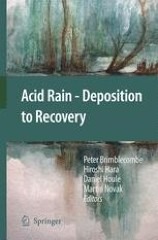
Acid Rain - Deposition to Recovery
Acid rain is still with us. Although it is a problem that people have worked diligently to solve, there are still many problem areas throughout the world. In reality the focus of acid rain research has shifted, and this book adds new vision to the topic. It contains papers, selected from Acid Rain 2005, the 7th International Conference on Acid Deposition, that take a broad perspective of the issues, emphasizing a number of themes: - the emission, concentration and deposition of pollutants / - nitrogen and trace elements in ecosystems and their effects on forests, water and soil / - studies of material damage and recovery - critical loads / The book is aimed at scientists and researchers who are working in the area of acid rain and its effects, and on nutrient cycling. This latest research will be of value to those concerned with the mitigation of acid rain effects.
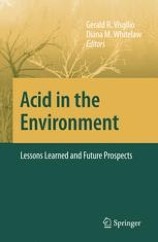
Acid in the Environment : Lessons Learned and Future Prospects
This book is the result of a conference held biannually at the Goodwin-Niering Center for Conservation Biology and Environmental Studies at Connecticut College.is a collection of essays that blends the research findings and the policy analyses of individuals from different academic disciplines with the positions advanced by representatives of NGOs. Acid in the Environment: Lessons Learned and Future Prospects presents a broad approach to the study of acid deposition, exposing readers with a scientific background to significant policy issues and those with a policy orientation to important ecological impacts. The book raises important questions that will serve as a springboard for discussion between diverse groups of teachers and students, concerned citizens and legislators, and scientists and policy makers.

Achieving the Paris Climate Agreement goals ; Part 2 : Science-based target setting for the finance industry — Net-Zero Sectoral 1.5˚C pathways for real economy sectors
Provides an in-depth analysis of industry sectors globally, and its purpose is to present emission reduction targets in 5-year steps (2025 to 2050) for the main twelve finance sectors per the Global Industry Classification System. This scientific analysis aims to support the United Nations Principles for Responsible Investment initiative to give sustainability guidance for the global finance industry. The industry sector pathways presented here are based on the latest global and regional 100% renewable energy and non-energy greenhouse gas Representative Concentration Pathways in order to keep climate change significantly under +1.5 C and thereby achieve the Paris Climate Agreement goals. The heart of this book is three chapters presenting the results of industry scenario modelling. These chapters cover twelve industry and service sectors as well as transportation and buildings. The specific energy demand and specific emissions are presented based on the emission accounting concept of “Scope 1, Scope 2 and Scope 3” emission pathways. This methodology has been developed to measure the climate and sustainability index for companies, and this research project expands the methodology to apply it to entire industry sectors ...
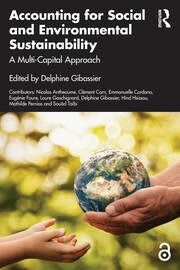
Accounting for social and environmental sustainability : A multi-capital approach
Offers an in‑depth examination of multi‑capital accounting, which has already been integrated within the corporate sustainability reporting directive and will follow on from sustainability reporting. the LIFTS model (limits and foundations towards sustainability accounting model) used in this book combines various scientific and practical contributions to develop budgets for environmental impacts and social obligations on an organisational scale. it proposes an accounting mechanism that enables an organization to manage each of its budgets and measure variances between forecast and actual. it provides an introduction to the principles of this model and its conditions of application and describes its implementation in numerous companies.
Accounting and Statistical Analyses for Sustainable Development : Multiple Perspectives and Information-Theoretic Complexity Reduction
In this book Claudia Lemke develops a comprehensive Multi-Level Sustainable Development Index (MLSDI) that is applicable to micro, meso, and macro objects by conducting methodological and empirical research.

A window on the future of geodesy ; Proceedings of the International Association of Geodesy. IAG General Assembly, Sapporo, Japan June 30 - July 11, 2003
These proceedings represent the worldwide picture of the state of the art of geodesy. The volume comprehensively covers the most recent results and supplies a good review of the new ideas developing in the field, opening a window to the future of geodesy.

A visual atlas for soil micromorphologists
This atlas is an up-to-date visual resource on the features and structures observed in soil thin sections, i.e. soil micromorphology.
A Sea Change: The Exclusive Economic Zone and Governance Institutions for Living Marine Resources
A Sea Change in a Changing Sea The oceans, seas and coastal areas encompass over 70% of the earth’s surface. They are a critical driver of the earth’s hydrologic cycle and climate system, important for c- merce, transport, and tourism, a source of economically important living marine resources, minerals such as hydrocarbons, as well as new pharmaceutical compounds. The marine environment provides essential habitats for thousands of marine living 1 2 resources, which in turn contribute significantly to global food security, employment, 3 and trade. Overall, the sea’s contribution to human welfare, in terms of market and non-market resources and environmental services, has been estimated at US$21 trillion/year (Costanza, 2000). However, despite the importance of the ocean realm to humans, there is a growing sense that human impacts are destabilizing this system. Some experts believe that current fishing levels are approaching or exceeding the total 4 productivity of the ocean ecosystem (National Research Council, 1999).
A primer on theoretical soil mechanics
A Primer to Theoretical Soil Mechanics is about adapting continuum mechanics to granular materials. The field of continuum mechanics offers many fruitful concepts and methods, however there is declining interest in the field due to its complex and fragmented nature. This book's purpose is therefore to facilitate the understanding of the theoretical principles of soil mechanics, as well as introducing the new theory of barodesy.
