



Page 46
Page 46
Communication Acoustics
The book chapters represent review articles covering the most relevant areas of the field. They are written with the goal of providing students with comprehensive introductions. Further they offer a supply of numerous references to the relevant literature. Besides its usefulness as a textbook, this will make the book a source of valuable information for those who want to improve or refresh their knowledge in the field of communication acoustics – and to work their way deeper into it. Due to its interdisciplinary character Communication Acoustics is bound to attract readers from many different areas, such as: acoustics, cognitive science, speech science, and communication technology.
Communicating, Networking : Interacting : The International Year of Global Understanding - IYGU
illustrates the benefits to be gained from digitally networked communication for health, education and transitioning economies in developing nations (Sierra Leone and Papua New Guinea) and developed nations. Growing powers of e-citizenship can help build sustainable futures. This small volume provides a collection of examples and ideas from which the authors hope will help build a wider resource. Understanding how to link everyday lives with global networks in the digital world in ways that add benefit for the world’s people, and the health of the planet, is an ongoing project. IYGU recognises the integral roles of networking and communication systems, as well as interactions between people, near and far, as fundamental for building better futures. The global penetration of digital devices means everyday life, present and future, is inextricably linked with information technologies

Communicating with One Another : Toward a Psychology of Spontaneous Spoken Discourse
In other words, this book is a call for a paradigm shift in the study of oral communication. It is a must read for people interested in language use, as well as for specialists in language studies. "The authors have identified crucial theoretical and methodological assumptions that have hampered scholarship on language use. Their critical assessment is grounded in nuanced theoretical analysis and rigorous empirical studies. As a result, they reveal the complexity, elegance, and moral aspects of day to day dialogical communication."
Communicating Science in Social Contexts : New models, new practices
Science communication, as a multidisciplinary field, has developed remarkably in recent years. It is now a distinct and exceedingly dynamic science that melds theoretical approaches with practical experience. Formerly well-established theoretical models now seem out of step with the social reality of the sciences, and the previously clear-cut delineations and interacting domains between cultural fields have blurred. Communicating Science in Social Contexts examines that shift, which itself depicts a profound recomposition of knowledge fields, activities and dissemination practices, and the value accorded to science and technology.
Communicating science and technology in society
Addresses the engagement between science and society from multiple viewpoints. At a time when trust in experts is being questioned, misinformation is rife and scientific and technological development show growing social impact, the volume examines the challenges in involving the public in scientific debates and decisions. It takes into account societal needs and concerns in research, and analyses the interface between the roles of institutions and individuals. From environmental challenges to science communication, participatory technological design to animal experimentation, and transdisciplinarity to norms and values in science, the volume brings together research on areas in which scientists and citizens interact, across diverse, often understudied, socio-cultural contexts in Europe.

Communicating European Research 2005 ; Proceedings of the Conference, Brussels, 14-15 November 2005
The book covers the main aspects of science and technology communication today and addresses topical questions such as: Is science journalism necessary at all? Should communication become one of the basic skills of scientists, as compulsory as thinking, testing and experimenting? Should our schools of the future put scientific literacy at the top of the science curriculum? Do we need science critics? Does the coverage of science in the media reflect the choice of the editors or does it accurately mirror the public’s interest? How does one capture the public’s attention when promoting science on local, commercial or entertainment radio? Why would we need standards in science communication? How can we remove any obstacles to communication among researchers and between researchers?

Classifications and Scores of the Shoulder
This book gives a clearly structured, well-defined compendium of classifications and scores of the shoulder for use in everyday clinical life to improve and simplify the communication between physicians and physiotherapists.
Classification and Modeling with Linguistic Information Granules : Advanced Approaches to Linguistic Data Mining
Many approaches have already been proposed for classification and modeling in the literature. These approaches are usually based on mathematical mod els. Computer systems can easily handle mathematical models even when they are complicated and nonlinear (e.g., neural networks). On the other hand, it is not always easy for human users to intuitively understand mathe matical models even when they are simple and linear. This is because human information processing is based mainly on linguistic knowledge while com puter systems are designed to handle symbolic and numerical information. A large part of our daily communication is based on words. We learn from various media such as books, newspapers, magazines, TV, and the Inter net through words. We also communicate with others through words. While words play a central role in human information processing, linguistic models are not often used in the fields of classification and modeling. If there is no goal other than the maximization of accuracy in classification and modeling, mathematical models may always be preferred to linguistic models. On the other hand, linguistic models may be chosen if emphasis is placed on interpretability.

Classification and Clustering for Knowledge Discovery
This book covers recent advances in unsupervised and supervised data analysis methods in Computational Intelligence for knowledge discovery. In its first part the book provides a collection of recent research on distributed clustering, self organizing maps and their recent extensions. If labeled data or data with known associations are available, we may be able to use supervised data analysis methods, such as classifying neural networks, fuzzy rule-based classifiers, and decision trees. Therefore this book presents a collection of important methods of supervised data analysis. "Classification and Clustering for Knowledge Discovery" also includes variety of applications of knowledge discovery in health, safety, commerce, mechatronics, sensor networks, and telecommunications.
City Logistics 3 : Towards sustainable and liveable cities
Presents recent advances in modelling, planning and evaluating city logistics for sustainable and liveable cities based on the application of ICT (Information and Communication Technology) and ITS (Intelligent Transport Systems). It highlights modelling the behaviour of stakeholders who are involved in city logistics as well as planning and managing policy measures of city logistics including cooperative freight transport systems in public-private partnerships. Case studies of implementing and evaluating city logistics measures in terms of economic, social and environmental benefits from major cities around the world are also given.
City Logistics 2 : Modeling and Planning Initiatives
Presents recent advances in modelling, planning and evaluating city logistics for sustainable and liveable cities based on the application of ICT (Information and Communication Technology) and ITS (Intelligent Transport Systems). It highlights modelling the behaviour of stakeholders who are involved in city logistics as well as planning and managing policy measures of city logistics including cooperative freight transport systems in public-private partnerships. Case studies of implementing and evaluating city logistics measures in terms of economic, social and environmental benefits from major cities around the world are also given.
City Logistics 1 : New opportunities and challenges
Presents recent advances in modelling, planning and evaluating city logistics for sustainable and liveable cities based on the application of ICT (Information and Communication Technology) and ITS (Intelligent Transport Systems). It highlights modelling the behaviour of stakeholders who are involved in city logistics as well as planning and managing policy measures of city logistics including cooperative freight transport systems in public-private partnerships. Case studies of implementing and evaluating city logistics measures in terms of economic, social and environmental benefits from major cities around the world are also given.

Citation Analysis in Research Evaluation
This book is written for members of the scholarly research community, and for persons involved in research evaluation and research policy. More specifically, it is directed towards the following four main groups of readers: – All scientists and scholars who have been or will be subjected to a quantitative assessment of research performance using citation analysis. – Research policy makers and managers who wish to become conversant with the basic features of citation analysis, and about its potentialities and limitations. – Members of peer review committees and other evaluators, who consider the use of citation analysis as a tool in their assessments. – Practitioners and students in the field of quantitative science and technology studies, informetrics, and library and information science. Citation analysis involves the construction and application of a series of indicators of the ‘impact’, ‘influence’ or ‘quality’ of scholarly work, derived from citation data, i.e. data on references cited in footnotes or bibliographies of scholarly research publications. Such indicators are applied both in the study of scholarly communication and in the assessment of research performance. The term ‘scholarly’ comprises all domains of science and scholarship, including not only those fields that are normally denoted as science – the natural and life sciences, mathematical and technical sciences – but also social sciences and humanities.

Cisco networks : Engineers' handbook of routing, switching, and security with IOS, NX-OS, and ASA
Overviews of the basic knowledge and skills needed by CCNA and CCNP exam takers. Prior familiarity with Cisco routing and switching is desirable but not necessary, as Chris Carthern, Dr. Will Wilson, and Noel Rivera start their book with a review of network basics. Further they explain practical considerations and troubleshooting when establishing a physical medium for network communications. Later they explain the concept of network layers, intermediate LAN switching, and routing. Next they introduce you to the tools and automation used with Cisco networks. Moving forward they explain management planes, data planes, and control planes. Next they describe advanced security, trouble shooting, and network management. They conclude the book with a section which focuses on using network automation to automate Cisco IOS networks. You will: Configure Cisco switches, routers, and data center devices in typical corporate network architectures / Use black-hat tools to conduct penetration testing on the security of your network / Configure and secure virtual private networks (VPNs) / Enable identity management in your network with the Cisco Identity Services Engine (ISE) to.
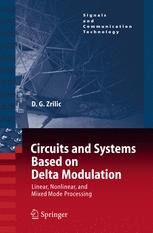
Circuits and Systems Based on Delta Modulation : Linear, Nonlinear and Mixed Mode Processing
This book is intended for students and professionals who are interested in the field of digital signal processing of delta-sigma modulated sequences. The overall focus is on the development of algorithms and circuits for linear, non-linear, and mixed mode processing of delta-sigma modulated pulse streams. The material presented here is directly relevant to applications in digital communication, DSP, instrumentation, and control.

Chemical Signals in Vertebrates 11
Presents the proceedings of "Chemical Signals in Vertebrates 11", hosted by the University of Liverpool and held July 25 - 28, 2006 at the University of Chester in the United Kingdom. Chemical Signals in Vertebrates 11 contains the latest research on chemical communication relevant to vertebrates, particularly focusing on new research since the last meeting in 2003. Topics covered include chemical ecology, biochemistry, behavior and neurobiology of both the main olfactory and vomeronasal systems of vertebrates, from amphibia to mammals including humans. A broad range of taxonomic groups and topics are discussed, including sections on new directions in semiochemistry, olfactory response and function, recognition within species, sexual communication, maternal-offspring communication, communication between species, and applications for zoo animal enrichment and pest control. The volume is dedicated to the memory of Dr. Bets Rasmussen and includes a special tribute chapter on her ground-breaking research on elephant communication.

Chemical Signals in Vertebrates 10
This book also represents the tenth in a series of books on chemical communication, chemical ecology, olfactory and vomeronasal research in vertebrate species. The species covered in the chapters herein range from fish to mammals including humans. By taxonomic breakdown the mammals are the most represented in number of species and chapter contributions. However, the hosts of the meeting endeavored to have some representative contributions covering all of the major vertebrate taxa.

Changing Education : Leadership, Innovation and Development in a Globalizing Asia Pacific
This book responds to the growing unease of educators and non-educators alike about the inadequacy of most current educational systems and programs to meet sufficiently the demands of fast changing societies. These systems and programs evolved and were developed in and for societies that have long been transformed, and yet no parallel transformation has taken place in the education systems they spawned. In the last twenty years or so, other sectors of society, such as transportation and communications systems, have radically changed the way they operate, but education has remained essentially the same. There is no doubt: education needs to change.

Change 2.0 : Beyond Organisational Transformation
"This is a book about change … . It’s a collection of 14 articles including four case studies. … ‘a collection of articles intended to inspire those involved in the practical implementation of change’." (Rodney Gray, Strategic Communication Management, Issue 11, 2008)

Chance Discoveries in Real World Decision Making : Data-based Interaction of Human intelligence and Artificial Intelligence
For this book, the editors invited and called for contributions from indispensable research areas relevant to "chance discovery," which has been defined as the discovery of events significant for making a decision, and studied since 2000. From respective research areas as artificial intelligence, mathematics, cognitive science, medical science, risk management, methodologies for design and communication, the invited and selected authors in this book present their particular approaches to chance discovery. The chapters here show contributions to identifying rare or hidden events and explaining their significance, predicting future trends, communications for scenario development in marketing and design, identification effects and side-effects of medicines, etc.
