



Page 43
Page 43
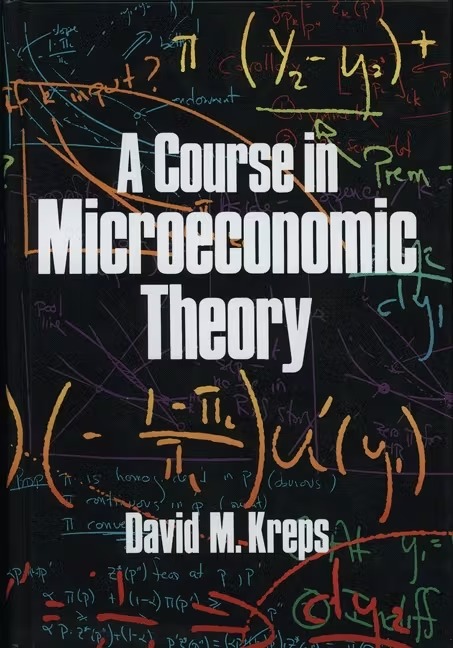
A Course in Microeconomic Theory
Offers a treatment of microeconomic theory - one that stresses the behavior of the individual actor in various institutional settings. This book begins with an exposition of the standard models of choice and the market. It is designed for the first-year graduate microeconomic theory course and is accessible to advanced undergraduates as well.

A Contingency-Based View of Chief Executive Officers' Early Warning Behaviour : An Empirical Analysis of German Medium-Sized Companies
Organizations need to identify risks and chances of environmental changes in order to adapt to or possibly even to influence them. Early warning which comprises scanning and interpretation plays an important role in this process. Whereas the traditional contingency approach considers early warning as a part of the organizational structure, the extended contingency theory assumes the additional influence of an individual’s personality on early warning. Andreas Kirschkamp empirically analyses the early warning behavior of Chief Executive Officers in German medium-sized companies. First, he presents the design variables of early warning, then the influencing contingency variables. On the basis of the scholarly research on psychological and contingency theory, the author deduces hypotheses and tests them. The results show that early warning behavior is not only influenced by traditional contingency variables but also by personal attitudes.

A Comprehensive Guide to Child Custody Evaluations : Mental Health and Legal Perspectives
A Comprehensive Guide to Child Custody Evaluations covers these three essential areas to walk readers through the evaluation process clearly and concisely. This unique interdisciplinary book emphasizes professional ethics, children’s psychological well-being, and clear communication among all parties as keys to resolving disputes with efficiency and thoroughness, and minimizing the chances of children and their families getting lost in red tape.

(R)Evolution : Organizations and the Dynamics of the Environment
Investigates the possible changes needed for industrial organizations to adapt to and remain competitive in their ever evolving environment. (R)Evolution’s main area of contribution to these very complex issues is embedded in the work’s ambitious attempt to borrow from evolutionary biology and genetics not only metaphors but also concepts and models to be adapted to the management of business organizations. The work provides us with a comprehensive vision of adaptation and variation in the business community, integrating various intellectual inputs which are based on an evolutionary vision of economic behavior. Using an extensive study of the literature in management science, and applying new models and methodologies in numerous case studies, Dekkers draws many insightful conclusions including the claim that companies often evolve slower than generally expected. Furthermore the research calls into question the effectiveness of the common practice of corporate reorganization. Embracing and merging most major contemporary developments in the theories of change into a comprehensive integrated approach, (R)Evolution is an invaluable resource for researchers specializing in the management of technological change.
