



Page 416
Page 416
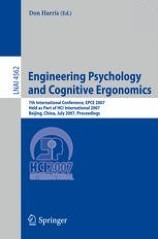
Engineering psychology and cognitive ergonomics ; 7th International Conference, EPCE 2007, Held as Part of HCI International 2007, Beijing, China, July 22-27, 2007, Proceedings
This book address the latest research and development efforts and highlight the human aspects of design and use of computing systems. It cover the entire field of Human-Computer Interaction, addressing major - vances in knowledge and effective use of computers in a variety of application areas. This volume contains papers in the thematic area of En- neering Psychology and Cognitive Ergonomics, addressing the following major topics: Cognitive and Affective Issues in User Interface Design, Cognitive Workload and Human Performance, Cognitive Modeling and Measuring, Safety Critical Applications and Systems

Engineering of Crystalline Materials Properties ; State of the Art in Modeling, Design and Applications
This volume collects the lecture notes delivered by the main speakers at the Erice 2007 International School of Crystallography, generously selected by NATO as an Advanced Study Institute (# 982582). The aim of the school was to discuss the state-of-the-art in molecular materials design, that is, the rational analysis and fabrication of crystalline solids showing a predefined structural organization of their component molecules and ions, which results in the manifestation of a specific collective property of technological interest.

Engineering Multi-Agent Systems ; 7th International Workshop, EMAS 2019, Montreal, QC, Canada, May 13–14, 2019, Revised Selected Papers
This book constitutes the thoroughly refereed post-conference proceedings of the 7th International Workshop on Engineering Multi-Agent Systems, EMAS 2019, held in Montreal, QC, Canada, in May 2019. The 13 revised full papers presented in this book were carefully selected and reviewed from 20 submissions. The papers are grouped in the following topical sections: Multi-Agent Interaction and Organization; Simulation; Social Awareness and Explainability; Learning and Reconfiguration; and Implementation Techniques and Tools.

Engineering mechanics 2 : Strength of materials : An introduction with many examples
Provides students with a clear introduction and to enable them to formulate and solve engineering problems in this field. For this purpose, the book provides a number of examples. The Contents : Introduction to linear elasticity – Plane stress state – Bars – Beams – Beam deflections – Shear stresses in beams – Torsion – Energy methods – Buckling of bars

Engineering Mechanics ; Vol.2 : Stresses, Strains, Displacements
"This is the second of two volumes … by Hartsuijker and Welleman (both, Dolft Univ. of Technology). … The concepts and applications are well presented; applications include both basic and advanced levels. The worked out examples nicely illustrate concepts. Figures and tables are clear and help understanding of the concepts. … In summary, the book is very well written and is a welcome addition to the literature of engineering mechanics. Summing Up: Recommended. Lower-division undergraduates through professionals." (M. G. Prasad, CHOICE, Vol. 45 (7), 2008)

Engineering Mechanics ; Vol.1 : Equilibrium
This is the first of two volumes introducing structural and continuum mechanics in a comprehensive and consistent way. The current book presents all theoretical developments both in text and by means of an extensive set of figures. This same approach is used in the many examples, drawings and problems. Both formal and intuitive (engineering) arguments are used in parallel to derive the principles used, for instance in bending moment diagrams and shear force diagrams. A very important aspect of this book is the straightforward and consistent sign convention, based on the stress definitions of continuum mechanics. The book is suitable for self-education.

Engineering Interactive Systems ; EIS 2007 Joint Working Conferences, EHCI 2007, DSV-IS 2007, HCSE 2007, Salamanca, Spain, March 22-24, 2007. Selected Papers
This book constitutes the post-conference proceedings of the WG2.7/13.4 10th Conference on Engineering Human Computer Interaction (EHCI 2007), the WG 13.2 First Conference on Human Centred Software Engineering (HCSE 2007), and the 14th Conference on Design Specification and Verification of Interactive Systems (DSV-IS 2007); jointly held as EIS 2007, the international event on Engineering Interactive Systems, in Salamanca, Spain, in March 2007 - under the auspices of IFIP.
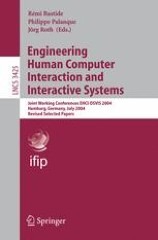
Engineering human computer interaction and interactive systems ; Joint Working Conferences EHCI-DSVIS 2004, Hamburg, Germany, July 11-13, 2004, Revised Selected Papers
As its name suggests, the EHCI-DSVIS conference has been a special event, merging two different, although overlapping, research communities: EHCI (Engineering for Human-Computer Interaction) is a conference organized by the IFIP 2.7/13.4 working group, started in 1974 and held every three years since 1989. The group’s activity is the scientific investigation of the relationships among the human factors in computing and software engineering. DSVIS (Design, Specification and Verification of Interactive Systems) is an annual conference started in 1994, and dedicated to the use of formal methods for the design of interactive systems. Of course these two research domains have a lot in common, and are informed by each other’s results.

Engineering Geology for Underground Rocks
This book clearly and systematically explains underground engineering geology principles, methods, theories and case studies, depicts engineering problems in underground rock engineering and how to study and solve them. It specially emphasizes mechanical and hydraulic couplings in rock engineering for wellbore stability, mining near aquifers and other underground structures where inflow is a problem. Using the methods and models given in this book, the reader is able to analyse underground geological engineering problems and also for the design of underground structures.

Engineering for Sustainable Development : Theory and Practice
Offers a wide range of civil, mechanical, electrical, and chemical engineering industry applications. Readers will also benefit from: A thorough introduction to contemporary sustainability challenges in the engineering discipline Comprehensive discussions of sustainability assessment tools, including triple bottom line assessment (TBL) and the environmental life cycle assessment (LCA) In-depth examinations of sustainable engineering strategies, including cleaner production and eco-efficiency methods and environmental management systems Detailed review of green engineering principles and industrial symbiosis in engineering application. A link between product stewardship and the design for the environment

Engineering Environment-Mediated Multi-Agent Systems ; International Workshop, EEMMAS 2007, Dresden, Germany, October 5, 2007. Selected Revised and Invited Papers
This book constitutes the thoroughly refereed proceedings of the International Workshop on Engineering Environment-Mediated Multi-Agent Systems, held in Dresden,The volume includes 16 thoroughly revised papers, selected from the lectures given at the workshop, together with 2 papers resulting from invited talks by prominent researchers in the field. The papers are organized in sections on engineering self-organizing applications, stigmergic interaction, modeling and structuring mediating environments, and environment-based support for context and organizations.

Engineering Damage Mechanics : Ductile, Creep, Fatigue and Brittle Failures
Engineering Damage Mechanics is deliberately oriented toward applications of Continuum Damage Mechanics to failures of mechanical and civil engineering components in ductile, creep, fatigue and brittle conditions depending upon the thermomechanical loading and the materials: metals and alloys, polymers, elastomers, composites, concretes. Nevertheless, to help engineers, researchers, beginners or not, the first two chapters are devoted to the main concepts of damage mechanics and to the associated computational tools.

Engineering Consulting Company
تم اختيار المشروع لتسليط الضوء بشكل أكبر على أهمية دورالشركات الهندسية وتطوير حياة المجتمع عامة، ويهدف المشروع إلى العمل على كافة الأصعدة بالاضافة لتلبية احتياجات الانسان مع مرور الوقت.

Engineering and health in compressed air work : Proceedings of the 2nd International conference on engineering and health in compressed air Work held at St Catherine's College, Oxford, from 25th to 27th September, 2002
Presents the proceedings of theSecond International Conference on Engineering and Health in Compressed Air Work, Heald at St Catherine's College, Oxford from 25th to 27th September 2002. The 35 papers in this volume cover a range of subjects, including experience with oxygen decompressionnin the UK and research related tothe introduction of oxygen decompression, which will be of interest to everyone involved with the engineering, medical or regulatory aspects of compressed air working and all those with an interest in hyperbaric exposure.

Engaged Fatherhood for Men, Families and Gender Equality : Healthcare, Social Policy, and Work Perspectives
This aim of this book is to launch an international, cross-disciplinary conversation on fatherhood engagement. By integrating perspective from three sectors—Health, Social Policy, and Work in Organizations—the book offers a novel perspective on the benefits of engaged fatherhood for men, for families, and for gender equality. The chapters are crafted to engaged broad audiences, including policy makers and organizational leaders, healthcare practitioners and fellow scholars, as well as families and their loved ones.

Energy Resources in East Africa: Opportunities and Challenges
East African states have historically shared several resources including energy and common heritage of its people. This book provides information on available sources of energy in the region and how the energy suppliers can exploit them in an integrated form to produce the right blend of energy for various applications e.g., industrial, domestic and recreational uses. We provide an in-depth analysis of the advantages and disadvantages of different energy sources in-terms of environmental, industrialization, distribution costs and impacts. We hope that the book will contribute towards a sustainable exploitation of energy resources for the improvement of the people’s quality of life.

Energy Poverty : (Dis)Assembling Europe's Infrastructural Divide
Aims to consolidate and advance debates on European and global energy poverty by exploring the political and infrastructural drivers and implications of the condition across a variety of spatial scales. It highlights the need for a geographical conceptualization of the different ways in which household-level energy deprivation both influences and is contingent upon disparities occurring at a wider range of spatial scales. There is a strong focus on the relationships among energy transformation, institutional change and place-based factors in determining the nature and location of energy-related injustices. The book also explores how patterns and structures of energy poverty have changed over time, as evidenced by some of the common measures used to describe the condition. In part, this means investigating the makeup of energy poor demographics across various social and spatial cleavages. More broadly, it also argues that energy sector reconfigurations are both reflected in and shaped by various domains of social and political organization, especially in terms of creating poverty-relevant outcomes.

Energy minimization methods in computer vision and pattern recognition ; 6th International Conference, EMMCVPR 2007, Ezhou, China, August 27-29, 2007, Proceedings
Contains critical issues of representation, learning, and inference. Important new themes include pr- abilistic grammars, image parsing, and the use of datasets with ground-truth to act as benchmarks for evaluating algorithms and as a way to train learning algorithms. Other themes include the development of efficient inference algorithms using advanced techniques from statistics, computer science, and applied mathematics. This book makes no distinction between oral and poster papers. It also contiants sections on al- rithms, applications, image parsing, image processing, motion, shape, and thr- dimensional processing.

Energy methods in structural mechanics : A comprehencive introduction to matrix and finite element methods of analysis
Provides a basic and clear introduction to the principles underlying finite elements and the computer based methods of the analysis of structures commonly used in industry. There can be a danger that, without such an understanding, engineers will use these computer based analysis tools as black boxes and accept results without being aware of the real significance of the information obtained.

Energy Manual : Sustainable Architecture
Presents a comprehensive look at the constructional parameters of energy efficiency and sustainability. It offers an advance look at the legal regulations being planned by the EU, and – as a tool ready for immediate use by architects, engineers, and designers in their daily work – it points the way toward the efficient and sustainable construction and operation of buildings. With its focus on the entire lifecycle of a building, it provides an integrated perspective – a necessary prerequisite for sustainable economic management.
