



Page 41
Page 41

Computer Aided Pharmaceutics and Drug Delivery : An Application Guide for Students and Researchers of Pharmaceutical Sciences
Examines the role of computer-assisted techniques for discovering, designing, optimizing and manufacturing new, effective, and safe pharmaceutical formulations and drug delivery systems. The book discusses computational approaches, statistical modeling and molecular modeling for the development and safe delivery of drugs in humans. The application of concepts of QbD (Quality by Design), DoE (Design of Experiments), artificial intelligence and in silico pharmacokinetic assessment/simulation have been made a lot easier with the help of commercial software and expert systems. This title provides in-depth knowledge of such useful software with illustrations from the latest researches. The book also fills in the gap between pharmaceutics and molecular modeling at micro, meso and maro scale by covering topics such as advancements in computer-aided Drug Design (CADD), drug-polymer interactions in drug delivery systems, molecular modeling of nanoparticles and pharmaceutics/bioinformatics.

Computational Science and High Performance Computing III ; The 3rd Russian-German Advanced Research Workshop, Novosibirsk, Russia, July 23 - 27, 2007
This volume contains 18 contributions to the Third Russian-German Advanced Research Workshop on Computational Science and High Performance Computing presented in July 2007 at Novosibirsk, Russia.
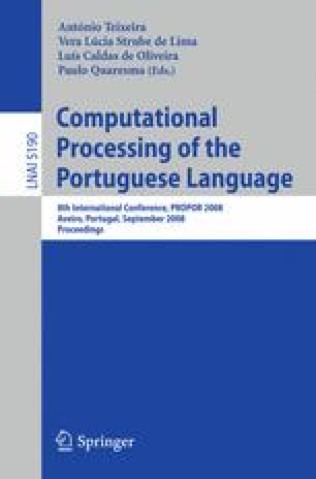
Computational Processing of the Portuguese Language ; 8th International Conference, PROPOR 2008 Aveiro, Portugal, September 8-10, 2008 Proceedings
This book constitutes the thoroughly refereed proceedings of the 8th International Workshop on Computational Processing of the Portuguese Language, PROPOR 2008, held in Aveiro, Portugal, in September 2008.

Computational methods in systems biology ; 18th International Conference, CMSB 2020, Konstanz, Germany, September 23–25, 2020, Proceedings
This book constitutes the refereed proceedings of the 18th International Conference on Computational Methods in Systems Biology, CMSB 2020, held in Konstanz, Germany, in September 2020.* The 17 full papers and 5 tool papers were carefully reviewed and selected from 30 submissions. In addition 3 abstracts of invited talks and 2 tutorials have been included in this volume. Topics of interest include formalisms for modeling biological processes; models and their biological applications; frameworks for model verification, validation, analysis, and simulation of biological systems; high-performance computational systems biology and parallel implementations; model inference from experimental data; model integration from biological databases; multi-scale modeling and analysis methods; computational approaches for synthetic biology; and case studies in systems and synthetic biology.

Computational logic in multi-agent systems ; Vol. 3487 ; 5th International Workshop, CLIMA V, Lisbon, Portugal, September 29-30, 2004, Revised Selected and Invited Papers
The notion of agency has recently increased its in?uence in the research and - velopment of computational logic based systems, while at the same time sign- cantly gaining from decades of research in computational logic. Computational logic provides a well-de?ned, general, and rigorous framework for studying s- tax, semantics and procedures, for implementations, environments, tools, and standards, facilitating the ever important link between speci?cation and ver- cation of computational systems. The purpose of the Computational Logic in Multi-agent Systems (CLIMA) international workshop series is to discuss techniques, based on computational logic, for representing, programming, and reasoning about multi-agent systems in a formal way. Former CLIMA editions were conducted in conjunction with other major computational logic and AI events Thesubmittedpapersshowedthatthelogicalfoundationsofmulti-agent systems are felt by a large community to be a very important research topic, upon which classical AI and agent-related issues are to be addressed.

Computational logic in multi-agent systems ; 8th International Workshop, CLIMA VIII, Porto, Portugal, September 10-11, 2007. Revised Selected and Invited Papers
This book constitutes the thoroughly refereed post-conference proceedings of the 8th International Workshop on Computational Logic for Multi-Agent Systems, CLIMA VIII, held in Porto, Portugal, in September 2007 - co-located with ICLP 2008, the International Conference on Logic Programming.
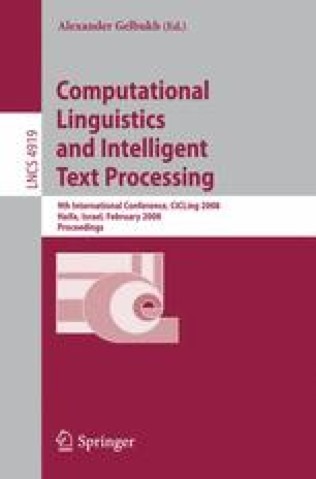
Computational linguistics and intelligent text processing ; 9th International Conference, CICLing 2008, Haifa, Israel, February 17-23, 2008. Proceedings
The CICLing conferences are intended to provide a wide-scope forum for the discussion of both the art and craft of natural language processing research and the best practices in its applications. This volume contains the papers accepted for oral presentation at the c- ference, as well as several of the best papers accepted for poster presentation.

Computational intelligence, cyber security and computational models. models and techniques for intelligent systems and automation ; 4th International Conference, ICC3 2019, Coimbatore, India, December 19–21, 2019, Revised Selected Papers
This book constitutes the proceedings of the 4th International Conference on Computational Intelligence, Cyber Security, and Computational Models, ICC3 2019, which was held in Coimbatore, India, in December 2019. The 9 papers presented in this volume were carefully reviewed and selected from 38 submissions. They were organized in topical sections named: computational intelligence; cyber security; and computational models.

Computational intelligence paradigms : Innovative Applications
The book includes a sample of research on the innovative applications of advanced computational intelligence paradigms. The characteristics of computational intelligence paradigms such as learning, generalization based on learned knowledge, knowledge extraction from imprecise and incomplete data are the extremely important for the implementation of intelligent machines.

Computational intelligence in biomedicine and bioinformatics : Current trends and applications
The purpose of this book is to provide an overview of powerful state-of-the-art methodologies that are currently utilized for biomedicine and/ or bioinformatics-oriented applications, so that researchers working in those fields could learn of new methods to help them tackle their problems.

Computational intelligence for engineering and manufacturing
Unlike traditional computing, Computational Intelligence is tolerant of imprecise information, partial truth and uncertainty. This book presents a collection of contributions on a focused treatment of important elements of CI, centred on its key element: learning.

Computational intelligence for agent-based systems
In these last years the digital technology explosion has spawned so many new lifestyle models that the boundaries between "real" and "digital" are fiercely debated. This scenario has deeply changed the viewpoint about computer applications: computers become smaller, cheapest and hugely distributed in wired or unwired networks, applications become so flexible and intelligent as to tailor its communication facilities in order to increase the usability of the system. Such data-intensive, unstructured spaces featured by minimal or no centralized control flow, present a challenge for traditional methods of analysis, design and integration of advanced, distributed and intelligent computer systems. Within this challenge, an important role is played by two important research areas : Fuzzy Technology, thanks to its ability to exploit the tolerance for imprecision to achieve tractability and Agent Technology, thanks to its nature to employ agent-wise communities to carry out complex goals by means of smart interaction, cooperation, and pro-activeness.

Computational intelligence and bioinformatics ; International conference on intelligent computing, ICIC 2006, Kunming, China, August 16-19, 2006, Proceedings, Part III
The International Conference on Intelligent Computing (ICIC) was formed to provide an annual forum dedicated to the emerging and challenging topics in artificial intelligence, machine learning, bioinformatics, and computational biology, etc. It aims to bring together researchers and practitioners from both academia and industry to share ideas, problems and solutions related to the multifaceted aspects of intelligent computing.the theme for this conference was “Emerging Intelligent Computing Technology and Applications”. Papers related to this theme were especially solicited, including theories, methodologies, and applications in science and technology.

Computational intelligence ; Vol. 4114 ; International conference on intelligent computing, ICIC 2006, Kunming, China, August 16-19, 2006, Proceedings, Part II
The International Conference on Intelligent Computing (ICIC) was formed to provide an annual forum dedicated to the emerging and challenging topics in artificial intelligence, machine learning, bioinformatics, and computational biology, etc. It aims to bring together researchers and practitioners from both academia and industry to share ideas, problems and solutions related to the multifaceted aspects of intelligent computing.

Computational intelligence : Research Frontiers : IEEE World Congress on Computational Intelligence, WCCI 2008, Hong Kong, China, June 1-6, 2008, Plenary/Invited Lectures
The book presents the expertise and experiences of leading researchers spanning a diverse spectrum of computational intelligence in the areas of neurocomputing, fuzzy systems, evolutionary computation, and adjacent areas.

Computational intelligence : Methods and techniques
This book focuses on various techniques of computational intelligence, both single ones and those which form hybrid methods. Those techniques are today commonly applied issues of artificial intelligence, e.g. to process speech and natural language, build expert systems and robots.

Computational intelligence : A compendium
Computational Intelligence paradigms have proven effective on real-world problems in virtually all disciplines including Science, Engineering, Business, healthcare, Management and Avionics. This handbook includes contributions from the leading international experts in their respective fields. There are twenty five chapters grouped in the following ten parts covering theoretical aspects and practical applications.

Computational formalism : Art history and machine learning
"Computational Formalism investigates examples of art historical analysis in the fields of computer and information sciences, and frames this research in the context of art historiography. The use of machine learning to analyze art images has ushered in a renewed interest in formalism in art history, but these new techniques create new critical challenges for the field"

Computational drug discovery and design
Provides new and updated methods and techniques for identification of drug target, binding sites prediction, high- throughput virtual screening, lead discovery and optimization, conformational sampling, prediction of pharmacokinetic properties using computer-based methodologies. Chapters also focus on the application of the latest artificial intelligence technologies for computer aided drug discovery.

Computational drug discovery : methods and application
Covers a wide range of cutting-edge computational technologies and computational chemistry methods that are transforming drug discovery. The book delves into recent advances, particularly focusing on artificial intelligence (AI) and its application for protein structure prediction, AI-enabled virtual screening, and generative modeling for compound design. Additionally, it covers key technological advancements in computing such as quantum and cloud computing that are driving innovations in drug discovery.
