



Page 41
Page 41
Lifting Modules : Supplements and Projectivity in Module Theory
Extending modules are generalizations of injective modules and, dually, lifting modules generalize projective supplemented modules. There is a certain asymmetry in this duality. While the theory of extending modules is well documented in monographs and text books, the purpose of our monograph is to provide a thorough study of supplements and projectivity conditions needed to investigate classes of modules related to lifting modules. The text begins with an introduction to small submodules, the radical, variations on projectivity, and hollow dimension. The subsequent chapters consider preradicals and torsion theories (in particular related to small modules), decompositions of modules (including the exchange property and local semi-T-nilpotency), supplements in modules (with specific emphasis on semilocal endomorphism rings), finishing with a long chapter on lifting modules, leading up their use in the theory of perfect rings, Harada rings, and quasi-Frobenius rings.
Lie Theory Vol.229 : Unitary Representations and Compactifications of Symmetric Spaces
It focuses on two fundamental questions in the theory of semisimple Lie groups: the geometry of Riemannian symmetric spaces and their compactifications; and branching laws for unitary representations, i.e., restricting unitary representations to (typically, but not exclusively, symmetric) subgroups and decomposing the ensuing representations into irreducibles.Ji's introductory chapter motivates the subject of symmetric spaces and their compactifications with carefully selected examples. A discussion of Satake and Furstenberg boundaries and a survey of the geometry of Riemannian symmetric spaces in general provide a good background for the second chapter, namely, the Borel–Ji authoritative treatment of various types of compactifications useful for studying symmetric and locally symmetric spaces. Borel–Ji further examine constructions of Oshima, De Concini, Procesi, and Melrose, which demonstrate the wide applicability of compactification techniques. Kobayashi examines the important subject of branching laws. Important concepts from modern representation theory, such as Harish–Chandra modules, associated varieties, microlocal analysis, derived functor modules, and geometric quantization are introduced. Concrete examples and relevant exercises engage the reader.
Lie theory ; Vol.230 : Harmonic analysis on symmetric spaces, general Plancherel theorems
Van den Ban’s introductory chapter explains the basic setup of a reductive symmetric space along with a careful study of the structure theory, particularly for the ring of invariant differential operators for the relevant class of parabolic subgroups. Advanced topics for the formulation and understanding of the proof are covered, including Eisenstein integrals, regularity theorems, Maass–Selberg relations, and residue calculus for root systems. Schlichtkrull provides a cogent account of the basic ingredients in the harmonic analysis on a symmetric space through the explanation and definition of the Paley–Wiener theorem. Approaching the Plancherel theorem through an alternative viewpoint, the Schwartz space, Delorme bases his discussion and proof on asymptotic expansions of eigenfunctions and the theory of intertwining integrals.
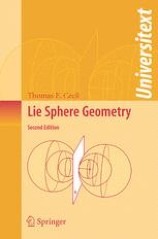
Lie Sphere Geometry : With Applications to Submanifolds
Provides a clear and comprehensive modern treatment of Lie sphere geometry and its applications to the study of Euclidean submanifolds. It begins with the construction of the space of spheres, including the fundamental notions of oriented contact, parabolic pencils of spheres, and Lie sphere transformations. The link with Euclidean submanifold theory is established via the Legendre map, which provides a powerful framework for the study of submanifolds, especially those characterized by restrictions on their curvature spheres.
Lie Groups : An Approach through Invariants and Representations
Lie groups has been an increasing area of focus and rich research since the middle of the 20th century. Procesi's masterful approach to Lie groups through invariants and representations gives the reader a comprehensive treatment of the classical groups along with an extensive introduction to a wide range of topics associated with Lie groups: symmetric functions, theory of algebraic forms, Lie algebras, tensor algebra and symmetry, semisimple Lie algebras, algebraic groups, group representations, invariants, Hilbert theory, and binary forms with fields ranging from pure algebra to functional analysis.
Lie Algebras and Algebraic Groups
The theory of Lie algebras and algebraic groups has been an area of active research in the last 50 years. It intervenes in many different areas of mathematics : for example invariant theory, Poisson geometry, harmonic analysis, mathematical physics. The aim of this book is to assemble in a single volume the algebraic aspects of the theory so as to present the foundation of the theory in characteristic zero. Detailed proofs are included and some recent results are discussed in the last chapters. All the prerequisites on commutative algebra and algebraic geometry are included.
Level Crossing Methods in Stochastic Models
Since its inception in 1974, the level crossing approach for analyzing a large class of stochastic models has become increasingly popular among researchers. This volume traces the evolution of level crossing theory for obtaining probability distributions of state variables and demonstrates solution methods in a variety of stochastic models including: queues, inventories, dams, renewal models, counter models, pharmacokinetics, and the natural sciences. Results for both steady-state and transient distributions are given, and numerous examples help the reader apply the method to solve problems faster, more easily, and more intuitively.
Leray–Schauder Type Alternatives, Complementarity Problems and Variational Inequalities
Complementarity theory, a relatively new domain in applied mathematics, has deep connections with several aspects of fundamental mathematics and also has many applications in optimization, economics and engineering. The study of variational inequalities is another domain of applied mathematics with many applications to the study of certain problems with unilateral conditions. This book is the first to discuss complementarity theory and variational inequalities using Leray–Schauder type alternatives.

Leonhard Euler
Euler was not only by far the most productive mathematician in the history of mankind, but also one of the greatest scholars of all time. He attained, like only a few scholars, a degree of popularity and fame which may well be compared with that of Galilei, Newton, or Einstei .This book is based in part on unpublished sources and comes right out of the current research on Euler. It is entirely free of formulae as it has been written for a broad audience with interests in the history of culture and science.

Lectures on the Automorphism Groups of Kobayashi-Hyperbolic Manifolds
Presents a coherent exposition of recent results on complete characterization of Kobayashi-hyperbolic manifolds with high-dimensional groups of holomorphic automorphisms. These classification results can be viewed as complex-geometric analogues of those known for Riemannian manifolds with high-dimensional isotropy groups, that were extensively studied in the 1950s-70s. The common feature of the Kobayashi-hyperbolic and Riemannian cases is the properness of the actions of the holomorphic automorphism group and the isometry group on respective manifolds.
Lectures on Symplectic Geometry
Provides a fast introduction to symplectic geometry for graduate students with some knowledge of differential geometry, de Rham theory and classical Lie groups. This text addresses symplectomorphisms, local forms, contact manifolds, compatible almost complex structures, Kaehler manifolds, hamiltonian mechanics, moment maps, symplectic reduction and symplectic toric manifolds. It contains guided problems, called homework, designed to complement the exposition or extend the reader's understanding.
Lectures on Probability Theory and Statistics : Ecole d'Eté de Probabilités de Saint-Flour XXXIII - 2003
Contains two of the three lectures that were given at the 33rd Probability Summer School in Saint-Flour (July 6-23, 2003). Amir Dembo’s course is devoted to recent studies of the fractal nature of random sets, focusing on some fine properties of the sample path of random walk and Brownian motion. In particular, the cover time for Markov chains, the dimension of discrete limsup random fractals, the multi-scale truncated second moment and the Ciesielski-Taylor identities are explored. Tadahisa Funaki’s course reviews recent developments of the mathematical theory on stochastic interface models, mostly on the so-called nabla varphi interface model. The results are formulated as classical limit theorems in probability theory, and the text serves with good applications of basic probability techniques.
Lectures on Algebraic Geometry I : Sheaves, Cohomology of Sheaves, and Applications to Riemann Surfaces
This book and the following second volume is an introduction into modern algebraic geometry. In the first volume the methods of homological algebra, theory of sheaves, and sheaf cohomology are developed. These methods are indispensable for modern algebraic geometry, but they are also fundamental for other branches of mathematics and of great interest in their own.In the last chapter of volume I these concepts are applied to the theory of compact Riemann surfaces. In this chapter the author makes clear how influential the ideas of Abel, Riemann and Jacobi were and that many of the modern methods have been anticipated by them.
Lectures on Advances in Combinatorics
The main focus of these lectures is basis extremal problems and inequalities – two sides of the same coin. Additionally they prepare well for approaches and methods useful and applicable in a broader mathematical context. Highlights of the book include a solution to the famous 4m-conjecture of Erdös/Ko/Rado 1938, one of the oldest problems in combinatorial extremal theory, an answer to a question of Erdös (1962) in combinatorial number theory "What is the maximal cardinality of a set of numbers smaller than n with no k+1 of its members pair wise relatively prime?", and the discovery that the AD-inequality implies more general and sharper number theoretical inequalities than for instance Behrend's inequality.

Learning and Intelligent Optimization ; 2nd International Conference, LION 2007 II, Trento, Italy, December 8-12, 2007. Selected Papers
The papers cover current issues of machine learning, artificial intelligence, mathematical programming and algorithms for hard optimization problems and are organized in topical sections on improving optimization through learning, variable neighborhood search, insect colony optimization, applications, new paradigms, cliques, stochastic optimization, combinatorial optimization, fitness and landscapes, and particle swarm optimization.
Le raisonnement bayésien : Modélisation et inférence = Bayesian reasoning : Modeling and inference
Describes in detail the practice of the Bayesian statistical approach using many examples chosen for their educational interest. The first part gives the general principles of statistical modeling making it possible to supervise but also to come to the aid of the imagination of the apprentice modeler. By examining examples of increasing difficulty, the reader forges the keys to building their own model. The second part presents the most useful calculation algorithms for estimating the unknowns of the model. Each inference method is presented and illustrated by numerous application cases.
Le choix bayésien: Principes et pratique
Covers the so-called Bayesian approach to statistical inference and in particular its decision-making aspects. The bases of this axiomatics (choice of the a priori, optimal decisions, tests and regions of confidence) are discussed in detail, as well as more recent openings of Bayesian analysis such as the choice of models, the use of numerical methods. Stochastic approximation (MCMC), the theory of noninformative laws (Berger-Bernardo axioms) and the relation to the classical theory of admissibility. Each chapter is completed by an extensive series of exercises of increasing difficulty and by bibliographical notes on the themes addressed. This book can be used in a Master's program in Applied Mathematics, Biometrics, Econometrics or any other program that uses quantitative information processing techniques. It only requires a basic course in probability theory and mathematical statistics as a preliminary.
Lattices and Ordered Sets
This book is intended to be a thorough introduction to the subject of ordered sets and lattices, with an emphasis on the latter. It can be used for a course at the graduate or advanced undergraduate level or for independent study. Prerequisites are kept to a minimum, but an introductory course in abstract algebra is highly recommended, since many of the examples are drawn from this area. The book has an excellent choice of topics, including a chapter on well ordering and ordinal numbers, which is not usually found in other texts. The approach is user-friendly and the presentation is lucid. There are more than 240 carefully chosen exercises.
Lattices and Ordered Algebraic Structures
Lattices and Ordered Algebraic Structures provides a lucid and concise introduction to the basic results concerning the notion of an order. Although as a whole it is mainly intended for beginning postgraduates, the prerequisities are minimal and selected parts can profitably be used to broaden the horizon of the advanced undergraduate. The treatment is modern, with a slant towards recent developments in the theory of residuated lattices and ordered regular semigroups.
Lattice : Multivariate Data Visualization with R
R is rapidly growing in popularity as the environment of choice for data analysis and graphics both in academia and industry. Lattice brings the proven design of Trellis graphics (originally developed for S by William S. Cleveland and colleagues at Bell Labs) to R, considerably expanding its capabilities in the process. Lattice is a powerful and elegant high level data visualization system that is sufficient for most everyday graphics needs, yet flexible enough to be easily extended to handle demands of cutting edge research. Written by the author of the lattice system, this book describes it in considerable depth, beginning with the essentials and systematically delving into specific low levels details as necessary. No prior experience with lattice is required to read the book, although basic familiarity with R is assumed.
