



Page 40
Page 40

Lasers in the Conservation of Artworks ; LACONA VI Proceedings, Vienna, Austria, Sept. 21--25, 2005
In 1995 Professor Costas Fotakis brought together restorers and scientists to discuss the potential of lasers in art conservation. Since then the field of "Lasers in the Conservation of Artworks" has gained enormously in importance. Nowadays restorers and laser scientists work close together in order to develop new fields of applications during the last years.

Lasers in the Conservation of Artworks ; LACONA V Proceedings, Osnabrück, Germany, Sept. 15-18, 2003
Since 1995, when Costas Fotakis first brought together restorers and scientists to discuss the potential of lasers in art conservation, the field has grown enormously in importance, and today restorers and laser scientists work together to develop new applications. This book presents the more than six dozen research papers prepared for LACONA V (Lasers in Art Conservation), held in Osnabrueck/Germany in September 2003. The fifth congress once again gathers restorers, art historians, museum staff, laser scientists and laser manufacturers. The topics include, among others: laser cleaning of artworks (case studies and side effects), removal of former conservation layers, fundamentals of laser-artwork interaction, online monitoring and process control, laser diagnostics, spectroscopy for monitoring and identification, networks and co-operation projects.

Lasers in Restorative Dentistry : A Practical Guide
Presents the state of the art in the use of laser in restorative dentistry. After discussion of relevant background, basic physics and laser types, the full range of clinical applications is covered with the aid of more than 600 clinical photographs, charts, and tables.
Lasers and Nuclei : Applications of Ultrahigh Intensity Lasers in Nuclear Science
Lasers and Nuclei describes the generation of high-energy-particle radiation with high-intensity lasers and its application to nuclear science. A basic introduction to laser--matter interaction at high fields is complemented by detailed presentations of state of the art laser particle acceleration and elementary laser nuclear experiments. The text also discusses future applications of lasers in nuclear science, for example in nuclear astrophysics, isotope generation, nuclear fuel physics and proton and neutron imaging.
Laser Spectroscopy : Vol.2 Experimental Techniques
Keeping abreast of the latest techniques and applications, this new edition of the standard reference and graduate text on laser spectroscopy has been completely revised and expanded. While the general concept is unchanged, the new edition features a broad array of new material, e.g. frequency doubling in external cavities, reliable cw-parametric oscillators, tunable narrow-band UV sources, more sensitive detection techniques, tunable femtosecond and sub-femtosecond lasers (X-ray region and the attosecond range), control of atomic and molecular excitations, frequency combs able to synchronize independent femtosecond lasers, coherent matter waves, and still more applications in chemical analysis, medical diagnostics, and engineering.
Laser Spectroscopy : Vol.1 Basic Principles
Keeping abreast of the latest techniques and applications, this new edition of the standard reference and graduate text on laser spectroscopy has been completely revised and expanded. While the general concept is unchanged, the new edition features a broad array of new material, e.g., frequency doubling in external cavities, reliable cw-parametric oscillators, tunable narrow-band UV sources, more sensitive detection techniques, tunable femtosecond and sub-femtosecond lasers (X-ray region and the attosecond range), control of atomic and molecular excitations, frequency combs able to synchronize independent femtosecond lasers, coherent matter waves, and still more applications in chemical analysis, medical diagnostics, and engineering.
Laser Resonators and Beam Propagation : Fundamentals, Advanced Concepts, Applications
Optical Resonators provides a detailed discussion of the properties of optical resonators for lasers from basic theory to recent research. In addition to describing the fundamental theories of resonators such as geometrical optics, diffraction, and polarisation the characteristics of all important resonator schemes and their calculation are presented. Experimental examples, practical problems and a collection of measurement techniques support the comprehensive treatment of the subject. Optical Resonators is the only book currently available that provides a comprehensive overview of the the subject. Combined with the structure of the text and the autonomous nature of the chapters this work will be as suitable for those new to the field as it will be invaluable to specialists conducting research. This second edition has been enlarged by new sections on Q-switching and resonators with internal phase/amplitude control. In addition, the whole book has been brought up-to-date.
Laser Dermatology
The continual array of laser technology throughout the world has been nothing short of miraculous. Over the last fifteen years, this field has continued to grow and expand with new technologies. This book represents the most up to date description of the latest in laser and light source technology.

Laser Ablation and its Applications
Laser Ablation and its Applications emphasizes the wide range of these topics rather than focusing on one specialty or discipline. It is intended for a graduate course in laser interactions with plasmas and materials, but it should be accessible to anyone with a graduate degree in physics or engineering.

LASER 2004; Proceedings of the 6th International Workshop on Application of Lasers in Atomic Nuclei Research (LASER 2004) held in Poznan, Poland, 24-27 May, 2004
6th International Workshop on Application of Lasers in Atomic Nuclei Research, LASER 2004, held in Poznan, Poland, 24-27 May, 2004 Researchers and graduate students interested in the Mössbauer Effect and its applications will find this volume indispensable. The volume presents the most recent developments in the methodology of Mössbauer spectroscopy.
Large Eddy Simulation for Incompressible Flows : An Introduction
First concise textbook on Large-Eddy Simulation, a very important method in scientific computing and engineeringFrom the foreword to the third edition written by Charles Meneveau: ".
Large Coulomb Systems: Lecture Notes on Mathematical Aspects of QED
A mathematically consistent formulation of relativistic quantum electrodynamics (QED) has still to be found. Nevertheless, there are several simplified effective models that successfully describe many body quantum systems and the interaction of radiation with matter. Large Coulomb Systems explores a selection of mathematical topics inspired by QED. It comprises selected, expanded and edited lectures given by international experts at a topical summer school and is intended as a high-level introduction for graduate students, postdocs and nonspecialists from related fields.

Landscapes of Mars : A Visual Tour
Landscapes of Mars is essentially a picture book that provides a visual tour of Mars. All the major regions and topographical features will be shown and supplemented with chapter introductions and extended captions. In a way, think of it as a visual tourist guide. Other topics covered are Martian uplands on the order of the elevation of Mt. Everest, Giant volcanoes and a rift system, the Grand Canyon of Mars, craters and the absence of craters over large regions (erosion), and wind shadows around craters, sand dunes, and dust devils.

LACAME 2004 ; Proceedings of the 9th Latin American Conference on the Applications of the Mössbauer Effect, (LACAME 2004) held in Mexico City, Mexico, 19-24 September 2004
Proceedings of the 9th Latin American Conference on the Applications of the Mössbauer Effect, LACAME 2004, held in Mexico City, Mexico, 19-24 September 2004. Researchers and graduate students interested in the Mössbauer Effect and its applications will find this volume indispensable. The volume presents the most recent developments in the methodology of Mössbauer spectroscopy.
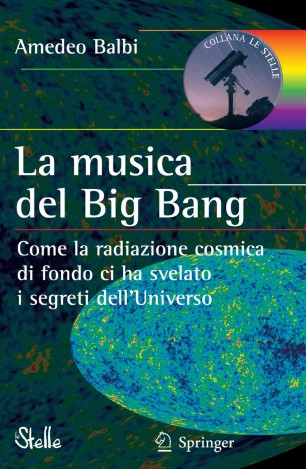
La musica del Big Bang : Come la radiazione cosmica di fondo ci ha svelato i segreti dell’Universo = The music of the Big Bang : How the cosmic background radiation revealed the secrets of the Universe to us
Cosmic microwave background radiation is the residue of the great heat following the Big Bang. A tenuous sign, over 13 billion years old, in which the answers to many of the questions about the nature of our Universe are hidden. Discovered by chance in 1964, in the last forty years this fossil trace of the origins of the Cosmos has been explored with every available means. Two Nobel Prizes in physics have already been awarded for research involving it, the last in 2006 for the results of the COBE satellite. Much of the information encoded in the cosmic background radiation was impressed by the superimposition of acoustic waves present in the early Universe: a "music" of the Big Bang, which cosmologists have tried for years to reconstruct, using techniques similar to those that allow to distinguish the sound of different musical instruments. Only recently have the first notes of this extraordinary cosmic symphony finally been revealed, but the investigation is not over yet. This book illustrates, with a language suitable even for non-specialists, the theories, observations and discoveries that have brought cosmology into a new era.
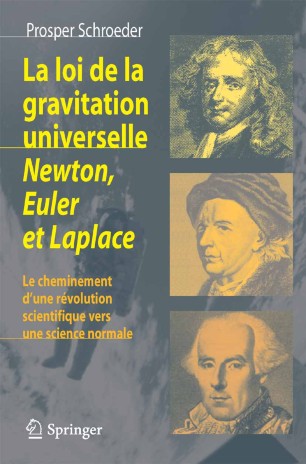
La loi de la gravitation universelle Newton, Euler et Laplace : Le cheminement d’une révolution scientifique vers une science normale = The law of universal gravitation Newton, Euler and Laplace : The progress of a scientific revolution towards a normal science
An analysis of Newton's ideas dismisses this hypothesis by the simple fact that the Principia sought to demonstrate the fallacy of earlier approaches. However, Newton suffered a failure in the application of his theory of gravitation to the explanation of the movement of the Moon, failure which marked the development of celestial mechanics throughout the 18th century. Clairaut, d'Alembert and Euler doubted the validity of Newtonian law almost at the same time and their ideas advanced celestial mechanics which reached the state of "normal science" with Laplace's treatise on celestial mechanics, a century after Newton.
La correspondance entre Henri Poincaré et les physiciens, chimistes et ingénieurs = The correspondence between Henri Poincaré and physicists, chemists and engineers
Cosmic microwave background radiation is the residue of the great heat following the Big Bang. A tenuous sign, over 13 billion years old, in which the answers to many of the questions about the nature of our Universe are hidden. Discovered by chance in 1964, in the last forty years this fossil trace of the origins of the Cosmos has been explored with every available means. Two Nobel Prizes in physics have already been awarded for research involving it, the last in 2006 for the results of the COBE satellite. Much of the information encoded in the cosmic background radiation was impressed by the superimposition of acoustic waves present in the early Universe: a "music" of the Big Bang, which cosmologists have tried for years to reconstruct, using techniques similar to those that allow to distinguish the sound of different musical instruments. Only recently have the first notes of this extraordinary cosmic symphony finally been revealed, but the investigation is not over yet. This book illustrates, with a language suitable even for non-specialists, the theories, observations and discoveries that have brought cosmology into a new era.
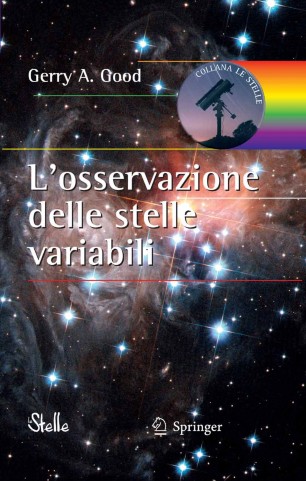
L’osservazione delle stelle variabili = The observation of variable stars
The observation of variable stars is one of the main contributions that amateur astronomers can offer to science and this book provides all the information necessary to pursue it profitably. In the first part the different classes of variables are presented in detail, with examples, light curves and physical descriptions. The second section, on the other hand, covers all the practical aspects of observation: from preparation and planning, to observation techniques, up to the management and processing of data.
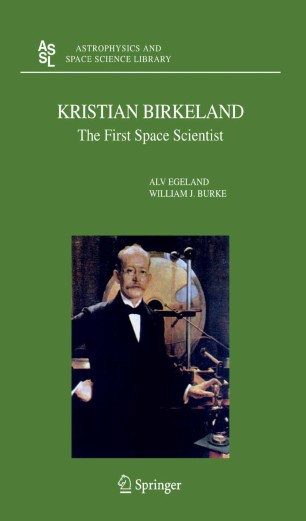
Kristian Birkeland : The First Space Scientist
PREFACEThisscientific biography of Kristian Birkeland (1867–1917) was written to bring the story ofa Norwegian national hero to the attention ofthe English-speaking world. Birkeland’sheroic stature was established not on a field of military battle,but in the bitter cold of the Artic wilderness ashe sought to answer basic questions abouthow the Sun controlled northern lights andmag-netic storms. He was also afather of Norsk Hydro one ofNorway’s largest industries. Birkel and died before reaching the age of 50.Because Birkel and never kept adiary, documented information about his family and private life is sparse. Before he died, Olaf Devik, the last of Birke-ffland’s close friends, gave along interview and graciously transferred his personal archive to A.E. Birkeland’s 82 scientific papers and three book-length publications map the progress of his investigations. addressed this book questions that had vexed European scientists for centuries. Why do the northern lights appear overhead when the Earth’s magnetic field is disturbed? How are magnetic storms connected to disturbances on the Sun? To answer these questions Birkeland interpreted his advance laboratory simulations and daring campaigns in the Arctic wilderness in the light of Maxwell’s newly discovered laws of electricity and magnetism. Birkeland’s ideas were dismissed for decades, only to be vindicated when satellites could fly above the Earth’s atmosphere.
Kramers-Kronig Relations in Optical Materials Research
This is the first one-volume work to provide a thorough and comprehensive description of the physical background, rigorous theory and applications of Kramers-Kronig relations in the fields of linear and nonlinear optical spectroscopy. Currently, Kramers-Kronig relations have become basic tools in the investigation of the optical properties of materials. A brief presentation of the related data-retrieval technique, the maximum entropy method, is also given. The contents and style potentially make this a standard text for physicists, chemists and engineers interested in optical-materials research and development.
