



Page 4
Page 4
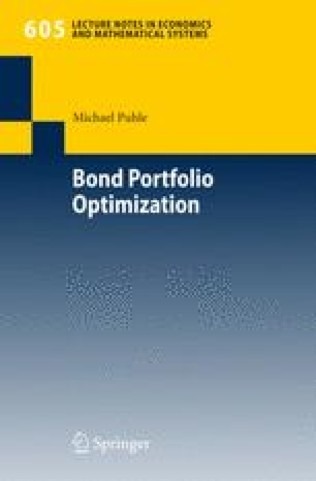
Bond Portfolio Optimization
1 The tools of modern portfolio theory are in general use in the equity markets, either in the form of portfolio optimization software or as an accepted frame- 2 work in which the asset managers think about stock selection. In the ?xed income market on the other hand, these tools seem irrelevant or inapplicable. Bond portfolios are nowadays mainly managed by a comparison of portfolio 3 4 risk measures vis ¶a vis a benchmark. The portfolio manager’s views about the future evolution of the term structure of interest rates translate th- selves directly into a positioning relative to his benchmark, taking the risks of these deviations from the benchmark into account only in a very crude 5 fashion, i.e. without really quantifying them probabilistically. This is quite surprising since sophisticated models for the evolution of interest rates are commonly used for interest rate derivatives pricing and the derivation of ?xed 6 income risk measures.

Bioactive components of milk
Of all food products dairy foods have the most potential concerning functional foods. Therefore, there is a tremendous amount of interest in value-added milk products and the identification of components in food which have health benefits. Bioactive Components of Milk provides an overview of these derived components and their diverse activities including: the stimulation of beneficial microflora, alerting the immune system to the presence of potential pathogens and allergens, binding and eliminating toxins, etc. The book is divided into four parts. The first part focuses on bioactive milk lipid components, which very widely among mammalian species. The second part describes different aspects of biological active colostrums and milk proteins and their derivatives, with special concern on species specific effects. The third part reviews the production of recombinant human proteins in the milk of livestock animals - including ethical issues - and the aims of altering milk composition for the benefit of both the animals themselves and the consumers. The final part focuses on the influence of ruminants nutrition on the biological activity of milk.
Binomial models in finance
This book deals with many topics in modern financial mathematics in a way that does not use advanced mathematical tools and shows how these models can be numerically implemented in a practical way. The book is aimed at undergraduate students, MBA students, and executives who wish to understand and apply financial models in the spreadsheet computing environment.The basic building block is the one-step binomial model where a known price today can take one of two possible values at the next time. In this simple situation, risk neutral pricing can be defined and the model can be applied to price forward contracts, exchange rate contracts, and interest rate derivatives.

Bacterial chromatin : Methods and protocols
Brings together new and updated methods to explore the structure and function of bacterial chromatin from molecular to the cellular scale. Chapters detail experimental protocols of in vivo and in vitro approaches, approaches to genome structure modeling, and data analysis. Written in the highly successful Methods in Molecular Biology series format, chapters include introductions to their respective topics, lists of the necessary materials and reagents, step-by-step, readily reproducible laboratory protocols, and key tips on troubleshooting and avoiding known pitfalls.
Applied Quantitative Finance
Applied Quantitative Finance (2nd edition) provides a comprehensive and state-of-the-art treatment of cutting-edge topics and methods. It provides solutions to and presents theoretical developments in many practical problems such as risk management, pricing of credit derivatives, quantification of volatility and copula modelling. The synthesis of theory and practice supported by computational tools is reflected in the selection of topics as well as in a finely tuned balance of scientific contributions on practical implementation and theoretical concepts. This linkage between theory and practice offers theoreticians insights into considerations of applicability and, vice versa, provides practitioners comfortable access to new techniques in quantitative finance.
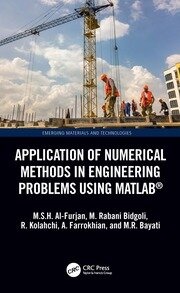
Application of numerical methods in engineering problems using MATLAB
Presents an analysis of structures using numerical methods and mathematical modeling. This structural analysis also includes beam, plate, and pipe elements, and examines deflection and frequency or buckling loads. The various engineering theories of beams/plates/shells are comprehensively presented, and the relationships between stress and strain, and the governing equations of the structure are extracted. To solve governing equations with numerical methods, there are two general types, including methods based on derivatives or integrals. Derivative-based methods have the advantage of flexibility in modeling boundary conditions, low analysis time, and a very high degree of accuracy.
Analysis II
As with the first, the second volume contains substantially more material than can be covered in a one-semester course. Such courses may omit many beautiful and well-grounded applications which connect broadly to many areas of mathematics. We of course hope that students will pursue this material independently; teachers may find it useful for undergraduate seminars. For an overview of the material presented, consult the table of contents and the chapter introductions. As before, we stress that doing the numerous exercises is indispensable for understanding the subject matter, and they also round out and amplify the main text. In writing this volume, we are indebted to the help of many.

Analysis by Its History
This book presents first-year calculus roughly in the order in which it first was discovered. The first two chapters show how the ancient calculations of practical problems led to infinite series, differential and integral calculus and to differential equations. The establishment of mathematical rigour for these subjects in the 19th century for one and several variables is treated in chapters III and IV. The text is complemented by a large number of examples, calculations and mathematical pictures and will provide stimulating and enjoyable reading for students, teachers, as well as researchers.

An Introduction to Manifolds
Manifolds, the higher-dimensional analogs of smooth curves and surfaces, are fundamental objects in modern mathematics. Combining aspects of algebra, topology, and analysis, manifolds have also been applied to classical mechanics, general relativity, and quantum field theory. In this streamlined introduction to the subject, the theory of manifolds is presented with the aim of helping the reader achieve a rapid mastery of the essential topics. By the end of the book the reader should be able to compute, at least for simple spaces, one of the most basic topological invariants of a manifold, its de Rham cohomology. Along the way the reader acquires the knowledge and skills necessary for further study of geometry and topology.

An introduction to differential geometry with applications to elasticity
Interestingly, notions that pertain to di?erential geometry per se,suchas covariant derivatives of tensor ?elds, are also introduced in Chapters 3 and 4, where they appear most naturally in the derivation of the basic boundary value problems of three-dimensional elasticity and shell theory.

Alginates in drug delivery
Alginates in Drug Delivery explores the vital precepts, basic and fundamental aspects of alginates in pharmaceutical sciences, biopharmacology, and in the biotechnology industry. The use of natural polymers in healthcare applications over synthetic polymers is becoming more prevalent due to natural polymers’ biocompatibility, biodegradability, economic extraction and ready availability. To fully utilize and harness the potential of alginates, this book presents a thorough understanding of the synthesis, purification, and characterization of alginates and their derivative. This book collects, in a single volume, all relevant information on alginates in health care, including recent advances in the field.
Advances in Fractional Calculus : Theoretical Developments and Applications in Physics and Engineering
The scope of the book is thus to present the state of the art in the study of fractional systems and the application of fractional differentiation.As this volume covers recent applications of fractional calculus, it will be of interest to engineers, scientists, and applied mathematicians.
Advanced REIT Portfolio Optimization : Innovative Tools for Risk Management
This book provides an investor-friendly presentation of the premises and applications of the quantitative finance models governing investment in one asset class of publicly traded stocks, specifically real estate investment trusts (REITs). The models provide highly advanced analytics for REIT investment, including: portfolio optimization using both historic and predictive return estimation; model backtesting; a complete spectrum of risk assessment and management tools with an emphasis on early warning systems, risk budgeting, estimating tail risk, and factor analysis; derivative valuation; and incorporating ESG ratings into REIT investment.
Adaptive-robust control with limited knowledge on systems dynamics : An artificial input delay approach and beyond
investigates the role of artificial input delay in approximating unknown system dynamics, referred to as time-delayed control (TDC), and provides novel solutions to current design issues in TDC. Its central focus is on designing adaptive-switching gain-based robust control (ARC) for a class of Euler–Lagrange (EL) systems with minimal or no knowledge of the system dynamics parameters. The newly proposed TDC-based ARC tackles the commonly observed over- and under-estimation issues in switching gain. The consideration of EL systems lends a practical perspective on the proposed methods, and each chapter is supplemented by relevant experimental data

A Course in Derivative Securities : Introduction to Theory and Computation
Aims at a middle ground between the introductory books on derivative securities and those that provide advanced mathematical treatments. It is written for mathematically capable students who have not necessarily had prior exposure to probability theory, stochastic calculus, or computer programming. It provides derivations of pricing and hedging formulas (using the probabilistic change of numeraire technique) for standard options, exchange options, options on forwards and futures, quanto options, exotic options, caps, floors and swaptions, as well as VBA code implementing the formulas. It also contains an introduction to Monte Carlo, binomial models, and finite-difference methods.
