



Page 38
Page 38

Foundations and applications of MIS : A model theory approach
Foundations and Applications of MIS presents a unique systems theory approach to management information system (MIS) development. The development is driven by the need to eliminate ambiguity in specification, design and construction of the application software. Further, the authors show that the considerable effort being expanded nowadays on validation, verification and testing, as required in current software engineering practices, will be reduced. The approach also reinforces the belief that MIS development is independent of software development. The work presents an approach that provides a theoretical foundation for MIS development from the systems theoretic viewpoint along with practical applications ranging from a transaction processing system to a solver system. Both formal systems theory and automatic system generation based on the authors' newly extended Prolog offer a significant increase in the efficiency of specification, design and production of the application software, as well as an increase in the functional reliability of the software produced. The book assumes a working knowledge of elementary set theory, logic, and familiarity with some systems concepts, such as the automaton model.

Foundation Website Creation with CSS, XHTML, and JavaScript
Foundation Website Creation with CSS, XHTML, and JavaScript covers the entire process of building a website. This process involves much more than just technical knowledge, and this book provides you with all the information you'll need to understand the concepts behind designing and developing for the Web, as well as the best means to deliver professional, best-practice-based results. There is far more to building a successful website than knowing a little Hypertext Markup Language (HTML). The process starts long before any coding takes place, and this book introduces you to the agile development process, explaining why this method makes so much sense for web projects and how best to implement it. Planning is vital, so you'll also learn how to use techniques such as brainstorming, wireframes, mockups, and prototypes to get your project off to the best possible start and help ensure smooth progress as it develops.

Foundation Web Design with Dreamweaver 8
Dreamweaver is Macromedia's bestselling web design/development environment. Dreamweaver has the capability to generate dynamic website code using server-side languages like ASP, PHP, and ASP.NET. We know that you don't always require a full database-driven site though, so this book focuses on using version 8 of Dreamweaver to design and create usable, standards-compliant websites using XHTML and CSS. One of the highlights of this version is much closer, tighter CSS/XHTML. This book will show you how to make the most of that feature. After a brief introduction to the latest version of Dreamweaver, and how CSS and XHTML fit into it, Craig Grannell looks at using the software for your web design projects in a hands-on, task based manner.

Foundation Flex for Developers : Data-Driven Applications with PHP, ASP.NET, ColdFusion, and LCDS
Flex is a very powerful and versatile technology for creating web application front-ends. But what every good web application needs is a robust data source, be it XML, or a database. Flex is very adaptable in terms of connecting to data sources, and that is the main focus of this book. In Foundation Flex for Developers, author Sas Jacobs assumes that you've got the basics of Flex down already, and explores in detail how to create professional data-centric Flex 2 and Flex 3 applications. In the first half of the book, she starts off with a brief exploration of Flex and ActionScript 3.0, before looking at application essentials in detail—creating custom components, user and web browser interactions, binding, formatting, and validating data, debugging, and more. In the second half of the book, the focus is on connecting Flex to data sources, and covers XML, LiveCycle Data Services, PHP, ASP.NET, and ColdFusion in detail, via a series of step-by-step case studies.

Foundation Flex for Designers
All Flex applications look the same—a blue-gray background and silver-skinned components—right? That doesn't have to be the case, though. This book shows you how to ensure that your Flex 2 and 3 projects stand out from the crowd and provide your users with an application that is both visually stunning and beautifully functional. Flex Builder, coupled with the Adobe Creative Suite (CS3), is a powerful combination, providing all the tools you need to create compelling, vibrant interfaces. This book guides you through creating applications with Flex Builder, designing layouts in Fireworks, creating custom skins for your components in Photoshop and Illustrator, and using CSS to enhance the appearance of your rich Internet applications (RIAs).

Foundation Flash CS3 Video
Video is one of the most exciting features on today's Internet, with widespread adoption being made possible by advances in bandwidth and software. But simply streaming video clips to Web users is only the tip of the iceberg! Flash CS3 offers a whole host of advanced video features, allowing you to create breathtaking user experiences. And this book, the second edition of the critically-acclaimed Foundation Flash 8 Video, shows you how to make the most of video in Flash CS3. The authors start with the basics of creating video ready for use on the web using popular applications such as Windows Movie Maker and iMovie, creating FLV (Flash video) using both Flash and other applications such as Sorenson Squeeze, and importing that video into Flash.
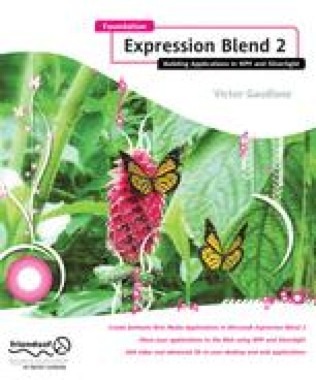
Foundation Expression Blend 2 : Building applications in WPF and silverlight
This book shows you how to take full advantage of Blend's interface, together with and Silverlight's vastly improved designer-developer workflow, guiding you through every step of development from downloading and installing of the development environment through creating finished, functional projects. You'll learn how to create simple drawing applications with the InkCanvas, make tabbed and scrollable interfaces, as well as build fully featured media players, photo galleries, and interactive 3D designs. Each chapter discusses major WPF and Silverlight features, provides a hands-on tutorial, and explains how that feature is implemented in the real world. In the end, you will have a collection of impressive WPF and Silverlight applications that can be added to your portfolio.

Foundation ASP.NET for Flash
If you're a reasonably experienced Flash user who has mastered the basics but wants to empower your SWFs, taking them further toward rich Internet applications, then you've come to the right place! Foundation ASP.NET for Flash will teach you everything you need to know to integrate two of the most exciting technologies used on the Web today. Using Flash and ASP.NET, it's possible to utilize the amazing user interface capabilities of Flash along with the extensive power of ASP.NET to create dynamic, data-driven web applications. In this book, advanced topics are made easy by providing intuitive step-by-step examples. This book covers Flash MX 2004 and Flash 8, ASP.NET 2.0, Visual Studio 2005, and Access and SQL Server 2005. It is an essential part of any Flash or ASP.NET web developer's arsenal.
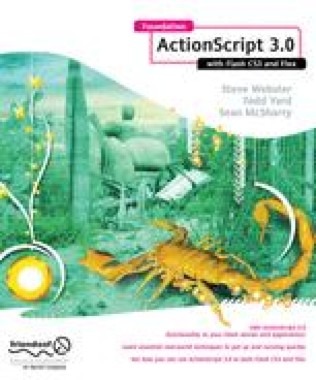
Foundation ActionScript 3.0 with Flash CS3 and Flex
If you want to create exciting dynamic web sites that will amaze your online audience, then the Flash platform is a great way to go, with it's many features, including powerful graphical and sound and video capabilities. To really harness the power of Flash though, you need to make use of ActionScript to provide dynamic effects, enable user interaction, and manipulate data. ActionScript 3.0, the Flash Platform's scripting language, offers a lot of new and powerful features. ActionScript is now a full-fledged programming language, with complete object-oriented capabilities, improved event handling, sound and video support, drawing capabilities, support for regular expressions, and much more. This book covers all the essential techniques from the ground up, allowing you to get up and running quickly and easily. Starting with the fundamentals, you'll learn about using ActionScript objects, manipulating sound and video, and harnessing the power of regular expressions and XML.

Foundation ActionScript 3 Animation : Making Things Move!
The material inside this book covers everything you need to know to harness the power of ActionScript 3.0. The book goes on to provide information on all the relevant trigonometry you will need, before moving on to physics concepts such as acceleration, velocity, easing, springs, collision detection, conservation of momentum, 3D, and forward and inverse kinematics.

Foundation 3ds Max 8 Architectural Visualization
Welcome to the world of 3D architectural visualizations using the most powerful and versatile 3D software package on the planet: 3ds Max. In just the last few years, the visualization industry has arguably become the fastest-growing 3D industry, and may soon overtake all others in total number of users. Just as the use of computer-aided design became the norm for nearly all architectural, engineering, and construction firms in the 1990s, 3D visualizations have become standard practice today. This book takes you through the challenge of learning one of the most complex computer programs ever created, by way of easy-to-follow tutorials and instruction. It specifically focuses on those parts of the program you need to know to produce stunning architectural visualizations.

Fostering transformative change for sustainability in the context of socio-ecological production landscapes and seascapes (SEPLS)
This book is a compilation of case studies that provide useful knowledge and lessons that derive from on-the-ground activities and contribute to policy recommendations, focusing on the relevance of social-ecological production landscapes and seascapes (SEPLS) to “transformative change.” The concept of “transformative change” has been gaining more attention to deal with today’s environmental and development problems, whereas both policy and scientific communities have been increasingly calling for transformative change toward sustainable society. The Intergovernmental Science-Policy Platform on Biodiversity and Ecosystem Services (IPBES) has planned to start the so-called “assessment on transformative change” if approved by the IPBES plenary to be held in 2021

Forward-backward stochastic differential equations and their applications
This volume is a survey/monograph on the recently developed theory of forward-backward stochastic differential equations (FBSDEs). Basic techniques such as the method of optimal control, the "Four Step Scheme", and the method of continuation are presented in full. Related topics such as backward stochastic PDEs and many applications of FBSDEs are also discussed in detail. The volume is suitable for readers with basic knowledge of stochastic differential equations, and some exposure to the stochastic control theory and PDEs. It can be used for researchers and/or senior graduate students in the areas of probability, control theory, mathematical finance, and other related fields.

Formulating poorly water soluble drugs
A pharmaceutical scientist’s approach toward solubility enhancement of a poorly water-soluble molecule typically includes detailed characterization of the compound’s physiochemical properties, solid-state modifications, advanced formulation design, non-conventional process technologies, advanced analytical characterization, and specialized product performance analysis techniques. The scientist must also be aware of the unique regulatory considerations pertaining to the non-conventional approaches often utilized for poorly water-soluble drugs. One faced with the challenge of developing a drug product from a poorly soluble compound must possess at a minimum a working knowledge of each of the above mentioned facets and detailed knowledge of most. In light of the magnitude of the growing solubility problem to drug development, this is a significant burden especially when considering that knowledge in most of these areas is relatively new and continues to develop.
Form-oriented analysis : A new methodology to model form-based applications
Form-based applications range from simple web shops to complex enterprise resource planning systems. Draheim and Weber adapt well-established basic modeling techniques in a novel way to achieve a modeling framework optimized for this broad application domain. They introduce new modeling artifacts, such as page diagrams and form storyboards, and separate dialogue patterns to allow for reuse. In their implementation they have developed new constructs such as typed server pages, and tools for forward and reverse engineering of presentation layers. The methodology is explained using an online bookshop as a running example in which the user can experience the modeling concepts in action. The combination of theoretical achievements and hands-on practical advice and tools makes this book a reference work for both researchers in the areas of software architectures and submit-response style user interfaces, and professionals designing and developing such applications. More information and additional material is also available online.
Formal Techniques for Networked and Distributed Systems - FORTE 2008 ; 28th IFIP WG 6.1 International Conference Tokyo, Japan, June 10-13, 2008 Proceedings
This book constitutes the refereed proceedings of the 28th IFIP WG 6.1 International Conference on Formal Techniques for Networked and Distributed Systems, FORTE 2008, held in Tokyo, Japan, in June 2008 co-located with TestCom/FATES 2008.The 19 revised full papers and 1 revised short paper presented together with 1 invited talk were carefully reviewed and selected from 44 submissions. The papers cover new approaches, concepts and experience in the application of formal methods for the specification and verification of distributed systems and applications.

Formal Techniques for Networked and Distributed Systems - FORTE 2006 ; 26th IFIP WG 6.1 International Conference, Paris, France, September 26-29, 2006, Proceedings
This book constitutes the refereed proceedings of the 26th IFIP WG 6.1 International Conference on Formal Techniques for Networked and Distributed Systems, FORTE 2006, held in Paris, France, in September 2006. The 26 revised full papers and 4 short papers presented together with 3 invited lectures were carefully reviewed and selected from 177 submissions. The papers focus on the construction of middleware and services using formalised and verified approaches.

Formal techniques for distributed objects, components, and systems ; 40th IFIP WG 6.1 International conference, FORTE 2020, Held as Part of the 15th International Federated Conference on distributed computing techniques, DisCoTec 2020, Valletta, Malta, June 15–19, 2020, Proceedings
This book constitutes the proceedings of the 40th IFIP WG 6.1 International Conference on Formal Techniques for Distributed Objects, Components, and Systems, FORTE 2020, held in Valletta, Malta, in June 2020, as part of the 15th International Federated Conference on Distributed Computing Techniques, DisCoTec 2020.*

Formal Models of Operating System Kernels
The purpose of this book is to show that the formal specification of kernels is not only possible but also necessary if operating systems are to achieve the levels of reliability and security that is demanded of them today. Specifications of a sequence of kernels of increasing complexity are included, acting as models to enable the designer to identify and reason about the properties of the design – thus making explicit that which is too often left implicit or even unknown.

Formal Models of Communicating Systems : Languages, Automata, and Monadic Second-Order Logic
This book studies the relationship between automata and monadic second-order logic, focusing on classes of automata that describe the concurrent behavior of distributed systems.
