



Page 36
Page 36

Industrial Robots Programming : Building Applications for the Factories of the Future
Industrial Robots Programming focuses on designing and building robotic manufacturing cells, and explores the capabilities of today’s industrial equipment as well as the latest computer and software technologies. Special attention is given to the input devices and systems that create efficient human-machine interfaces, and how they help non-technical personnel perform necessary programming, control, and supervision tasks.

Industrial applications of semantic web ; Proceedings of the 1st International IFIP/WG12.5 Working Conference on Industrial Applications of Semantic Web, August 25-27, 2005 Jyvaskyla, Finland
The IFIP series publishes state-of-the-art results in the sciences and technologies of information and communication. The scope of the series includes: foundations of computer science; software theory and practice; education; computer applications in technology; communication systems; systems modeling and optimization; information systems; computers and society; computer systems technology; security and protection in information processing systems; artificial intelligence; and human-computer interaction. Proceedings and post-proceedings of referred international conferences in computer science and interdisciplinary fields are featured. These results often precede journal publication and represent the most current research. The principal aim of the IFIP series is to encourage education and the dissemination and exchange of information about all aspects of computing.
Inductive logic programming ; 18th International Conference, ILP 2008 Prague, Czech Republic, September 10-12, 2008 Proceedings
This book constitutes the refereed proceedings of the 18th International Conference on Inductive Logic Programming, ILP 2008, held in Prague, Czech Republic, in September 2008.The 20 revised full papers presented together with the abstracts of 5 invited lectures were carefully reviewed and selected during two rounds of reviewing and improvement from 46 initial submissions. All current topics in inductive logic programming are covered, ranging from theoretical and methodological issues to advanced applications. The papers present original results in the first-order logic representation framework, explore novel logic induction frameworks, and address also new areas such as statistical relational learning, graph mining, or the semantic Web.

Inductive logic programming ; 17th International Conference, ILP 2007, Corvallis, OR, USA, June 19-21, 2007, Revised Selected Papers
The 18th International Conference on Inductive Logic Programming was held in Prague, September 10–12, 2008. ILP returned to Prague after 11 years, and it is tempting to look at how the topics of interest have evolved during that time. The ILP community clearly continues to cherish its beloved ?rst-order logic representation framework. This is legitimate, as the work presented at ILP 2008 demonstrated that there is still room for both extending established ILP approaches (such as inverse entailment) and exploring novel logic induction frameworks (such as brave induction). Besides the topics lending ILP research its unique focus.
Inductive logic programming ; 16th International Conference, ILP 2006, Santiago de Compostela, Spain, August 24-27, 2006, Revised Selected Papers
This book constitutes the thoroughly refereed post-proceedings of the 16th International Conference on Inductive Logic Programming, ILP 2006, held in Santiago de Compostela, Spain, in August 2006. The papers address all current topics in inductive logic programming, ranging from theoretical and methodological issues to advanced applications.
Inductive logic programming ; 15th International Conference, ILP 2005, Bonn, Germany, August 10-13, 2005, Proceedings
“Change is inevitable.” Embracing this quote we have tried to carefully exp- iment with the format of this conference, the 15th International Conference on Inductive Logic Programming, hopefully making it even better than it already was. But it will be up to you, the inquisitive reader of this book, to judge our success. The major changes comprised broadening the scope of the conference to include more diverse forms of non-propositional learning, to once again have tutorials on exciting new areas, and, for the ?rst time, to also have a discovery challenge as a platform for collaborative work. This year the conference was co-located with ICML 2005, the 22nd Inter- tional Conference on Machine Learning, and also in close proximity to IJCAI 2005, the 19th International Joint Conference on Arti?cial Intelligence. - location can be tricky, but we greatly bene?ted from the local support provided by Codrina Lauth, Michael May, and others. We were also able to invite all ILP and ICML participants to shared events including a poster session, an invited talk, and a tutorial about the exciting new area of “statistical relational lea- ing”. Two more invited talks were exclusively given to ILP participants and were presented as a kind of stock-taking—?ttingly so for the 15th event in a series—but also tried to provide a recipe for future endeavours.

Induction, Algorithmic Learning Theory, and Philosophy
This is the first book to collect essays from philosophers, mathematicians and computer scientists working at the exciting interface of algorithmic learning theory and the epistemology of science and inductive inference. Readable, introductory essays provide engaging surveys of different, complementary, and mutually inspiring approaches to the topic, both from a philosophical and a mathematical viewpoint.

Individual differences in sensory and consumer science : Experimentation, analysis and interpretation
Individual differences in sensory and consumer science: Experimentation, Analysis and Interpretation presents easily readable, State-of-the-art coverage on how to plan and execute experiments that give rise to individual differences, Also providing the framework for successful analysis and interpretation of results. The book highlights the different methodologies that can be applied and how to select the correct methodology based on the type of study you are performing, Be it product research and development, Quality control or consumer acceptance studies.Written by an experienced team of statisticians and sensory and consumer scientists, The book provides both academics and industry professionals with the first complete overview of a topic of ever-increasing importance.

Indiscrete Thoughts
Indiscrete Thoughts gives a glimpse into a world that has seldom been described, that of science and technology as seen through the eyes of a mathematician. The era covered by this book, 1950 to 1990, was surely one of the golden ages of science as well as of the American university. Cherished myths are debunked along the way as Gian-Carlo Rota takes pleasure in portraying, warts and all, some of the great scientific personalities of the period —Stanislav Ulam (who, together with Edward Teller, signed the patent application for the hydrogen bomb), Solomon Lefschetz (Chairman in the 1950s of the Princeton mathematics department), William Feller (one of the founders of modern probability theory), Jack Schwartz (one of the founders of computer science), and many others.

Independent component analysis and signal separation ; 7th International Conference, ICA 2007, London, UK, September 9-12, 2007, Proceedings
Independent Component Analysis and Signal Separation has applications at the intersection of many science and engineering disciplinesconcernedwithunderstandingandextractingusefulinformationfrom data as diverse as neuronal activity and brain images, bioinformatics, com- nications, the World Wide Web, audio, video, sensor signals, or time series.

Independent Component Analysis and Blind Signal Separation ; 6th International Conference, ICA 2006, Charleston, SC, USA, March 5-8, 2006, Proceedings
This book constitutes the refereed proceedings of the 6th International Conference on Independent Component Analysis and Blind Source Separation, ICA 2006, held in Charleston, SC, USA, in March 2006. The 120 revised papers presented were carefully reviewed and selected from 183 submissions. The papers are organized in topical sections on algorithms and architectures, applications, medical applications, speech and signal processing, theory, and visual and sensory processing.

Increasing the security and reliability of e-health system using blockchain technology
The Blockchain technology is the buzzword of the year, and as this new technology slowly matured, it seems clear that from banking to supply chain logistics, it is ready for disruption. And in healthcare in particular, there is a massive opportunity for blockchain revolution to disrupt and lead the digital transformation. From medical records to pharmaceutical supply chains, to smart contracts for payment distribution, there are a plenty of methods to leverage this technology. Thus it has reached a great boom in the health sector, due to its importance to overcome interoperability and security challenges of health records systems in e-health.

Inconsistency tolerance
Inconsistency arises in many areas in advanced computing. Often inconsistency is unwanted, for example in the specification for a plan or in sensor fusion in robotics; however, sometimes inconsistency is useful. Whether inconsistency is unwanted or useful, there is a need to develop tolerance to inconsistency in application technologies such as databases, knowledge bases, and software systems. To address this situation, inconsistency tolerance is being built on foundational technologies for identifying and analyzing inconsistency in information, for representing and reasoning with inconsistent information, for resolving inconsistent information, and for merging inconsistent information. The idea for this book arose out of a Dagstuhl Seminar on the topic held in summer 2003. The nine chapters in this first book devoted to the subject of inconsistency tolerance were carefully invited and anonymously reviewed. The book provides an exciting introduction to this new field.

In Search of an Integrative Vision for Technology : Interdisciplinary Studies in Information Systems
This book provides a fascinating reading experience for anyone interested in an inquiring relationship between technical progress and the quality of the human condition. It manages to keep a healthier balance between these two complex topics than is found in most publications of the genre, too often they consist either of much technology and little philosophy or the converse.... The book also manages to build accessible bridges over the gulf that tends to separate the philosophical language from the 'real' concerns of technologists."

Improving image quality in visual cryptography
This book comprehensively covers the important efforts in improving the quality of images in visual cryptography (VC), with a focus on cases with gray scale images. It not only covers schemes in traditional VC and extended VC for binary secret images, but also the latest development in the analysis-by-synthesis approach.

Improvements in System Safety ; Proceedings of the Sixteenth Safety-critical Systems Symposium, Bristol, UK, 5-7 February 2008
Improvements in System Safety contains the full complement of papers presented at the sixteenth annual Safety-critical Systems Symposium, held at Bristol, UK, in February 2008.The Symposium is for engineers, managers and academics in the field of safety, across all industry sectors, and so the papers included in this volume offer a wide-ranging coverage of major safety issues as well as a good blend of academic research and industrial experience. They include discussions of some of the most recent developments in the field.

Implementing semantic web services : The SESA framework
Service-oriented computing has become one of the predominant factors in IT research and development efforts over the last few years. In spite of several standardization efforts that advanced from research labs into industrial-strength technologies and tools, there is still much human effort required in the process of finding and executing Web services.
Implementing distributed systems with Java and CORBA
This book provides graduate students and practitioners with knowledge of the CORBA standard and practical experience of implementing distributed systems with CORBA's Java mapping. With tested code examples that will run immediately.
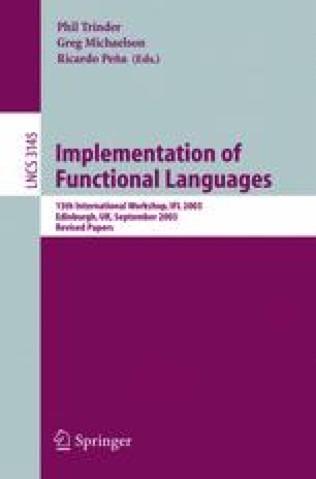
Implementation of functional languages ; 15th International Workshop, IFL 2003, Edinburgh, UK, September 8-11, 2003. Revised Papers
This book constitutes the thoroughly refereed post-proceedings of the 15th International Workshop on the Implementation of Functional Languages, IFL 2003, held in Edinburgh, UK in September 2003. The 11 revised full papers presented were carefully selected during two rounds of reviewing and revision from 32 workshop presentations. The papers are organized in topical sections on language constructs and programming, static analysis and types, parallelism, and generic programming.
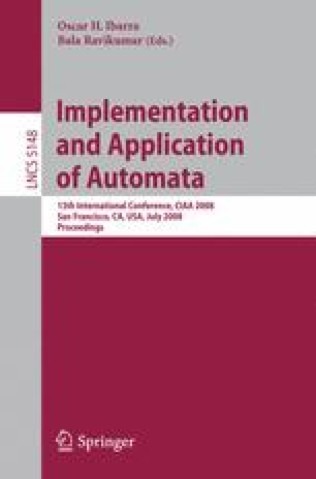
Implementation and Applications of Automata ; 13th International Conference, CIAA 2008, San Francisco, California, USA, July 21-24, 2008. Proceedings
This book constitutes the thoroughly refereed post-proceedings of the 13th International Conference on Implementation and Application of Automata, CIAA 2008, held in San Francisco, USA, in July 2008.The 26 revised full papers togehter with 4 invited papers were carefully reviewed and selected from 40 submissions and have gone through two rounds of reviewing and improvement. The papers cover various topics in the theory, implementation, and applications of automata and related structures.
