



Page 33
Page 33
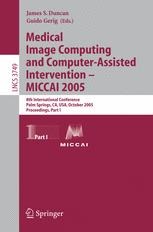
Medical Image Computing and Computer-Assisted Intervention – MICCAI 2005 ; 8th International Conference, Palm Springs, CA, USA, October 26-29, 2005, Proceedings, Part I
This paper presents a method for classification of medical images, using machine learning and deformation-based morphometry. A morphological representation of the anatomy of interest is first obtained using highdimensional template warping, from which regions that display strong correlations between morphological measurements and the classification (clinical) variable are extracted using a watershed segmentation, taking into account the regional smoothness of the correlation map which is estimated by a crossvalidation strategy in order to achieve robustness to outliers. A Support Vector Machine-Recursive Feature Elimination (SVM-RFE) technique is then used to rank computed features from the extracted regions, according to their effect on the leave-one-out error bound. Finally, SVM classification is applied using the best set of features, and it is tested using leave-one-out. The results from a group of 61 brain images of female normal controls and schizophrenia patients demonstrate not only high classification accuracy (91.8%) and steep ROC curves, but also exceptional stability with respect to the number of selected features and the SVM kernel size

Medical centers management system
The medical clinics management system (MCMS) is a system that manages a group of clinics distributed within different governorates and regions in Syria, as it manages data entry processes for each patient such as personal information, disease and accompanying symptoms in addition to doctors' information, and clinics through a web application. The system also performs mining algorithms on the current data for discovering new symptoms and diseases by analyzing patient, diseases and symptoms data available within the database, to subsequently notify the admins of the emergence of a new symptom or an increase in a disease in a given area. In addition to generating daily or weekly reports containing the number of visits and cases of recovery and other information.

Medical biotechnology, biopharmaceutics, forensic : science and bioinformatics
Covers a range of topics on exploiting Nigeria’s mega biodiversity for food security and health; DNA forensic science and its applications; medical biotechnology and biopharmaceutics; medicinal and underutilized plants; impact and mitigation of antibiotic resistance; bioinformatics applications; medical insect biotechnology; etc. The book will be useful reference material for the scientists and researchers working in the fields of nutraceuticals, molecular diagnostics and DNA forensics, biopharmaceuticals and medical biotechnology, nanotechnology, antimicrobials from indigenous plant species, bioinformatics, etc.

Medical Applications of Colloids
This volume collects chapters dealing with significant topics in colloids and surfaces relevant to medical applications. The book will be of interest to scientists and practitioners in areas as diverse as medical diagnostics, drug formulations, X-ray photoelectron spectroscopy of biomaterials, and particle transport in human airways.

Medial Representations : Mathematics, Algorithms and Applications
The last half century has seen the development of many biological or physical theories that have explicitly or implicitly involved medial descriptions of objects and other spatial entities in our world. Simultaneously mathematicians have studied the properties of these skeletal descriptions of shape, and, stimulated by the many areas where medial models are useful, computer scientists and engineers have developed numerous algorithms for computing and using these models. We bring this knowledge and experience together into this book in order to make medial technology more widely understood and used.

Media Theory : Interdisciplinary Applied Mathematics
The focus of this book is a mathematical structure modeling a physical or biological system that can be in any of a number of `states.' Each state is characterized by a set of binary features, and differs from some other neighbor state or states by just one of those feature. A simple example of a `state’ is a partial solution of a jigsaw puzzle, which can be transformed into another partial solution or into the final solution just by adding or removing a single adjoining piece. The evolution of such a system over time is considered. Such a structure is analyzed from algebraic and probabilistic (stochastic) standpoints.

Mechatronics : Dynamics of Electromechanical and Piezoelectric Systems
Deals with Lagrange equations for electromechanical systems, including piezoelectric transducers and selected applications. Intended for the research community and graduate students at the MSc and PhD level, this book is an extension to piezoelectric systems of the work, ""Dynamics of Mechanical and Electromechanical Systems"", published in 1968.

Mechanochemistry in Nanoscience and Minerals Engineering
Mechanochemistry as a branch of solid state chemistry enquires into processes which proceed in solids due to the application of mechanical energy. This provides a thorough, up to date overview of mechanochemistry of solids and minerals. Applications of mechanochemistry in nanoscience with special impact on nanogeoscience are described. Selected advanced identification methods, most frequently applied in nanoscience, are described as well as the advantage of mechanochemical approach in minerals engineering. Examples of industrial applications are given. Mechanochemical technology is being applied in many industrial fields: powder metallurgy (synthesis of nanometals, alloys and nanocompounds), building industry (activation of cements), chemical industry (solid waste treatment, catalyst synthesis, coal ashes utilization), minerals engineering (ore enrichment, enhancement of processes of extractive metallurgy), agriculture industry (solubility increase of fertilizers), and pharmaceutical industry (improvement of solubility and bioavailability of drugs).

Mechanizing Mathematical Reasoning : Essays in Honor of Jörg H. Siekmann on the Occasion of His 60th Birthday
By presenting state-of-the-art results in logical reasoning and formal methods in the context of artificial intelligence and AI applications, this book commemorates the 60th birthday of Jörg H. Siekmann. The 30 revised reviewed papers are written by former and current students and colleagues of Jörg Siekmann; also included is an appraisal of the scientific career of Jörg Siekmann entitled "A Portrait of a Scientist: Logics, AI, and Politics." The papers are organized in four parts on logic and deduction, applications of logic, formal methods and security, and agents and planning.

Mechanics of the 21st Century ; Proceedings of the 21st International Congress of Theoretical and Applied Mechanics, Warsaw, Poland, 15-21 August 2004
Contains the proceedings of the 21st International Congress of Theoretical and Applied Mechanics, ICTAM04, held in Warsaw, in August 2004. This book discusses the field of mechanics, and is aimed at engineers and scientists. The texts of 27 invited lectures are included along with a CD-ROM with 1225 extended summaries of presented papers.

Mechanics of Structural Elements : Theory and Applications
The book systematically presents variational principles and methods of analysis for applied elasticity and structural mechanics. The variational approach is used consistently for both, constructing numerical procedures and deriving basic governing equations of applied mechanics of solids; it is the derivation of equations where this approach is most powerful and best grounded by mathematics. The book is oriented towards experts in civil engineering, researchers, developers of software for mechanical strength, stability, and oscillation analysis; it can be used by practical engineers who employ software tools to do their job and who want to know more about the theoretical background of the strength analysis. The book will be useful to senior and postgraduate students of engineering, to professors of structural analysis at civil or mechanical engineering departments of technical universities.

Mechanics of Materials
Provides a precise presentation of subjects illustrated with numerous engineering examples that students both understand and relate to theory and application. The tried and true methodology for presenting material gives students the best opportunity to succeed in this course. From the detailed examples, to the homework problems, instructors and students can be confident the material is clearly explained and accurately represented.
Mechanics of Materials
Provides a review of statics, covering the topics needed to begin the study of mechanics of materials including free-body diagrams, equilibrium, trusses, frames, centroids, and distributed loads. It presents the foundations and applications of mechanics of materials with emphasis on visual analysis, using sequences of figures to explain concepts and giving detailed explanations of the proper use of free-body diagrams. The Cauchy tetrahedron argument is included, which allows determination of the normal and shear stresses on an arbitrary plane for a general state of stress. An optional chapter discusses failure and modern fracture theory, including stress intensity factors and crack growth.

Mechanics of Civil Engineering Structures
Presents the material needed by practicing engineers engaged in the design of civil engineering structures, and students of civil engineering. The book covers the fundamental principles of mechanics needed to understand the responses of structures to different types of load and provides the analytical and empirical tools for design. The title presents the mechanics of relevant structural elements—including columns, beams, frames, plates and shells—and the use of mechanical models for assessing design code application. Eleven chapters cover topics including stresses and strains; elastic beams and columns; inelastic and composite beams and columns; temperature and other kinematic loads; energy principles; stability and second-order effects for beams and columns; basics of vibration; indeterminate elastic-plastic structures; plates and shells.

Mechanical System Dynamics
This textbook gives a clear and thorough presentation of the fundamental principles of mechanical systems and their dynamics. It provides both the theory and applications of mechanical systems in an intermediate theoretical level, ranging from the basic concepts of mechanics, constraint and multibody systems over dynamics of hydraulic systems and power transmission systems to machine dynamics and robotics.
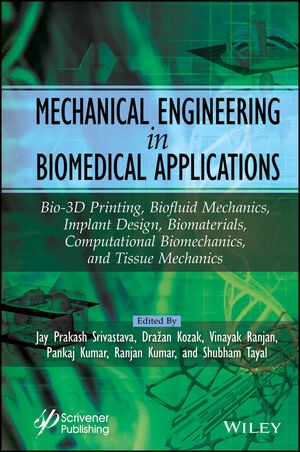
Mechanical engineering in biomedical application: bio-3D printing, biofluid mechanics, implant design, biomaterials, computational biomechanics, tissue mechanics
Explores the latest research and developments related to the interdisciplinary field of biomedical and mechanical engineering offering insights and perspectives on the research, key technologies, and mechanical engineering techniques used in biomedical applications.

Meat Biotechnology
The main goal of this book is to provide the reader with the recent developments in biotechnology and their applications in the meat processing chain. To achieve this goal, the book is divided into four parts. The first part deals with the use of modern biotechnology applied to farm animals. The second part focuses on the recent biotechnological developments in starter cultures for better meat fermentation. The third part discusses current approaches to improve the quality and nutritional properties of meats. The final part presents the latest advances in protection against foodborne pathogens, and other recent trends in the field. Written by distinguished international contributors, this book brings together the advances in such varied and different biotechnological topics

Measuring Professional Competence for the Teaching of Mathematical Modelling : A Test Instrument
This book presents a structural model and an associated test instrument designed to provide a detailed analysis of professional competences for teaching mathematical modelling. The conceptualisation is based on the COACTIV model, which describes aspects, areas and facets of professional competences of teachers. The manual provides an overview of the essential teaching skills in application-related contexts and offers the tools needed to capture these aspects. It discusses the objectives and application areas of the instrument, as well as the development of the test. In addition, it describes the implementation and evaluates the quality and results of the structural equation analysis of the model.

Measuring Precipitation from Space : EURAINSAT and the Future
More than 20 years after the last book on the subject the worldwide precipitation community has produced a comprehensive overview of its activities, achievements, ongoing research and future plans. Measuring Precipitation from Space presents state-of-the-art rainfall estimation algorithms, validation strategies, precipitation modelling, and assimilation in numerical weather prediction models. Clouds and precipitation observations and modelling are addressed for the improvement of the rainfall product quality. Special attention is given to the applications to monitoring and forecasting weather events and to climate monitoring in a frame of growing public interest.

Measuring Entrepreneurship : Building a Statistical System
This volume provides a comprehensive review of the theoretical concepts and empirical models of entrepreneurship from a non-conventional perspective. Its main purpose is to contribute to the design of an efficient system of indicators of entrepreneurship and competitiveness. The existence of a gap between the theory of entrepreneurship and the methods and data available for testing its main propositions has been widely recognized. Hence, some of the most prestigious researchers have collaborated to review and develop the statistical sources, indicators and proxies currently available for empirical studies on the phenomena of entrepreneurship. The book thereby makes recent advances in the theory and application of the economics of entrepreneurship accessible to a wider audience, including policy makers, emphasizing data requirements to advance the future research agenda and to allow for a better design and monitoring of entrepreneurial policy.
