



Page 31
Page 31
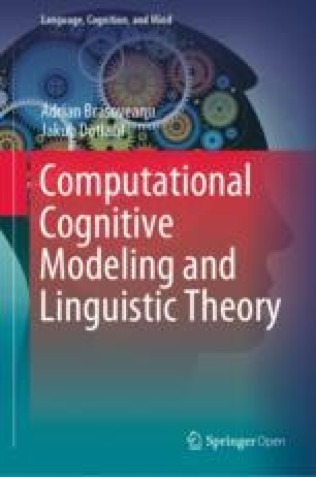
Computational Cognitive Modeling and Linguistic Theory
This book introduces a general framework that allows natural language researchers to enhance existing competence theories with fully specified performance and processing components. Gradually developing increasingly complex and cognitively realistic competence-performance models, it provides running code for these models and shows how to fit them to real-time experimental data. This computational cognitive modeling approach opens up exciting new directions for research in formal semantics, and linguistics more generally, and offers new ways of (re)connecting semantics and the broader field of cognitive science.

Command-Line Rust : A Project-Based Primer for Writing Rust CLIs
Rather than focusing on the language as a whole, this guide teaches Rust using a single small, complete, focused program in each chapter. Author Ken Youens-Clark shows you how to start, write, and test each of these programs to create a finished product. You'll learn how to handle errors in Rust, read and write files, and use regular expressions, Rust types, structs, and more.

Combinatorial pattern matching ; Vol. 3537 ; 16th Annual Symposium, CPM 2005, Jeju Island, Korea, June 19-22, 2005, Proceedings
This volume presents the proceedings of The 16th Annual Symposium on Combinatorial Pattern Matching was heldon Jeju Island, Korea on June 19–22, 2005. the Program Committee accepted 37 of the submissionsto be presented at the conference. This collection of papers offers original research contributionsin combinatorial pattern matching and its applications.In addition to the selected papers
Combinatorial pattern matching ; 19th Annual Symposium, CPM 2008, Pisa, Italy, June 18-20, 2008 Proceedings
This book constitutes the refereed proceedings of the 19th Annual Symposium on Combinatorial Pattern Matching, CPM 2008, held in Pisa, Italy, in June 2008.

Collins English dictionary and thesaurus : All-in-one support for everyday use ; 4th ed.
The perfect word reference to broaden your knowledge of English, ideal for everyday use, at home, in the office or at school. Matching dictionary and thesaurus entries are shown together for easy reference, with synonyms clearly shown in shaded boxes. Collins English Dictionary and Thesaurus combines a comprehensive dictionary with all the alternatives and opposites you need on the same page.

Collaboration Technologies and Social Computing ; 26th International Conference, CollabTech 2020, Tartu, Estonia, September 8–11, 2020, Proceedings
This book constitutes the proceedings of the 26th International Conference on Collaboration Technologies and Social Computing, CollabTech 2020. The conference was scheduled to take place in Tartu, Estonia, in September 2020. It was held virtually due to the COVID-19 pandemic. The 10 full and 5 work-in-progress papers presented in this volume were carefully reviewed and selected from 25 submissions.

Cohesion, coherence and temporal reference from an experimental corpus pragmatics perspective
Provides new methodological and theoretical insights into temporal reference and its linguistic expression, from a cross-linguistic experimental corpus pragmatics approach. Verbal tenses, in general, and more specifically the categories of tense, grammatical and lexical aspect are treated as cohesion ties contributing to the temporal coherence of a discourse, as well as to the cognitive temporal coherence of the mental representations built in the language comprehension process. As such, it investigates the phenomenon of temporal reference at the interface between corpus linguistics, theoretical linguistics and pragmatics, experimental pragmatics, psycholinguistics, natural language processing and machine translation.
Cognitive Systems ; Joint Chinese-German Workshop, Shanghai, China, March 7-11, 2005, Revised Selected Papers
This book organized in topical sections on multimodal human-computer interfaces, neuropsychology and neurocomputing, Chinese-German natural language processing and psycholinguistics, as well as information processing and retrieval from the semantic Web for intelligent applications.

Cognitive Aspects of Bilingualism
A unique feature of this book is that chapters favor that line of cognitive linguistics which makes a clear distinction between real world and projected world. Information conveyed by language must be about the projected world. Both the experimental results and the systematic claims in this volume call for a weak form of whorfianism. Also, chapters add some relatively unexplored issues of bilingualism to the well-known ones, such as gender systems in the bilingual mind, context and task, synergic concepts, blending, the relationship between lexical categorization and ontological categorization among others.

Code-switching in Bilingual Children
The goal of this volume is to prove that mixed utterances in young bilinguals can be analyzed in the same way as adult code-switching. Analyzing a rich corpus of spontaneous child data, the author provides detailed empirical evidence for latest minimalist assumptions on the architecture of mind and confirms that code-switching is only constrained by the two grammars of the languages involved. The data show that the quantity of mixing in children depends on an individual choice rather than on language development, language dominance, or other factors. Besides critically reviewing the literature on language mixing in children and adults, this work offers a thorough grammatical analysis of the code-switching data of five Italian/German children. The book provides new insights not only in the field of code-switching and of language mixing in young bilinguals, but also in issues concerning general questions on linguistic theory which are difficult to be answered with monolingual data.

Codes : An Introduction to Information Communication and Cryptography
Information is an important feature of the modern world. Mathematical techniques underlie the devices that we use to handle it, for example, mobile phones, digital cameras, and personal computers. This book is an integrated introduction to the mathematics of coding, that is, replacing information expressed in symbols, such as a natural language or a sequence of bits, by another message using (possibly) different symbols. There are three main reasons for doing this: economy, reliability, and security, and each is covered in detail. Only a modest mathematical background is assumed, the mathematical theory being introduced at a level that enables the basic problems to be stated carefully, but without unnecessary abstraction.

Coded Leadership : Developing Scalable Management in an AI-induced Quantum World
Introduces the necessary background to understand the challenges in today’s organizational leadership and how artificial intelligence enables learning to be viewed from a probabilistic framework. Introduction to Quantum Natural Language Processing. Overview of Leadership and AI. The Age of Quantum Superiority. Challenges to Today’s Leadership. AI-induced Strategic Implementation and Organizational Performance.

Code : The Hidden Language of Computer Hardware and Software ; 2nd ed
The classic guide to how computers work, updated with new chapters and interactive graphics Computers are everywhere --- most obviously in our laptops and smartphones, but also our cars, televisions, microwave ovens, alarm clocks, robot vacuum cleaners, and other smart appliances. Have you ever wondered what goes on inside these devices to make our lives easier but occasionally more infuriating? Explores more deeply the bit-by-bit, gate-by-gate construction of the heart of every smart device ― the central processing unit that combines the simplest of basic operations to perform the most complex of feats. Along with new chapters, Petzold created a new website, CodeHiddenLanguage.com, that uses animated interactive graphics to make computers even easier to comprehend.

Clinical text mining : Secondary use of electronic patient records
Describes the results of natural language processing and machine learning methods applied to clinical text from electronic patient records. It is divided into twelve chapters. Chapters 1-4 discuss the history and background of the original paper-based patient records, their purpose, and how they are written and structured. These initial chapters do not require any technical or medical background knowledge. The remaining eight chapters are more technical in nature and describe various medical classifications and terminologies such as ICD diagnosis codes, SNOMED CT, MeSH, UMLS, and ATC. Chapters 5-10 cover basic tools for natural language processing and information retrieval, and how to apply them to clinical text. The book’s closing chapters present a number of applications in clinical text mining and summarise the lessons learned from the previous chapters.

Clinical Pathways in Stroke Rehabilitation : Evidence-based Clinical Practice Recommendations
This book focuses on practical clinical problems that are frequently encountered in stroke rehabilitation. Consequences of diseases, e.g. impairments and activity limitations, are addressed in rehabilitation with the overall goal to reduce disability and promote participation.
Mathematical Methods in Computer Science : Essays in Memory of Thomas Beth
This Festschrift volume contains the proceedings of the conference Mathematical Methods in Computer Science, MMICS 2008, which was held during December 17-19, 2008, in Karlsruhe, Germany, in memory of Thomas Beth.The themes of the conference reflected the many interests of Thomas Beth. Although, these interests might seem diverse, mathematical methods and especially algebra as a language constituted the common denominator of all of his scientific achievements.
Mathematical Linguistics
Mathematical Linguistics introduces the mathematical foundations of linguistics to computer scientists, engineers, and mathematicians interested in natural language processing. The book presents linguistics as a cumulative body of knowledge from the ground up, with no prior knowledge of linguistics being assumed, covering more than the average two-semester introductory course in linguistics.This comprehensive, reader-friendly volume offers readers a high-level orientation, discussing the foundations of the field and presenting both the classical work and the most recent results. It covers an extremely rich array of topics including not only syntax and semantics but also phonology and morphology, probabilistic approaches, complexity, learnability, and the analysis of speech and handwriting.

Mathematical Foundations of Computer Science 2008 ; 33rd International Symposium, MFCS 2008, Toru´n, Poland, August 25-29, 2008. Proceedings
Constitutes the refereed proceedings of the 33rd International Symposium on Mathematical Foundations of Computer Science, MFCS 2008, held in Torun, Poland, in August 2008.The 45 revised full papers presented together with 5 invited lectures were carefully reviewed and selected from 119 submissions. All current aspects in theoretical computer science and its mathematical foundations are addressed, ranging from algorithmic game theory, algorithms and data structures, artificial intelligence, automata and formal languages, bioinformatics, complexity, concurrency and petrinets, cryptography and security, logic and formal specifications, models of computations, parallel and distributed computing, semantics and verification.

Mathematical Foundations of Computer Science 2005 ; 30th International Symposium, MFCS 2005, Gdansk, Poland, August29-September 2. 2005, Proceedings
Constitutes the proceedings of the 30th International Symposium on Mathematical Foundations of Computer Science, MFCS 2005, held in Gdansk, Poland in August/September 2005. The 62 papers address various aspects in theoretical computer science, ranging from quantum computing, approximation, automata, circuits, scheduling, games, and more.
Mathematical Approaches to Software Quality
This book considers the potential and limitations of the various mathematical approaches and thereby aims to give a balanced view of the usability of each mathematical approach. Written with both student and professional in mind, this book assists the reader in applying mathematical methods to solve practical problems that are relevant to software engineers. It is suitable for coursework or self-study and there is helpful material on tools to support the various mathematical approaches.
