



Page 3
Page 3

Dinaric Perspectives on TIMSS 2019 : Teaching and Learning Mathematics and Science in South-Eastern Europe
This book brings together national experts from across the Dinaric region to rigorously review IEA’s Trends in International Mathematics and Science Study (TIMSS) 2019 grade four data to develop a multidimensional and culturally sensitive perspective on their TIMSS 2019 primary-level results. The Dinaric region, named after the Dinaric Alps, is located in South-eastern Europe, and stretches through Croatia, Bosnia and Herzegovina, Serbia, Montenegro, Kosovo[1], Albania, and North Macedonia. IEA’s TIMSS has been an invaluable resource for monitoring international trends in mathematics and science achievement at grades four and eight since 1995. The TIMSS 2019 administration of the test to grade four students, provided a unique opportunity for analysis within shared regional settings and enabled the construction of this first report based on international study results from the region, prepared by the National Research Coordinators in collaboration with IEA.

Contributions from Science Education Research
In August 2005, over 500 international researchers from the field of science education met at the 5th European Science Education Research Association conference in Barcelona, Spain. Two of the main topics at this conference were: the decrease in the number of students interested in school science and concern about the worldwide outcomes of studies on students’ scientific literacy. At the conference, over 400 papers were presented, covering a wide range of topics relevant to science education research, such as evidence-based practice, teachers’ professional development, the role of ICT and multimedia, formal and informal learning environments, and argumentation and modelling in science education. This volume includes edited versions of 37 outstanding papers presented during the conference, including the lectures of the keynote speakers. They have been selected for their quality, variety and interest, and present a good overview of the field of science education research.

Collaboration in designing a pedagogical approach in information literacy
This book combines expertise in information literacy with expertise in education and teaching to share tips and tricks for the development of good information literacy teaching and training in universities and libraries.
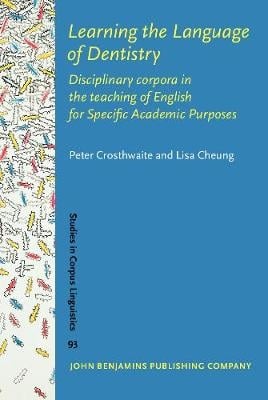
Learning the language of dentistry : disciplinary corpora in the teaching of English for specific academic purposes
Explores the affordances of disciplinary corpora for the teaching and learning of the language of dentistry, within the field of English for Specific Academic Purposes (ESAP). We extract disciplinary register features and vocabulary from three key genres of the dentistry discipline (published experimental research articles, case reports, and novice/professional research reports within the Dental Public Health domain), before integrating these features into ESAP pedagogy in the form of corpus-based ESAP materials that promote student-led direct engagement with disciplinary corpora – an approach known as 'data-driven learning'. This book is a timely and relevant addition to the field of corpus linguistics and ESAP, and is especially targeted at ESAP professionals who are required to teach disciplinary discourses but who may struggle to know what to teach as non-experts of the target discipline.
Learning Languages, Learning Life-skills : Autobiographical reflexive approach to teaching and learning a foreign language
Learning Languages, Learning Life Skills offers an autobiographical reflexive approach to foreign language education. The orientation of the book is practical, containing rich descriptions of language learning situations including authentic language use and student stories.
Learning and Teaching for the Twenty-first Century : Festschrift for Professor Phillip Hughes
This book stresses learning and teaching, rather than teaching and learning. The contention of the contributors is that the focus in all educational endeavours should not be primarily on teachers and teaching, but on learners; how to best facilitate learning, in the most effective, enjoyable, relevant and cost-effective ways for learners, whether they be children, youth or adults. The focus is therefore on how learning can be enhanced, through effective teaching; and how individuals can be best prepared to be excellent teachers.
Language Learning Motivation and L2 Pragmatic Competence
It presents an original study that not only enriches our knowledge of the feasibility of modern technology in collecting large-scale data related to pragmatic competence but also eminently connects L2 pragmatics more closely with mainstream second language acquisition research by focusing on the role of motivation in pragmatic learning.
Building the Foundation : Whole Numbers in the Primary Grades : The 23rd ICMI Study
This twenty-third ICMI Study addresses for the first time mathematics teaching and learning in the primary school (and pre-school) setting, while also taking international perspectives, socio-cultural diversity and institutional constraints into account. One of the main challenges of designing the first ICMI primary school study of this kind is the complex nature of mathematics at the early level. Accordingly, a focus area that is central to the discussion was chosen, together with a number of related questions. The broad area of Whole Number Arithmetic (WNA), including operations and relations and arithmetic word problems, forms the core content of all primary mathematics curricula. this study presents a meta-level analysis and synthesis of what is currently known about WNA, providing a useful base from which to gauge gaps and shortcomings, as well as an opportunity to learn from the practices of different countries and contexts.
Beyond Cartesian Dualism : Encountering affect in the teaching and learning of science.
There is surprisingly little known about affect in science education. Despite periodic forays into monitoring students’ attitudes-toward-science, the effect of affect is too often overlooked. Beyond Cartesian Dualism gathers together contemporary theorizing in this axiomatic area. In fourteen chapters, senior scholars of international standing use their knowledge of the literature and empirical data to model the relationship between cognition and affect in science education. Their revealing discussions are grounded in a broad range of educational contexts including school classrooms, universities, science centres, travelling exhibits and refugee camps, and explore an array of far reaching questions. What is known about science teachers’ and students’ emotions? How do emotions mediate and moderate instruction? How might science education promote psychological
Barriers and Biases in Computer-Mediated Knowledge Communication : And How They May Be Overcome
This books deals with computer-mediated cooperation and communication scenarios in teaching and learning situations, leisure activities (e.g. laypersons looking for expert information on the internet), and net-based communication at work. Such scenarios will become increasingly important. But the successful use of such computer-mediated settings is not trivial. Cooperative learning and work itself requires special skills and strategies. And the technical settings with sometimes restricted, sometimes new possibilities for communication add problems on top of the cooperation itself. What are the barriers in computer-mediated communication for cooperative learning and work? Which are the most relevant biases in computer-mediated information processing? Based on empirical research the contributors from psychology, education and computer sciences offer different perspectives on the nature and causes of such barriers.
Argumentation in Science Education : Perspectives from Classroom-Based Research
This book brings together the work of leading experts in argumentation in science education. It presents research combining theoretical and empirical perspectives relevant for secondary science classrooms. Since the 1990s, argumentation studies have increased at a rapid pace, from stray papers to a wealth of research exploring ever more sophisticated issues. This volume constitutes a unique collection and covers fundamental issues in argumentation such as cognitive, methodological and epistemological aspects; classroom-based research in teaching and learning of argumentation in science classrooms; and argumentation in context such as in socio-scientific and moral contexts. The book’s underlying premise is that argumentation is a significant aspect of scientific inquiry and plays an important role in teaching and learning of science.

Analyse asymptotique et couche limite = Asymptotic analysis and boundary layer
The aim of the book is to give teachers and students (from Bac + 4) in applied mathematics and fluid mechanics a teaching and learning tool illustrated by fifty problems accompanied by their detailed correction. This book presents a new method of asymptotic analysis for "boundary layer" problems. This is called MASC "Method of Complementary Successive Approximations". The first half of the book is devoted, in addition to the presentation of the MASC, to organize the knowledge necessary for the asymptotic analysis and to give the keys allowing the understanding of what is a problem called "boundary layer" and the methods allowing. to build an approximation. The second part is devoted to the application of MASC in fluid mechanics and to the comparison with the more traditional methods resulting from the famous MDAR, "Method of Connected Asymptotic Developments".
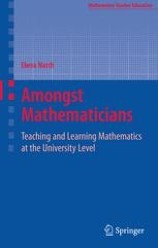
Amongst Mathematicians : Teaching and Learning Mathematics at University Level
Amongst Mathematicians offers a unique perspective on the ways in which mathematicians perceive their students' learning, teach and reflect on their teaching practice; also on how they perceive the often fragile relationship between the communities of mathematics and mathematics education.This book demonstrates the pedagogical potential that lies in collaborative undergraduate mathematics education research that engages mathematicians, researchers and students. Nardi also addresses the need for action in undergraduate mathematics education and offers a discourse for reform through demonstrating the feasibility and potential of collaboration between mathematicians and mathematics education researchers.
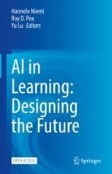
AI in learning : Designing the future
AI (artificial intelligence) is predicted to radically change teaching and learning in both schools and industry causing radical disruption of work. AI can support well-being initiatives and lifelong learning but educational institutions and companies need to take the changing technology into account. Moving towards AI supported by digital tools requires a dramatic shift in the concept of learning, expertise and the businesses built off of it. Based on the latest research on AI and how it is changing learning and education, this book will focus on the enormous opportunities to expand educational settings with AI for learning in and beyond the traditional classroom. This book also introduces ethical challenges related to learning and education, while connecting human learning and machine learning.

Academic Integrity in Canada : An Enduring and Essential Challenge
Firmly grounded in the scholarly literature globally, it engages with the experience of local practicioners. It presents aspects of academic integrity that is specific to Canada, such as the existence of an "honour culture", rather than relying on an "honour code". It also includes Indigenous voices and perspectives that challenge traditional understandings of intellectual property, as well as new understandings that have arisen as a consequence of Covid-19 and the significant shift to online and remote learning.
