



Page 3
Page 3
Hybrid Systems : Computation and Control ; 11th International Workshop, HSCC 2008, St. Louis, MO, USA, April 22-24, 2008. Proceedings
Contains the proceedings ofthe 11th Workshop on Hybrid Systems: Computation and Control (HSCC 2008) held in St. Louis, Missouriduring April 22–24,2008.The annual workshop on hybrid systems focuses on research inbedded ,reactive systems in volving theinterplay between symbolic/switchingand continuous dynamical behaviors. HSCC attracts academic as well as industrial researchers to exchange information on the latest developments of applications and theoretical advancements in the design, analysis, control, optimization, and implementation of hybrid systems, with particular attention to embedded and networked control systems. We would like to thank the Program Committee members and the reviewers for an excellent job of evaluating the submissions and participating in the online Program Committee discussions.

How AI Impacts Urban Living and Public Health ; 17th International Conference, ICOST 2019, New York City, NY, USA, October 14-16, 2019, Proceedings
This book cover topics such as: e-health technology design; well-being technology; biomedical and health informatics; and smart environment technology.

Holonic and multi-agent systems for manufacturing ; 3rd International Conference on industrial applications of holonic and multi-agent systems, HoloMAS 2007, Regensburg, Germany, September 3-5, 2007, Proceedings
The research of holonic and agent-based systems is developing rapidly, as is the community around this R&D topic. Despite the fact that real-life practical implementations of such systems remain surprisingly rare, the leaders in different branches of industry feel that the holonic and agent-based systems represent the only way to manage and control very complex, highly distributed systems in the future.

High performance computing in science and engineering 07 ; Transactions of the High Performance Computing Center, Stuttgart (HLRS) 2007
This book presents the state-of-the-art in simulation on supercomputers. Presenting results for both vector-based and microprocessor-based systems, the book allows comparison between performance levels and usability of various architectures.
High performance computing in science and engineering 04 ; Transactions of the High Performance Computing Center, Stuttgart (HLRS) 2004
This book presents the state-of-the-art in modelling and simulation on supercomputers. Leading German research groups present their results achieved on high-end systems of the High Performance Computing Center Stuttgart (HLRS) for the year 2004. The reports cover all fields of computational science and engineering ranging from computational fluid dynamics via computational physics and chemistry to computer science. Special emphasis is given to industrially relevant applications. Presenting results for both vector-systems and micro-processor based systems the book allows to compare performance levels and usability of a variety of supercomputer architectures. In the light of the success of the Japanese Earth-Simulator this book may serve as a guide book for a US response

High performance computing in science and engineering 05 ; Transactions of the High Performance Computing Center, Stuttgart (HLRS) 2005
This book presents the state-of-the-art in simulation on supercomputers. Leading researchers present results achieved on systems of the High Performance Computing Center Stuttgart (HLRS) for the year 2006. The reports cover all fields of computational science and engineering ranging from CFD via computational physics and chemistry to computer science with a special emphasis on industrially relevant applications. Presenting results for both vector-systems and micro-processor based systems the book allows to compare performance levels and usability of various architectures. As HLRS operates the largest NEC SX-8 vector system in the world this book gives an excellent insight into the potential of vector systems.

Haptics: Science, Technology, Applications ; 12th International Conference, EuroHaptics 2020, Leiden, The Netherlands, September 6–9, 2020, Proceedings
This book constitutes the proceedings of the 12th International Conference on Human Haptic Sensing and Touch Enabled Computer Applications, EuroHaptics 2020, held in Leiden, The Netherlands, in September 2020.

Haptic and Audio Interaction Design ; 1st International Workshop, HAID 2006, Glasgow, UK, August 31 - September 1, 2006, Proceedings
Overview The International Workshop on Haptic and Audio Interaction Design was - ganized as part of the EPSRC-funded MultiVis project. The main focus of the workshop was to investigate how the modalities of sound and haptics (touch) could be used together in interaction, and what novel interfaces could be p- vided when they are used in conjunction. What are the relative advantages of each of the modalities when used alone and together? Are there reasons why haptic-based information is moreuseful in certain situations than equivalent - dio information? How can di?erent modalities be used together to create c- pelling and useful interaction with computer-based systems?
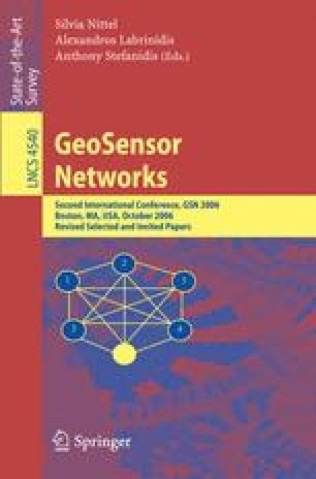
GeoSensor Networks : 2nd International Conference, GSN 2006, Boston, MA, USA, October 1-3, 2006, Revised Selected and Invited Papers
This book constitutes the thoroughly refereed proceedings of the Second GeoSensor Networks Conference, held in Boston, Massachusetts, USA, in October 2006. The conference addressed issues related to the collection, management, processing, analysis, and delivery of real-time geospatial data using distributed geosensor networks. This represents an evolution of the traditional static and centralized geocomputational paradigm.
Generative programming and component engineering ; 4th International conference, GPCE 2005, Tallinn, Estonia, September 29 - October 1, 2005, Proceedings
Generative Programming and Component Engineering (GPCE) is a leading - searchconferenceonautomaticprogrammingandcomponentengineering.These approaches to software engineering have the potential to revolutionize software development as automation and components revolutionized manufacturing. The conference brings together researchers and practitioners interested in adva- ing automation for software development. It is also a premier forum for cro- fertilization between the programming language and software engineering - search communities. GPCEaroseasajointconference, mergingthepriorconferenceonGenerative and Component-Based Software Engineering (GCSE) and the Workshop on - mantics, Applications, andImplementationofProgramGeneration(SAIG). The proceedingsofthepreviousGPCEconferenceswerepublishedintheLNCSseries of Springer as volumes2487,2830, and 3286.In 2005 GPCE wasco-locatedwith the International Conference on Functional Programming (ICFP) and the s- posium on Trends in Functional Programming (TFP), re?ecting the vigorous interaction between the functional programming and generative programming research communities. GPCE and ICFP are both sponsored by the Association for Computing Machinery. The quality and breadth of the papers submitted to GPCE 2005 was impr- sive. All 86 papers, including 5 papers for tool demonstrations, were rigorously reviewed by 17 highly quali?ed Program Committee members. The members of the Program Committee ?rst provided in-depth individual reviews of the s- mitted papers, and then debated the merits of the papers through an extended electronicProgramCommitteemeeting.After much(friendly) argument,25r- ular papers and 2 tool demonstration papers were selected for publication. The ProgramCommittee provided extensive technical feedback to the authors of the submittedpapers.Theconferenceprogramwascomplementedwiththreeinvited talks, three extended tutorials, and three all-day workshops.

Fuzzy-Neuro Approach to Agent Applications : From the AI Perspective to Modern Ontology
The book provides a full explanation of the concepts and theories of intelligent agents and agent-based systems. Providing a comprehensive theoretical background, the author covers modern artificial intelligence topics such as ontologies, neural networks, chaos theory, fuzzy logics and genetic algorithms. Finally, the author details how the iJADK toolkit (intelligent Java agent development kit for intelligent e-business applications) can be used in the design and implementation phases of real applications.

Fundamental approaches to software engineering ; 23rd International Conference, FASE 2020, Held as Part of the European Joint Conferences on Theory and Practice of Software, ETAPS 2020, Dublin, Ireland, April 25–30, 2020, Proceedings
This book constitutes the proceedings of the 23rd International Conference on Fundamental Approaches to Software Engineering, FASE 2020, which took place in Dublin, Ireland, in April 2020, and was held as Part of the European Joint Conferences on Theory and Practice of Software, ETAPS 2020. The 23 full papers, 1 tool paper and 6 testing competition papers presented in this volume were carefully reviewed and selected from 81 submissions.

Functional Biomaterials : Drug Delivery and Biomedical Applications
Explores in depth a wide range of functional biomaterials-based systems for drug, gene delivery, and biomedical aspects. The chapters cover newer technologies such as polymeric micelle, pH-responsive biomaterials, stimuli-responsive hydrogels, silk fibroin, inorganic biomaterials, synthetic biomaterials, 3D printed biomaterials, metallic biomaterials, ceramic and hybrid biomaterials. It also describes the theranostic approaches for cancer therapy, the biomaterials-based nanofibers scaffolds in tissue engineering, as well as the strategies applications of metallic biomaterials for the medical and dental prosthetic field.

From P2P to Web Services and Grids : Peers in a Client/Server World
Provides an overview of peer-to-peer (P2P) technologies that have revolutionized the way we think about distributed computing and the internet. This book compares these technologies to alternative solutions, most notably web services and Grid computing but also other technologies, such as client/server based systems and agent technologies.

Foundations of Multi-Paradigm Modelling for Cyber-Physical Systems
This book coherently gathers well-founded information on the fundamentals of and formalisms for modelling cyber-physical systems (CPS). Highlighting the cross-disciplinary nature of CPS modelling, it also serves as a bridge for anyone entering CPS from related areas of computer science or engineering.

Foundations of 3D Graphics Programming : Using JOGL and Java3D ; 2nd ed.
This thoroughly updated and enhanced second edition of Foundations of 3D Graphics Programming is an innovative shortcut to graphics theory and programming using JOGL, a new vehicle of 3D graphics programming in Java. This revised edition of the successful, reader-friendly text covers all graphics basics and several advanced topics, as well as some basic concepts in Java programming for those who currently are C/C++ programmers. Specifically, it provides all the core aspects of OpenGL programming in Java using JOGL, along with concisely presented computer graphics theories. In addition, it uses a top-down approach to lead the reader into programming and applications up-front. The content about theory provides a high-level understanding of all basic graphics, and of using JOGL instead of implementing a graphics system. Explanations are integrated with the sample programs, which are specifically designed for learning and accompanying this book.
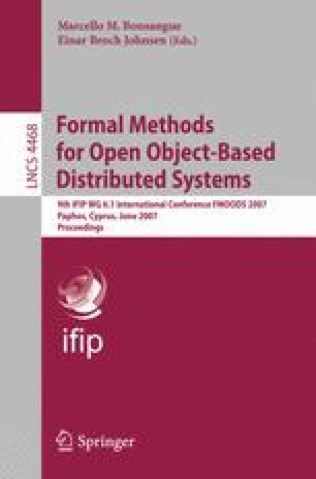
Formal Methods for Open Object-Based Distributed Systems ; 9th IFIP WG 6.1 International Conference, FMOODS 2007, Paphos, Cyprus, June 6-8, 2007, Proceedings
This book constitutes the refereed proceedings of the 9th IFIP WG 6.1 International Conference on Formal Methods for Open Object-Based Distributed Systems, FMOODS 2007, held in Paphos, Cyprus in June 2007. The papers are organized in topcical sections on model checking rewriting logic components and services algebraic calculi specification, verification and refinenment, and quality of service.

Formal Methods for Industrial Critical Systems ; 12th International Workshop, FMICS 2007, Berlin, Germany, July 1-2, 2007, Revised Selected Papers
This book constitutes the thoroughly refereed post-workshop proceedings of the 12th International Workshop on Formal Methods for Industrial Critical Systems, FMICS 2007, held in Berlin, Germany, in July 2007 - colocated with CAV 2007, the 19th International Conference on Computer Aided Verification.

Formal Methods for Computational Systems Biology ; 8th International School on Formal Methods for the Design of Computer, Communication, and Software Systems, SFM 2008 Bertinoro, Italy, June 2-7, 2008 Advanced Lectures
This volume presents the set of papers accompanying the lectures of the eighth International School on Formal Methods for the Design of Computer, Com- nication, and Software Systems (SFM). This series of schools addresses the use of formal methods in computer science asaprominent approach to theri gorousdesign of computer, communication, and software systems. The main aim of the SFM series is to ofer a good spectrum of current research in foundations as well as applications of formal methods, which can be of help for graduate students and young researchers who intend to approach the feld.

Formal Methods for Components and Objects ; Vol. 4111 ; 4th International Symposium, FMCO 2005, Amsterdam, The Netherlands, November 1-4, 2005, Revised Lectures
This book presents 19 revised invited keynote lectures and revised tutorial lectures given by top-researchers at the 4th International Symposium on Formal Methods for Components and Objects, FMCO 2005, held in Amsterdam, Netherlands, in November 2005. The book provides a unique combination of ideas on software engineering and formal methods that reflect the current interest in the application or development of formal methods for large scale software systems such as component-based systems and object systems.
