



Page 252
Page 252

Agent-oriented information systems IV ; 8th International bi-conference workshop, AOIS 2006, Hakodate, Japan, May 9, 2006 and Luxembourg, Luxembourg, June 6, 2006, Revised Selected Papers
In AOIS, we focus on the application of agent technology in information systems development and explore the potential for facilitating the increased usage of agent technology in the creation of information systems in the widest sense.
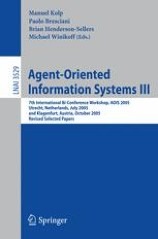
Agent-oriented information systems III ; 7th International bi-conference workshop, AOIS 2005, Utrecht, The Netherlands, July 26, 2005, and Klagenfurt, Austria, October 27, 2005, Revised Selected Papers
In 2005, two AOIS workshops were held internationally. The first was affiliated with the AAMAS 2005 meeting in July in Utrecht in The Netherlands and chaired by Henderson-Sellers and Winikoff and the second with ER 2005 in November in Klagenfurt in Austria and chaired by Kolp and Bresciani. The best papers from these meetings were identified and authors invited to revise and possibly extend their papers in the light of reviewers’ comments and feedback at the workshop. We have grouped these papers loosely under four headings: Agent behavior, communications and reasoning; Methodologies and ontologies; Agent-oriented software engineering; and Applications.

Agent-oriented information systems II ; 6th International bi-conference workshop, AOIS 2004, Riga, Latvia, June 8, 2004 and New York, NY, USA, July 20, 2004, revised selected papers
Information systems have become the backbone of all kinds of organizations - day. In almost every sector – manufacturing, education, health care, government and businesses large and small – information systems are relied upon for - eryday work, communication, information gathering and decision-making. Yet, the in?exibilities in current technologies and methods have also resulted in poor performance, incompatibilities and obstacles to change. As many organizations are reinventing themselves to meet the challenges of global competition and e-commerce, there is increasing pressure to develop and deploy new technologies that are ?exible, robust and responsive to rapid and unexpected change. Agent concepts hold great promise for responding to the new realities of - formation systems. They o?er higher-level abstractions and mechanisms which address issues such as knowledge representation and reasoning, communication, coordination, cooperation among heterogeneous and autonomous parties, p- ception, commitments, goals, beliefs, intentions, etc., all of which need conc- tual modelling. On the one hand, the concrete implementation of these concepts can lead to advanced functionalities.
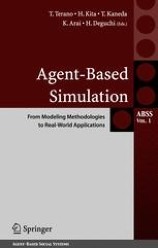
Agent-Based Simulation : From Modeling Methodologies to Real-World Applications; Post Proceedings of the Third International Workshop on Agent-Based Approaches in Economic and Social Complex Systems 2004
Agent-based modeling/simulation is an emerging field that uses bottom-up and experimental analysis in the social sciences. Selected research from that presented at the Third International Workshop on Agent-Based Approaches in Economic and Social Complex Systems 2004, held in May 2004 in Kyoto, Japan, is included in this book. The aim of the workshop was to employ the bottom-up approach to social and economic problems by modeling, simulation, and analysis using a software agent. This research area is an emerging interdisciplinary field among the social sciences and computer science, attracting broad attention because it introduces a simulation-based experimental approach to problems that are becoming increasingly complex in an era of globalization and innovation in information technology. The state-of-the-art research and findings presented in this book will be indispensable tools for anyone involved in this rapidly growing discipline.

Agent Technology from a Formal Perspective
The field of agent & multi-agent systems is experiencing tremendous growth. At the same time the field of formal methods is blossoming and has proven its importance in industrial and government applications. The FAABS (Formal Approaches to Agent-Based Systems) workshops, merging the concerns of the two fields, provided a timely and compelling platform on which the growing concerns and requirement of agent-based systems users that systems should be accompanied by behavioral assurances, could be discussed. This book has arisen from the overwhelming response to FAABS ’00, ’02 & ’04 and all chapters are updated or represent new research, and are designed to provide a more in-depth treatment of the topic. Examples of how others have applied formal methods to agent-based systems are included, plus formal method tools & techniques that readers can apply to their own systems.
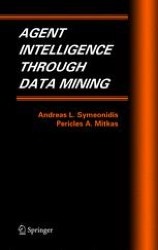
Agent Intelligence Through Data Mining
AGENT INTELLIGENCE THROUGH DATA MINING offers a self-contained overview of a relatively young but important area of research: the intersection of agent technology and data mining. This intersection leads to considerable advancements in the area of information technologies, drawing the increasing attention of both research and industrial communities. It can take two forms: a) the more mundane use of intelligent agents for improved data mining and; b) the use of data mining for smarter, more efficient agents. The second approach is the main focus of this volume. this book presents a methodology for developing multi-agent systems, describes available open-source tools to support this process, and demonstrates the application of the methodology on three different cases. AGENT INTELLIGENCE THROUGH DATA MINING is designed for a professional audience composed of researchers and practitioners in industry.

Agent Computing and Multi-Agent Systems ; 9th Pacific Rim International Workshop on Multi-Agents, PRIMA 2006, Guilin, China, August 7-8, 2006, Proceedings
PRIMA is a series of workshops on agent computing and multi-agent systems, integrating the activities in Asia and Pacific Rim countries. Agent computing and multi-agent systems are computational systems in which several autonomous or se- autonomous agents interact with each other or work together to perform some set of tasks or satisfy some set of goals. These systems may involve computational agents that are homogeneous or heterogeneous, they may involve activities on the part of agents having common or distinct goals, and they may involve participation on the part of humans and intelligent agents. The aim of PRIMA 2006 was to bring together Asian and Pacific Rim researchers and developers from academia and industry to report on the latest technical advances or domain applications and to discuss and explore scientific and practical problems as raised by the participants. PRIMA 2006 received 203 submitted papers.
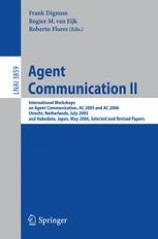
Agent Communication II ; International Workshops on Agent Communication, AC 2005 and AC 2006, Utrecht, Netherlands, July 25, 2005, and Hakodate, Japan, May 9, 2006, Selected and Revised Papers
Although everyone recognizes communication as a central concept in mul- agents, many no longer see agent communication as a research topic. Unf- tunately there seems to be a tendency to regard communication as a kind of information exchange that can easily be covered using the standard FIPA ACL. However, the papers in this volume show that research in agent communication is far from ?nished. If we want to develop the full potential of multi-agent s- tems, agent communication should also develop to a level beyond parameter or value passing as is done in OO approaches! In this book we present the latest collection of papers around the topic of agentcommunication.Thecollectioncomprisesofthebestpapersfromtheagent communication workshops of 2005 and 2006, enriched with a few revised agent communication papers from the AAMAS conference.
Agent communication ; International workshop on agent communication, AC 2004, New York, NY, July 19, 2004
In this book, we present a collection of papers around the topic of agent com- nication. The communication between agents has been one of the major topics of research in multiagent systems. The current work can therefore build on a number of previous Workshops of which the proceedings have been published in earlier volumes in this series. The basis of this collection is formed by the accepted submissions of the Workshop on Agent Communication held in c- junction with the AAMAS Conference in July 2004 in New York. the current collection comprises a very good and quite complete overview of the state of the art in this area of research and gives a good indication of the topics that are of major interest at the moment. The papers can roughly be divided over the following ?ve themes: – social commitments – multiparty communication – content languages – dialogues and conversations – speech acts Although these themes are of course not mutually exclusive they indicate some main directions of research. We therefore have arranged the papers in the book according to the topics indicated above.

Agent and Multi-Agent Systems : Technologies and Applications ; 2nd KES International Symposium, KES-AMSTA 2008, Incheon, Korea, March 26-28, 2008. Proceedings
The KES-AMSTA Symposium Series is a sub-series of the KES Conference Series. The aim of the symposium was to provide an international forum for scientific research into the technologies and applications of agent and multi-agent systems.

Agent and multi-agent systems : Technologies and applications ; 1st KES International Symposium, KES-AMSTA 2007, Wroclaw, Poland, May 31-June 1, 2007, Proceedings
The aim of the symposium was to provide an international forum for scientific - search in the technologies and applications of agent and multi-agent systems. Agents and multi-agent systems are related to the modern software which has long been r- ognized as a promising technology for constructing autonomous, complex and intel- gent systems. A key development in the field of agent and multi-agent systems has been the specification of agent communication languages and formalization of - tologies. Agent communication languages are intended to provide standard decla- tive mechanisms for agents to communicate knowledge and make requests of each other, whereas ontologies are intended for conceptualization of the knowledge - main.

After Taste : Expanded Practice in Interior Design
Comprising texts, interviews and portfolios that collectively document new theories and emerging critical practices in the field of interior design. The material is informed by, but not limited to, the annual AfterTaste symposia hosted by Parsons The New School of Design. The book s central argument is that the field of interior design is inadequately served by its historical reliance on taste-making and taste-makers, and, more recently from a set of theoretical concerns derived from architecture; the volume seeks to set an expanded frame by advancing new voices and perspectives in both the theory and practice of interior design, considered as an independent discipline. In 2007, the Department of Architecture, Interior Design and Lighting at Parsons The New School for Design inaugurated an annual international symposium series dedicated to the critical study of the interior.

After Bourdieu : Influence, Critique, Elaboration
Intellectual origins & orientations We begin by providing an overview of Bourdieu’s life as a scholar and a public intellectual. The numerous obituaries and memorial tributes that have appeared following Bourdieu’s untimely death have revealed something of his life and career, but few have stressed the intersection of his social origins, career trajectory, and public intellectual life with the changing political and social context of France. This is precisely what David Swartz’s “In memoriam” attempts to accomplish. In it he emphasizes the coincidence of Bourdieu’s young and later adulthood with the period of decolonization, the May 1968 French university crisis, the opening up of France to privatization of many domains previously entrusted to the state (l’état providence), and, most threatening to post-World War II reforms, the emergence of globalization as the hegemonic structure of the 21st century.

African Land Reform Under Economic Liberalisation: States, Chiefs, and Rural Communities
This book offers unique in-depth, comprehensive, and comparative analyses of the motivations, context, and outcomes of recent land reforms in Africa. Whereas a considerable number of land reforms have been carried out by African governments since the 1990s, no systematic analysis on their meaning has so far been conducted. In the age of land reform, Africa has seen drastic rural changes. Analysing the relationship between those reforms and change, the chapters in this book reveal not only their socio-economic outcomes, such as accelerated marketisation of land, but also their political outcomes, which have often been contrasting.

African Biodiversity : molecules, organisms, ecosystems
BIOTA is an interdisciplinary research project focusing on sustainable use and conservation of biodiversity in Africa (http://www.biote-africa.de). Session titles were Biogeography and Speciation Processes, Phylogenetic Patterns and Systematics, Diversity Declines and Conservation, and Applied Biodiversity Informatics
Affirmative aesthetics and wilful women : Gender, space and wobility in contemporary cinema
Adopts a fluid approach to space designed to accommodate wilful, affirmative, and imaginative perspectives of gender on screen.

Affective computing and intelligent interaction ; 1st international conference, ACII 2005, Beijing, China, October 22-24, 2005, Proceedings
Traditionally, the machine end of human–machine interaction has been very passive, and certainly has had no means of recognizing or expressing a?ective information. But without the ability to process such information, computers cannot be expected to communicate with humans in a natural way. The ability to recognize and express a?ect is one of the most important features of - man beings. We therefore expect that computers will eventually have to have the ability to process a?ect and to interact with human users in ways that are similar to those in which humans interact with each other. A?ective computing and intelligent interaction is a key emerging technology that focuses on m- iad aspects of the recognition, understanding, and expression of a?ective and emotional states by computers.
Aesthetic Surgery of the Facial Mosaic
This authoritative reference book assembles the experience of an international faculty of authors, each of whom has performed several thousand facelifts, i.e. procedures to rejuvenate and harmonize the human face. All procedures in this regard are covered and the text is accompanied by extensive artwork and photographs. The authors share their experience, including tips and tricks, as well as ways to avoid complications and pitfalls. Special emphasis is given to the concept of looking at the face as a mosaic, i.e. treating its individual parts in a harmonic way and maintaining mimic units. Combining different methods.

Aesthetic Surgery of the Abdominal Wall
We have come a long way since the days when abdominal wall contouring was p- formed by simple dermolipectomies, with no attention to diastasis correction and muscular reinforcement, and little regard for the final aesthetic result. Nowadays, an abdominoplasty may be indicated for even the most demanding of patients. Details such as placement of the incision and umbilicoplasty are meticulously planned so as to conceal undesirable scars. Since the advent of suction-assisted lipectomy, in as- ciation with a classical operation or as an isolated procedure, the plastic surgeon has become capable of remodeling the entire trunk, assuring removal of considerable amounts of adipose tissue.
Advertising in contemporary consumer culture
This is the first scholarly book dedicated to reading the work of contemporary filmmakers and their impact on modern marketing and advertising. Drawing from consumer culture theory, film and media studies, the author presents an expansive analysis of a range of renowned filmmakers who have successfully applied their aesthetic and narrative vision to commercial advertising. It challenges some traditional advertising tropes and sheds light on the changing nature of advertising in the contemporary media context. Utilising Deleuze and Guattari’s notion of assemblage, This book addresses themes of spatiality and time, narrative and aesthetics and consumer reception within a new frame of reference that re-contextualises classical concepts of genre, platform and aesthetic categories. These diverse elements are embedded into a larger discussion of the resonance of contemporary advertising for consumer culture and the implications of the hybridity characteristic of convergent media platforms for understanding the potential of advertising in the twenty-first century.
