



Page 250
Page 250

Experimental Algorithms ; 7th International Workshop, WEA 2008 Provincetown, MA, USA, May 30-June 1, 2008 Proceedings
The Workshop on Experimental Algorithms, WEA, is intended to be an international forum for research on the experimental evaluation and engineering of algorithms, as well as in various aspects of computational optimization and its applications. The emphasis of the workshop is the use of experimental me- ods to guide the design, analysis, implementation, and evaluation of algorithms, heuristics, and optimization programs. WEA 2008 was held at the Provincetown Inn, Provincetown, MA, USA, on May 30 – June 1, 2008. This was the seventh workshop of the series.

Experimental Algorithms ; 6th International Workshop, WEA 2007, Rome, Italy, June 6-8, 2007, Proceedings
Fostering and disseminating high quality research results focused on the experimental analysis of algorithms the papers are devoted to the design, analysis, implementation, experimental evaluation, and engineering of efficient algorithms. Among the application areas addressed are most fields applying advanced algorithmic techniques, such as combinatorial optimization, approximation, graph theory, discrete mathematics, data mining, simulation, cryptography and security, scheduling, searching, sorting, string matching, coding, networking, etc.

Experimental Algorithms ; 5th International Workshop, WEA 2006, Cala Galdana, Menorca, Spain, May 24-27, 2006, Proceedings
This book constitutes the refereed proceedings of the 5th International Workshop on Experimental and Efficient Algorithms, WEA 2006, held in Cala Galdana, Menorca, Spain in May 2006. The 26 revised full papers presented together with 3 invited talks were carefully reviewed and selected from 92 submissions. The book is devoted to the design, analysis, implementation, experimental evaluation, and engineering of efficient algorithms. Among the application areas addressed are most fields applying advanced algorithmic techniques.

Experiment Design for Civil Engineering : Methods and Examples
Fills in the gap in ABET requirements to teach experiment design. Provides a standardized approach to experiment design that can work for any experiment. Includes completed experiment designs suitable for college laboratory and professional applications. Shows how to organize experimental data as it is collected to optimize usefulness. Provides templates for design of the experiment and for presenting the resulting data to technical and nontechnical audiences or clients.

Experiment and Natural Philosophy in Seventeenth-Century Tuscany : The History of the Accademia del Cimento
This work is to counter historiographies that search for the origins of modern science within the experimental practices of Europe’s first scientific institutions, such as the Cimento. It proposes that we should look beyond the experimental rhetoric found in published works, to find that the Cimento academicians were participants in a culture of natural philosophical theorising that existed throughout Europe.

Experience-Based Communication
Experience-based Communication is a powerful tool. Companies can use it to bring their values to life and to make their messages accessible and credible. By communicating in a way that can be both sensed and felt, companies can increase their influence on internal and external stakeholders - and existing and potential customers. This book teaches you how to architect the way your company is experienced at every real-life touchpoint. How to use physical meetings and locations to create an affinity with a given market segment. And how to engage your audience mentally, physically and socially in order to transform them into loyal customers and willing ambassadors.

Expanding Horizons in Bioethics
What are the resources and needs, the strengths and the vulnerabilities of patients, of society, or of nature? How do we evaluate the societal potential of scientific discovery? It is fairly well assured that we are influencing the terms of existence of many inhabitants of this planet, from flora to fauna to humans. Moreover, history has shown that while technologies can be used neutrally, they can be (and have been) used to the great benefit – or the great detriment – of human life and the fate of the world as a whole. How various types of knowledge and technological ability will be deployed is up to us, individually and collectively. How such information and ability should be deployed, and for what reasons, are questions at the core of bioethical inquiry. These are the "expanding horizons in bioethics" to which this volume refers. This volume is comprised of fourteen essays. It is a rare gathering of scholarly opinion, featuring well-known experts from a diversity of disciplines. The topics addressed are of immediate concern to the public. The essays ask questions about human nature, genetic technologies, reproductive rights, human subjects research, and environmental issues – all in provocative and challenging new ways. Yet the themes that emerge throughout the volume are of enduring interest to anyone concerned about the interactions of scientific development, ethics, and society. This volume is of interest to students and teachers of bioethics and related topics, as well as to professionals working in these disciplines.

Exosomes based drug delivery strategies for brain disorders
Provides a comprehensive overview of the role of exosomes in brain diseases, including stroke, multiple sclerosis, Parkinson's disease, Alzheimer's disease, epilepsy, and depression. It covers the basics of exosome biogenesis, composition, and synthesis, as well as the therapeutic potential of exosomes in brain disorders. The correlation between exosomes and neuroinflammation, the challenges of using exosomes as a novel carrier, and engineered exosomes to deliver therapeutic protein are covered well in this book. Use of radiolabelled exosomes as a diagnostic tool and the toxicity studies of exosomes with potential overcome approaches. It is an essential resource for researchers, clinicians, and healthcare professionals working in the field of exosome research, especially on its applications in brain disorders.

Exoplanets : Detection, Formation, Properties, Habitability
This edited, multi-author volume will be an invaluable introduction and reference to all key aspects in the field of exoplanet research. The reviews cover: Detection methods and properties of known exoplanets, Detection of extrasolar planets by gravitational microlensing. The formation and evolution of terrestrial planets in protoplanetary and debris disks. The brown dwarf-exoplanet connection. Formation, migration mechanisms and properties of hot Jupiters. Dynamics of multiple exoplanet systems. Doppler exoplanet surveys. Searching for exoplanets in the stellar graveyard. Formation and habitability of extra solar planets in multiple star systems. Exoplanet habitats and the possibilities for life. Moons of exoplanets: habitats for life.

Exogenous and endogenous factors affecting happiness, happy mind, happy life
Emotions are the language of the soul. Our brain is the emotional center where every emotion is produced including happiness. Happiness underlying factors are considerable from two dimensions: endogenous factors and exogenous factors Therefore, this research aimed to consider biological factors that underlie happiness. The research is divided into several sub-groups (brain, genetics, neurotransmitters, endocrinology, hormones, drugs, diseases, and other exogenous factors). In spite of difficulties in finding special genes, several genes distributed to emotion and mood. Neuroscience studies showed that some part of brain (e.g. amygdala, hipocamp and limbic system) and neurotransmitters (e.g. dopamine, serotonin, norepinefrine and endorphin) play a role in control of happiness. A few studies pointed to the role of cortisol and adrenaline (adrenal gland) and oxitocin (pituitary gland) in controlling happiness.

Exit-architecture design between war and peace : With a foreword by Heiner Mühlmann and a project by Exit Ltd.
A oeFirst we shape things, then they shape usa, was Churchilla (TM)s view. What kind of architecture can be said to shape? Who does it shape? And by what means does it shape? The authora (TM)s answers to these questions are a surprise. Through war and proximity to stress. After a tour da (TM)horizon through Roman temples, Washingtona (TM)s corridors of power and Meccaa (TM)s anti-panic architecture it becomes clear that architecture is anything but in the background. Instead it is situated in the hot spot of transmission dynamics and is capable of altering cultures, empires and even religions.
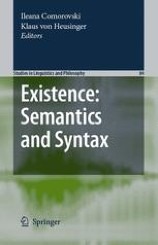
Existence: Semantics and Syntax
This collection is an important contribution to the semantic and syntactic analysis of the expression of existence. The volume focuses on the three main linguistic constructions expressing existence: copular clauses, existential sentences, and (in)definiteness. The papers analyze the interaction between the basic notion of existence and pervasive phenomena of natural language, such as quantification and presupposition. The contributions represent state of the art research on theoretical and comparative issues related to the expression of existence, and make extensive reference to the semantic and syntactic facts of English and of various other languages. The richness of new data and the juxtaposition of different theoretical stances bring a number of new questions into focus.

Existence and Regularity Properties of the Integrated Density of States of Random Schrödinger Operators
The theory of random Schrödinger operators is devoted to the mathematical analysis of quantum mechanical Hamiltonians modeling disordered solids. Apart from its importance in physics, it is a multifaceted subject in its own right, drawing on ideas and methods from various mathematical disciplines like functional analysis, selfadjoint operators, PDE, stochastic processes and multiscale methods. The present text describes in detail a quantity encoding spectral features of random operators: the integrated density of states or spectral distribution function. Various approaches to the construction of the integrated density of states and the proof of its regularity properties are presented.

Exhibition Design : An Introduction ; 2nd ed.
Offers a thorough grounding in the principles of designing for exhibitions. It describesthe skills needed to become an exhibition designer, including: Developing a brief and working with clients Design principles for graphics, circulation, lighting, and accessibility Presenting ideas to clients The practicalities of productionVisual material includes photographs of completed exhibitions by world-renowned designers, concept drawings, computer renderings, charts, and tables of informationall for a wide range of exhibitions around the world, permanent and temporary, including museums and galleries, visitor centers, brand experiences, festivals, and trade fairs. The book will inform and inspire, as well as equip students and new exhibition designers with a valuable guide to the profession

Exercises in Modules and Rings
This Problem Book offers a compendium of 639 exercises of varying degrees of difficulty in the subject of modules and rings at the graduate level. The material covered includes projective, injective, and flat modules, homological and uniform dimensions, noncommutative localizations and Goldie’s theorems, maximal rings of quotients, Frobenius and quasi-Frobenius rings, as well as Morita’s classical theory of category dualities and equivalences. Each of the nineteen sections begins with an introduction giving the general background and the theoretical basis for the problems that follow. All exercises are solved in full detail; many are accompanied by pertinent historical and bibliographical information, or a commentary on possible improvements, generalizations, and latent connections to other problems.

Exercises in Environmental Physics
Exercises in Environmental Physics covers the essential topics in university courses in environmental physics including: Energy and the environment / Fluid mechanics / Evapotranspiration, soil physics and groundwater hydrology / Pollution / Ocean and atmospheric physics / The planet in space This is the first book specifically devoted to exercises on the application of physics to describe the environment including the human impact. It is a valuable tool for students to develop skills in the manipulation of physical concepts and methods while learning environmental science. The exercises are drawn from the author's teaching experience and the need for stimulating practice problems in various environmental physics courses. A chapter on mathematical methods used in the book supplements the material.

Exercises in Architecture : Learning to Think as an Architect
It involves awakening abilities that remain dormant in most people. It is like learning language for the first time; a task made more mystifying by the fact that architecture deals not in words but in places: places to stand, to walk, to sit, to hide, to sleep, to cook, to eat, to work, to play, to worship… Written for those who want to be architects. It suggests a basis for early experiences in a school of architecture; but it could also be used in secondary schools and colleges, or as self-directed preparation for students in the months before entering professional education.

Exercise-induced acute renal failure : Acute renal failure with severe loin pain and Patchy renal Ischemia after anaerobic exercise
Acute renal failure induced by rhabdomyolysis after strenuous, prolonged exercise such as marathon running or mountain climbing is a well-known medical phenomenon, but exercise-induced acute renal failure after short-term anaerobic exercise - for instance, short-distance track races - has been recognized only recently. This monograph provides in-depth information on exercise-induced acute renal failure after short-term anaerobic exercise, which causes severe pain in the loin and patchy renal ischemia with no sign of rhabdomyolysis. Half of the patients suffering from this condition experience renal hypouricemia, for which approximately 20% are treated with dialysis. This book includes characteristics of the disease, diagnosis, treatment and prognosis, and corresponding preventive measures. Important information on gene analysis and etiology is also included, creating a valuable resource for nephrologists as well as for emergency physicians and those in the field of sports medicine.

Executing magic in the modern era : Criminal bodies and the Gallows in popular medicine
This book explores the magical and medical history of executions from the eighteenth to the early twentieth century by looking at the afterlife potency of criminal corpses, the healing activities of the executioner, and the magic of the gallows site. The use of corpses in medicine and magic has been recorded back into antiquity. The lacerated bodies of Roman gladiators were used as a source of curative blood, for instance. In early modern Europe, a great trade opened up in ancient Egyptian mummies and the fat of executed criminals, plundered as medicinal cure-alls. However, this is the first book to consider the demand for the blood of the executed, the desire for human fat, the resort to the hanged man’s hand, and the trade in hanging rope in the modern era. It ends by look at the spiritual afterlife of dead criminals.

Excimer Laser Technology
This comprehensive survey on Excimer Lasers investigates the current range of the technology, applications and devices of this commonly used laser source, as well as the future of new technologies, such as F2 laser technology. Additional chapters on optics, devices and laser systems complete this compact handbook. A must read for laser technology students, process application researchers, engineers or anyone interested in excimer laser technology. An effective and understandable introduction to the current and future status of excimer laser technology.
