



Page 25
Page 25

Modeling and computations in electromagnetics ; A volume dedicated to Jean-Claude Nédélec
Modeling and computations in electromagnetics is a quite novel and growing discipline, expanding as a result of the steadily increasing demand for designing electrical devices, modeling electromagnetic materials, and simulating electromagnetic fields in nanoscale structures. The aim of this volume is to bring together prominent worldwide experts to review state-of-the-art developments and future trends of modeling and computations in electromagnetics. This volume is devoted to merging the expertise of scientists working in this dynamic discipline, and to raising interest for challenging issues. The most significant advances in computational techniques have been made only in the last few years, and several challenging technological applications are presented in this volume.
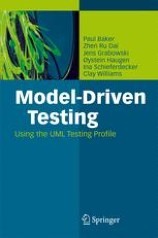
Model-Driven Testing : Using the UML Testing Profile
Written by the original members of this standardization group, this book shows you how to use UML to test complex software systems. The authors introduce UTP step-by-step, using a case study that illustrates how UTP can be used for test modeling and test specification. You’ll learn how UTP concepts can be used for functional and non-functional testing, with example applications and best practices for user-interfaces and service oriented architectures. In addition, the authors demonstrate how to apply UTP using frameworks like TTCN-3 and the JUnit test framework for Java.

Model-Driven Architecture - Foundations and Applications ; 2nd European Conference, ECMDA-FA 2006, Bilbao, Spain, July 10-13, 2006, Proceedings
The goal of the European Conference on Model-Driven Architecture — Foundations and Applications (ECMDA-FA) is to bring together industry and academia to tackle the problems in model-driven development. This volume includes 18 foundation papers and 12 application papers, which is a fine balance between both worlds. ECMDA-FA 2006 also hosted six workshops on both theoretical and practical aspects of MDA. Furthermore, the keynote speakers, David Frankel and Bran Selic, from some of the world’s largest IT companies proved that industry is very much involved in MDA. This second ECMDA-FA conference is the result of the work of the authors who submitted a total of 78 papers, the Program Committee members who took the effort to review the papers, the people organizing the workshops, and of course the Steering Committee. All in all, several hundreds of people have worked hard to make this conference a success.

Model-Based Testing of Reactive Systems : Advanced Lectures
This book is based on a seminar held in Dagstuhl Castle, Germany, in January 2004. It presents 19 carefully reviewed and revised lectures given at the seminar in a well-balanced way ensuring competent complementary coverage of all relevant aspects. An appendix provides a glossary for model-based testing and basics on finite state machines and on labelled transition systems. The lectures are presented in topical sections on testing of finite state machines, testing of labelled transition systems, model-based test case generation, tools and case studies, standardized test notation and execution architectures, and beyond testing.

Model-based Geostatistics
Geostatistics is concerned with estimation and prediction problems for spatially continuous phenomena, using data obtained at a limited number of spatial locations. The name reflects its origins in mineral exploration, but the methods are now used in a wide range of settings including public health and the physical and environmental sciences. Model-based geostatistics refers to the application of general statistical principles of modeling and inference to geostatistical problems. This volume is the first book-length treatment of model-based geostatistics. The authors have written an expository text, emphasizing statistical methods and applications rather than the underlying mathematical theory. Analyses of datasets from a range of scientific contexts feature prominently, and simulations are used to illustrate theoretical results. Readers can reproduce most of the computational results in the book by using the authors' R-based software package, geoR, whose usage is illustrated in a computation section at the end of each chapter.
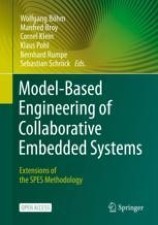
Model-Based Engineering of Collaborative Embedded Systems : Extensions of the SPES Methodology
This book presents the results of the "Collaborative Embedded Systems" (CrESt) project, aimed at adapting and complementing the methodology underlying modeling techniques developed to cope with the challenges of the dynamic structures of collaborative embedded systems (CESs) based on the SPES development methodology.

Model tests and numerical simulations of liquefaction and lateral spreading ; LEAP-UCD-2017
This book presents work collected through the Liquefaction Experiments and Analysis Projects (LEAP) in 2017. It addresses the repeatability, variability, and sensitivity of lateral spreading observed in twenty-four centrifuge model tests on mildly sloping liquefiable sand.

Model Reduction and Coarse-Graining Approaches for Multiscale Phenomena
Model reduction and coarse-graining are important in many areas of science and engineering. How does a system with many degrees of freedom become one with fewer? How can a reversible micro-description be adapted to the dissipative macroscopic model? These crucial questions, as well as many other related problems, are discussed in this book. Specific areas of study include dynamical systems, non-equilibrium statistical mechanics, kinetic theory, hydrodynamics and mechanics of continuous media, (bio)chemical kinetics, nonlinear dynamics, nonlinear control, nonlinear estimation, and particulate systems from various branches of engineering. The generic nature and the power of the pertinent conceptual, analytical and computational frameworks helps eliminate some of the traditional language barriers, which often unnecessarily impede scientific progress and the interaction of researchers between disciplines such as physics, chemistry, biology, applied mathematics and engineering. All contributions are authored by experts, whose specialities span a wide range of fields within science and engineering.

Model Driven Engineering Languages and Systems ; 11th International Conference, MoDELS 2008, Toulouse, France, September 28 - October 3, 2008. Proceedings
The book also contains three keynote speeches and contributions to workshops, symposia, tutorials and panels at the conference. The papers are organized in topical sections on Model Transformation: Foundations; Requirements Modeling; Domain-Specific Modeling; Model Transformation: Techniques, Composition and Analysis of Behavioral Models; Model Comprehension; Model Management; Behavioral Conformance and Refinement; Metamodeling and Modularity; Constraints; Model Analysis; Service-Oriented Architectures; Adaptive and Autonomic Systems; Empirical Studies; Evolution and Reverse Engineering; Modeling Language Semantics; Dependability Analysis and Testing; Aspect-Oriented Modeling; Structural Modeling;and Embedded Systems.
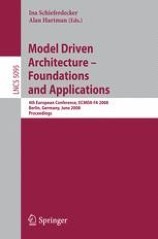
Model Driven Architecture - Foundations and Applications ; 4th European Conference, ECMDA-FA 2008, Berlin, Germany, June 9-13, 2008. Proceedings
The 31 revised full papers presented - 21 research papers and 10 industry papers - were carefully reviewed and selected from 87 submissions. The papers address all current issues of model-driven architecture, i.e. model management, executable models, concrete syntaxes, aspects, and concerns, validation and testing, model-based systems engineering, model-driven development and service-oriented architectures, and the application of model-driven development. The papers are organized in topical sections on model management, executable models, concrete syntaxes, aspects and concerns, validation and testing, model-based systems engineering, model-driven development and service-oriented architectures, as well as surveys on applying model-driven development.

Model Checking Software ; Vol. 3925 ; 13th International SPIN Workshop, Vienna, Austria, March 30 - April 1, 2006, Proceedings
he name “SPIN” refers both to a workshopon model checking and to a famous model checking tool. The SPIN workshop is an annual forum for practitioners and researchersinterested in state space-based techniques for the validation and analysis of software and hardware systems, including communication protocols. It focuses on techniques based on explicit representations of state spaces, as implemented in the SPIN model checker or other tools, and techniques based on a combination of explicit representations with other representations. The SPIN model checker has proven to be particularly suited for the analysis of concurrent asynchronous systems. The workshop aims to encourage interaction and exchange of ideas with all related areas in software engineering.
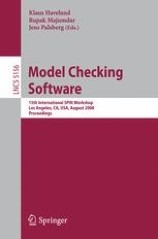
Model Checking Software ; 15th International SPIN Workshop, Los Angeles, CA, USA, August 10-12, 2008 Proceedings
This book constitutes the refereed proceedings of the 15th International SPIN workshop on Model Checking Software, SPIN 2008, held in Los Angeles, CA, USA, in August 2008.The 17 revised full papers presented together with 1 tool paper and 4 invited talks were carefully reviewed and selected from 41 submissions. The main focus of the workshop series is software systems, including models and programs. The papers cover theoretical and algorithmic foundations as well as tools for software model checking and foster interactions and exchanges of ideas with related areas in software engineering, such as static analysis, dynamic analysis, and testing.

Model Based Learning and Instruction in Science
This book describes new, model based teaching methods for science instruction. It presents research that describes these new methods in a very diverse group of settings: middle school biology, high school physics, and college chemistry classrooms. Mental models in these areas such as understanding the structure of the lungs or cells, molecular structures and reaction mechanisms in chemistry, or causes of current flow in electricity are notoriously difficult for many students to learn. Yet these lie at the core of conceptual understanding in these areas. The studies focus on a variety of teaching strategies such as discrepant questioning, analogies, animations, model competition, and hands on activities.

Model Based Inference in the Life Sciences : A Primer on Evidence
The abstract concept of "information" can be quantified and this has led to many important advances in the analysis of data in the empirical sciences. This text focuses on a science philosophy based on "multiple working hypotheses" and statistical models to represent them. The fundamental science question relates to the empirical evidence for hypotheses in this set—a formal strength of evidence. Kullback-Leibler information is the information lost when a model is used to approximate full reality. Hirotugu Akaike found a link between K-L information (a cornerstone of information theory) and the maximized log-likelihood (a cornerstone of mathematical statistics). This combination has become the basis for a new paradigm in model based inference. The text advocates formal inference from all the hypotheses/models in the a priori set—multimodel inference.

Modal Array Signal Processing : Principles and Applications of Acoustic Wavefield Decomposition
Many applications of acoustic signal processing, such as teleconferencing and surveillance systems, require an estimate of several parameters present in the observed acoustic wavefield. The most important parameters are the number as well as the location of active acoustic sources. This book deals with the problem of detecting and localizing multiple simultaneously active wideband acoustic sources by applying the notion of wavefield decomposition using circular and spherical microphone arrays. The decomposed wavefield representation is used to serve as a basis for so-called modal array signal processing algorithms, which have the significant advantage over classical array signal processing algorithms that they inherently support multiple wideband acoustic sources. A rigorous derivation of modal array signal processing algorithms for unambiguous source detection and localization as well as performance evaluations by means of measurements using an actual real-time capable implementation are discussed.

Modafinil as a drug to raise mental and cognitive abilities
Investigates the scientific foundation of Modafinil’s cognitive effects, examining its pharmacodynamics, pharmacokinetics, and clinical applications. Furthermore, it explores the drug’s comparative advantages over natural cognitive enhancers, its side effect profile, patterns of use, and broader societal impact. By offering a comprehensive overview, this study aims to contribute to a better understanding of Modafinil as a modern cognitive enhancer in both medical and non-medical contexts.
mODa 8 - Advances in Model-Oriented Design and Analysis ; Proceedings of the 8th International Workshop in Model-Oriented Design and Analysis held in Almagro, Spain, June 4–8, 2007
The volume contains the proceedings of the 8th Workshop on Model-Oriented Design and Analysis. This book offers leading and pioneering work on optimal experimental designs, both from a mathematical/statistical point of view and with regard to real applications. Scientists from all over the world, from Eastern and Western Europe, the USA, Latin-America, Asia and Africa, have contributed to this volume. Primary topics are designs for nonlinear models and applications to experimental medicine.

Mobilizing Adults for Positive Youth Development : Strategies for Closing the Gap between Beliefs and Behaviors
"In today's fast-paced, often-dehumanizing world, increasing positive adult involvement and influence is particularly vital. To further that goal, Mobilizing Adults for Positive Youth Development: Strategies for Closing the Gap between Beliefs and Behaviors brings together, in one concise volume, the advice and expertise of leading scholars dedicated to affecting positive youth development. Taken together, the chapters in this book provide a multifaceted, multidisciplinary blueprint for social change." "Mobilizing Adults for Positive Youth Development: Strategies for Closing the Gap between Beliefs and Behaviors is a must-have volume for both practitioners and researchers - in fact, for anyone interested and involved in working toward achieving positive youth development.

Mobility, data mining and privacy : Geographic knowledge discovery
This book assesses this research frontier from a computer science perspective, investigating the various scientific and technological issues, open problems, and roadmap. The editors manage a research project called GeoPKDD, Geographic Privacy-Aware Knowledge Discovery and Delivery, funded by the EU Commission and involving 40 researchers from 7 countries, and this book tightly integrates and relates their findings in 13 chapters covering all related subjects, including the concepts of movement data and knowledge discovery from movement data; privacy-aware geographic knowledge discovery; wireless network and next-generation mobile technologies; trajectory data models, systems and warehouses; privacy and security aspects of technologies and related regulations; querying, mining and reasoning on spatiotemporal data; and visual analytics methods for movement data.

Mobilities of the Highly Skilled towards Switzerland : The Role of Intermediaries in Defining “Wanted Immigrants”
This book analyses the strategies of migration intermediaries from the public and private sectors in Switzerland to select, attract, and retain highly skilled migrants who represent value to them. It reveals how state and economic actors define “wanted immigrants” and provide them with privileged access to the Swiss territory and labour market. This book thus shifts the focus from an approach that takes the category of highly skilled migrant for granted to one that regards context as crucial for structuring migrants’ characteristics, trajectories, and experiences. Beyond consideration of professional qualifications, the ways decision-makers perceive candidates and shape their resource environments are crucial for constructing them as skilled or unskilled, wanted or unwanted, welcome or unwelcome.
