



Page 23
Page 23

Constraint Theory : Multidimensional Mathematical Model Management
The enormous potential of digital computation to manage new complex systems is impeded by exponential increases in complexity. As the model's dimensionality increases from hundreds to thousands of variables, and as submodels constructed by diverse technical teams are integrated into the total model, the model is likely to become inconsistent and even more likely, the computational requests on the model become unallowable. This text analyzes the way constraint theory employs bipartite graphs and constraint matrices to detect and correct these well-posed problems. It also presents the process of locating the "kernel of constraint", literally trillions of times faster than a random search, determining consistency and compatibility within seconds.

Congruency, Expectations and Consumer Behavior in Digital Environments
A progress in technologies, the increasing expansion and use of digital environments lead to remarkable shifts of business activities. These transformations not only impact business but also affect consumers’ attitudes, beliefs, and practices. Thus, Frederic Nimmermann sheds light on consumer behavior in central subareas in digital environments such as advertising.

Conceptual Modeling for Traditional and Spatio-Temporal Applications : The MADS Approach
This book shows that a conceptual design approach for spatio-temporal databases is both feasible and easy to apprehend. While providing a firm basis through extensive discussion of traditional data modeling concepts, the major focus of the book is on modeling spatial and temporal information. Parent, Spaccapietra and Zimányi provide a detailed and comprehensive description of an approach that fills the gap between application conceptual requirements and system capabilities, covering both data modeling and data manipulation features.

Conceptual Landscapes : Fundamentals in the Beginning Design Process
Explores the dilemma faced in the early moments of design thinking through a gradient of work in landscape and environmental design media by both emerging and well-established designers and educators of landscape architecture. It questions where and, more importantly, how the process of design starts. Deconstructs the steps of conceptualizing design in order to reignite pedagogical discussions about timing and design fundamentals, and to reveal how the spark of an idea happens – from a range of unique perspectives. Through a careful arrangement of visual essays that integrate analog, digital, and mixed-media works and processes, the book highlights differences between diverse techniques and triggers debate between design, representation, technology, and creative culture in the field.

Computer-Aided Highway Engineering
Aimed at developing professional knowledge in the field of highway engineering with adequate skills in planning, designing and implementation of the highway project with an exposure of hands on training of computer software in designing the worldwide road infrastructures. It discusses Digital Terrain Model (DTM) using satellite data including highway geometric, pavement and tunnel design, supported by relevant tutorials. Quantity estimation, cost estimation and production of various types of construction drawings are described in detail with theory and tutorials backed by real project data. Recognizes the role of information and computer technology in various aspects of highway design. Reviews different tasks for feasibility studies and DPR with software applications. Explores topographic survey, Digital Terrain Model (DTM) and highway geometrics and, pavement and drainage design. Discusses project estimations for various revisions of the engineering work. Includes HEADS Pro along with chapter wise tutorials containing design and field data, tutorial guides and various tutorial videos.
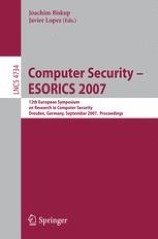
Computer Security – ESORICS 2007 ; 12th European Symposium On Research In Computer Security, Dresden, Germany, September 24 - 26, 2007, Proceedings
This book address issues such as data protection; security protocols; systems; web and network security; privacy; threat modeling and detection; information flow; and security in emerging applications such as cryptocurrencies, the Internet of Things and automotive.

Computer Security – ESORICS 2006 ; 11th European Symposium on Research in Computer Security, Hamburg, Germany, September 18-20, 2006, Proceedings
This book constitutes the refereed proceedings of the 11th European Symposium on Research in Computer Security, ESORICS 2006. it presents original research contributions, case studies and implementation experiences addressing any aspect of computer security - in theory, mechanisms, applications, or practical experience.

Computer Security - ESORICS 2005
These proceedings contain the papers selected for presentation at the 10th - ropean Symposium on Research in Computer Security (ESORICS), held S- tember 12–14, 2005 in Milan, Italy. In response to the call for papers 159 papers were submitted to the conf- ence. These paperswere evaluated on the basis of their signi?cance, novelty,and technical quality. Each paper was reviewed by at least three members of the program committee. The program committee meeting was held electronically,

Computer safety, reliability, and security ; Vol. 4166 ; 25th International Conference, SAFECOMP 2006, Gdansk, Poland, September 27-29, 2006, Proceedings
The conference focuses on the state of the art, expe- ence and new trends in the areas of safety, security and reliability of critical IT systems and applications and serves as a platform for knowledge and technology transfer for researchers, industry (suppliers, operators, users), regulators and certi?ers of such systems. SAFECOMP provides ample opportunity to exchange insights and experiences on emerging methods, approaches and practical so- tions to safety, security and reliability problems across the borders of di?erent application domains and technologies.

Computer Music Modeling and Retrieval Vol. 3902 ; 3rd International Symposium, CMMR 2005, Pisa, Italy, September 26-28, 2005, Revised Papers
This book constitutes the thoroughly refereed post-proceedings of the Third International Computer Music Modeling and Retrieval Symposium, CMMR 2005. the papers address a broad variety of topics. The papers are organized in topical sections on sound synthesis; music perception and cognition; interactive music: interface, interaction, gestures and sensors, music composition; music retrieval: music performance, music analysis, music representation; as well as interdisciplinarity and computer music.

Computer Music Modeling and Retrieval ; Vol. 3310
This volume contains the final proceedings for the 2004 Computer Music Model-ing and Retrieval Symposium (CMMR 2004). CMMR is an annualevent focusing on important aspects of computer music. CMMR 2004 is the sec-ond event in this series. The use of computers in music is well established. CMMR 2004 provided aunique opportunity to meet and interact with peers concerned with the cross-influence of the technological and creative in computer music. The field of com-puter music is interdisciplinary by nature and closely related to a number of com-puter science and engineering areas such as information retrieval, programming,human computer interaction, digital libraries, hypermedia, artificial intelligence,acoustics, signal processing, etc. The event gathered many interesting people(researchers, educators, composers, performers, and others). There were manyhigh-quality keynote and paper presentations, that fostered inspiring discussions.

Computational Thinking Education
This book is under a CC BY 4.0 license. This book offers a comprehensive guide, covering every important aspect of computational thinking education. It provides an in-depth discussion of computational thinking, including the notion of perceiving computational thinking practices as ways of mapping models from the abstraction of data and process structures to natural phenomena. Further, it explores how computational thinking education is implemented in different regions, and how computational thinking is being integrated into subject learning in K-12 education. In closing, it discusses computational thinking from the perspective of STEM education, the use of video games to teach computational thinking, and how computational thinking is helping to transform the quality of the workforce in the textile and apparel industry.

Computational Techniques for Dental Image Analysis
With the technology innovations dentistry has witnessed in all its branches over the past three decades, the need for more precise diagnostic tools and advanced imaging methods has become mandatory across the industry. Recent advancements to imaging systems are playing an important role in efficient diagnoses, treatments, and surgeries. Provides innovative insights into computerized methods for automated analysis. The research presented within this publication explores pattern recognition, oral pathologies, and diagnostic processing.

Computational intelligence for agent-based systems
In these last years the digital technology explosion has spawned so many new lifestyle models that the boundaries between "real" and "digital" are fiercely debated. This scenario has deeply changed the viewpoint about computer applications: computers become smaller, cheapest and hugely distributed in wired or unwired networks, applications become so flexible and intelligent as to tailor its communication facilities in order to increase the usability of the system. Such data-intensive, unstructured spaces featured by minimal or no centralized control flow, present a challenge for traditional methods of analysis, design and integration of advanced, distributed and intelligent computer systems. Within this challenge, an important role is played by two important research areas : Fuzzy Technology, thanks to its ability to exploit the tolerance for imprecision to achieve tractability and Agent Technology, thanks to its nature to employ agent-wise communities to carry out complex goals by means of smart interaction, cooperation, and pro-activeness.

Computational formalism : Art history and machine learning
"Computational Formalism investigates examples of art historical analysis in the fields of computer and information sciences, and frames this research in the context of art historiography. The use of machine learning to analyze art images has ushered in a renewed interest in formalism in art history, but these new techniques create new critical challenges for the field"

Computational earthquake physics ; Part I
The book is divided into two parts: The present volume - Part I - focuses on microscopic simulation, scaling physics, dynamic rapture and wave propagation, earthquake generation, cycle and seismic pattern. Topics covered range from numerical developments, rupture and gouge studies of the particle model, Liquefied Cracks and Rayleigh Wave Physics, studies of catastrophic failure and critical sensitivity, numerical and theoretical studies of crack propagation, developments in finite difference methods for modeling faults, long time scale simulation of interacting fault systems, modeling of crustal deformation, through to mantle convection.

Combinatorial Image Analysis ; Vol.4040 : 11th International Workshop, IWCIA 2006, Berlin, Germany, June 19-21, 2006, Proceedings
Constitutes the refereed proceedings of the 11th International Workshop on Combinatorial Image Analysis, IWCIA 2006, held in Berlin, June 2006. The book presents 34 revised full papers together with two invited papers, covering topics including combinatorial image analysis; grammars and models for analysis and recognition of scenes and images; combinatorial topology and geometry for images; digital geometry of curves and surfaces; algebraic approaches to image processing, and more.

Combinatorial Image Analysis ; 12th International Workshop, IWCIA 2008, Buffalo, NY, USA, April 7-9, 2008. Proceedings
This volume contains the proceedings of the 12th International Workshop on Combinatorial Image Analysis. Coverage includes digital geometry, curves and surfaces, applications of computational geometry, as well as medical imaging and biometrics.

Combinatorial image analysis ; 10th International Workshop, IWCIA 2004, Auckland, New Zealand, December 1-3, 2004, Proceedings
This volume presents the proceedings of the 10th International Workshop on Combinatorial Image Analysis,held 2004, in Auckland, New Zealand. For this workshop we received 86 submitted papers from 23 countries. We selected 55 papers for the conference. completed the program. Conference papers are presented in this volume under the following topical part titles: discrete tomography (3 papers), combinatorics and computational models (6), combinatorial algorithms (6), combinatorial mathematics (4), d- ital topology (7), digital geometry (7), approximation of digital sets by curves and surfaces (5), algebraic approaches (5), fuzzy image analysis (2), image s- mentation (6), and matching and recognition (7). These subjects are dealt with in the context of digital image analysis or computer vision.

Color Drawing : Design Drawing Skills and Techniques for Architects, Landscape Architects, and Interior Designers
Ultimate resource for professionals and students who need to develop and communicate design ideas with clear, attractive, impressive color drawings. Update with over 100 pages, contains an entirely new section focused on state-of-the-art digital techniques to greatly enhance the sophistication of presentation drawings, and offers new and innovative ideas for the reproduction and distribution of finished drawings.
