



Page 224
Page 224
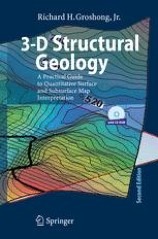
3-D Structural Geology : A Practical Guide to Quantitative Surface and Subsurface Map Interpretation
This book provides an overview of techniques for constructing structural interpretations in 2-D, 2½-D and 3-D environments; for interpolating - tween and extrapolating beyond the control points; and for validating the final int- pretation. The underlying philosophy is that structures are three-dimensional solid bodies and that data from throughout the structure, whether in 2-D or 3-D format, should be integrated into an internally consistent 3-D interpretation. It is assumed that most users of this book will do their work on a computer. C- sequently, the book provides quantitative structural methods and techniques that are designed for use with spreadsheets, mapping software, and three-dimensional c- puter-graphics programs. The book is also intended to provide the background for understanding what interpretive software, for example, a computer contouring p- gram, does automatically. Most techniques are presented in both a traditional format appropriate for paper, pencil, and a pocket calculator, and in quantitative format for use with spreadsheets and computer-graphics or computer-aided-design programs.

3D Segmentation for medical images (OsteoVision) = التقطيع ثلاثي الأبعاد للصور الطبية
With the increasing integration of AI across various sectors, artificial intelligence (AI) is already playing a significant role in the healthcare industry, and its use is expected to grow further. AI systems used in image processing and computer vision algorithms have shown a significant ability to perform many operations such as segmentation, classification, and detection. This project presents the application of computer vision algorithms in the field of medical imaging for diagnostic, therapeutic, and interventional purposes. This thesis explores the use of several computer vision algorithms to address different pathologies, specifically brain tumors (glioma) (see Appendix A) and knee osteoarthritis (OA), as well as tracking the progression of knee osteoarthritis using the Kellgren and Lawrence (KL) grading system, a common method for classifying the severity of OA into five grades. To achieve the desired impact, the project employs various techniques, including 3D segmentation for brain tumors, 2D segmentation for knee joints, and multinomial classification for determining the severity of knee OA injuries. The primary aims of the project are to enhance diagnostic accuracy, assist in creating treatment plans, provide an assistive tool for healthcare providers to make more informed decisions, leverage AI's capabilities to detect abnormalities that might escape the human eye, and streamline workflow. To facilitate these goals, the project incorporates a user-friendly UI, a website, and a Flutter-based mobile application, enabling healthcare providers to efficiently integrate these tools into their practice and improve patient care.

3D Recording and Interpretation for Maritime Archaeology
Includes recording and analysis of maritime archaeology through emerging technologies, including both practical and theoretical contributions. Topics include photogrammetric recording, laser scanning, marine geophysical 3D survey techniques, virtual reality, 3D modelling and reconstruction, data integration and Geographic Information Systems. This convergence of digital technologies such as underwater photography and photogrammetry, 3D sonar, 3D virtual reality, and 3D printing has highlighted a pressing need for these new methodologies to be considered together, both in terms of defining the state-of-the-art and for consideration of future directions.
3D printing in oral & maxillofacial surgery
A comprehensive guide to 3D printing and 3D bioprinting methods and their application in oral and maxillofacial surgeries. Among the 3D printing methods considered are fused deposition modeling, selective laser sintering, photopolymer jetting, powder binder printing, and stereolithography, while the coverage of 3D bioprinting encompasses inkjet, microextrusion, and laser techniques. In each case, the relevance of the technique to oral and maxillofacial surgery is explained. In addition, the available inks and bioinks for 3D printing are reviewed. The roles of soft and hard tissue printing in oral and maxillofacial tissue engineering and the use of 3D printing in multi- and interfacial tissue engineering are then examined in depth. The particular value of 3D printing in the treatment of critically sized defects is discussed separately. Finally, up-to-date information is provided on guided tissue/bone regeneration using 3D printing. The book will be of interest to both oral and maxillofacial surgeons and biomedical engineers.
3D Mesh processing and character animation : with examples using OpenGL, OpenMesh and Assimp
Focusses specifically on topics that are important in three-dimensional modelling, surface design and real-time character animation. It provides an in-depth coverage of data structures and popular methods used in geometry processing, keyframe and inverse kinematics animations and shader based processing of mesh objects. It also introduces two powerful and versatile libraries, OpenMesh and Assimp, and demonstrates their usefulness through implementations of a wide range of algorithms in mesh processing and character animation respectively. This Textbook is written for students at an advanced undergraduate or postgraduate level who are interested in the study and development of graphics algorithms for three-dimensional mesh modeling and analysis, and animations of rigged character models.
3D Imaging, Analysis and Applications
This textbook is designed for postgraduate studies in the field of 3D Computer Vision. It also provides a useful reference for industrial practitioners; for example, in the areas of 3D data capture, computer-aided geometric modelling and industrial quality assurance. This second edition is a significant upgrade of existing topics with novel findings. Additionally, it has new material covering consumer-grade RGB-D cameras, 3D morphable models, deep learning on 3D datasets, as well as new applications in the 3D digitization of cultural heritage and the 3D phenotyping of crops.
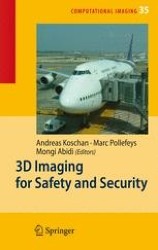
3D Imaging for Safety and Security
This book is so far the first that covers the current state of the art in 3D imaging for safety and security. Special attention was given to advanced 3D imaging technologies in the context of safety and security applications. Comparative evaluation studies showing advantages of 3D imaging over traditional 2D imaging for a given computer vision or pattern recognition task were emphasized. Moreover, additional experts in the field of 3D imaging for safety and security were invited by the editors for a contribution to this book.
3-D Computer vision : Principles, algorithms and applications
Offers advanced content on computer vision (basic content can be found in its prerequisite textbook, “2D Computer Vision: Principles, Algorithms and Applications”), including the basic principles, typical methods and practical techniques. It is intended for graduate courses on related topics, e.g. Computer Vision, 3-D Computer Vision, Graphics, Artificial Intelligence, etc. The book is mainly based on my lecture notes for several undergraduate and graduate classes I have offered over the past several years, while a number of topics stem from my research publications co-authored with my students. This book takes into account the needs of learners with various professional backgrounds, as well as those of self-learners. Furthermore, it can be used as a reference guide for practitioners and professionals in related fields.
3D cell culture : Methods and protocols
Expands on the previous edition with discussions about the latest organoid models developed for many more organs; new hydrogels and devices for 3D culture; and the organoid systems that have been improved by incorporating more components of tissue microenvironments in the in vitro culture. The chapters in this book are organized into five parts and cover topics such as biofabrication, organoids, microfluidic systems, bioprinting, and image analysis. Written in the highly successful Methods in Molecular Biology series format, chapters include introductions to their respective topics, lists of the necessary materials and reagents, step-by-step, readily reproducible laboratory protocols, and tips on troubleshooting and avoiding known pitfalls.
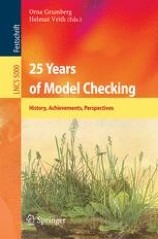
25 Years of Model Checking : History, Achievements, Perspectives
Model checking technology is among the foremost applications of logic to computer science and computer engineering. The model checking community has achieved many breakthroughs, bridging the gap between theoretical computer science and hardware and software engineering, and it is reaching out to new challenging areas such as system biology and hybrid systems. Model checking is extensively used in the hardware industry and has also been applied to the verification of many types of software. Model checking has been introduced into computer science and electrical engineering curricula at universities worldwide and has become a universal tool for the analysis of systems.
17th International Conference on Information Technology–New Generations (ITNG 2020)
This volume presents the 17th International Conference on Information Technology—New Generations (ITNG), and chronicles an annual event on state of the art technologies for digital information and communications. The application of advanced information technology to such domains as astronomy, biology, education, geosciences, security, and healthcare are among the themes explored by the ITNG proceedings. Visionary ideas, theoretical and experimental results, as well as prototypes, designs, and tools that help information flow to end users are of special interest. Specific topics include Machine Learning, Robotics, High Performance Computing, and Innovative Methods of Computing. The conference features keynote speakers; a best student contribution award, poster award, and service award; a technical open panel, and workshops/exhibits from industry, government, and academia.

150 Best New Eco Home Ideas
Features nearly 500 pages of full-color photographs and dozens of inventive and decorative profiles. Architects, designers, and homeowners today looking for comfortable, beautiful dwellings with a minimal carbon footprint will find a cornucopia of ideas in this handsome compendium. A fabulous review of the most forward-thinking eco-friendly house designs being created today, 150 Best New Eco Home Ideas showcases the work of internationally renowned architects and designers who have achieved practical, innovative, and stunning solutions around the globe. From solar paneling and wind energy systems to environmentally-friendly heating and cooling solutions and thermal glazing to trombe walls, 150 Best New Eco Home Ideas covers the latest trends and breakthroughs in eco homes. Inspiring and inventive, this lush sourcebook is essential for architects, designers, interior decorators, and all conscientious homeowners interested in creating warm and inviting homes with only a fraction of the environmental impact of those using conventional methods
14th International Congress for Applied Mineralogy (ICAM2019) ; Belgorod State Technological University named after V. G. Shukhov, 23–27 September 2019, Belgorod, Russia
This proceedings of the 14th International Council for Applied Mineralogy Congress (ICAM) in Belgorod, Russia cover a wide range of topics including applied mineralogy, advanced and construction materials, ore and industrial minerals, mineral exploration, cultural heritage, etc. It includes contributions to geometallurgy, industrial minerals, oil and gas reservoirs as well as stone artifacts and their preservation. The International Congress on Applied Mineralogy strengthens the relation between the research on applied mineralogy and the industry.
103 Trigonometry Problems : From the Training of the USA IMO Team
103 Trigonometry Problems contains highly-selected problems and solutions used in the training and testing of the USA International Mathematical Olympiad (IMO) team. Though many problems may initially appear impenetrable to the novice, most can be solved using only elementary high school mathematics techniques.

100% Evil
This professional work led to a personal passion, and so the illustrators chose to draw a small series on rosier subjects like maps and love. But as the world around them grew darker, they decided to explore the other end of the emotional spectrum and devote themselves to evil. 100% Evil is the result: a thoughtful, comical, andat timesjoyful book that just goes to show that sometimes it's good to be bad.

100 cases in acute medicine
A succinct summary of the patient's history, examination and initial investigations, including photographs where relevant, is followed by questions on the diagnosis and management of each case. The answer includes a detailed discussion on each topic, with further illustration where appropriate, providing an essential revision aid as well as a practical guide for students and junior doctors. Making clinical decisions and choosing the best course of action is one of the most challenging and difficult parts of training to become a doctor. Fully revised and updated for this second edition, these cases will teach students and junior doctors to recognize important clinical symptoms and signs, and to develop their diagnostic and management skills.

(R)Evolution : Organizations and the Dynamics of the Environment
Investigates the possible changes needed for industrial organizations to adapt to and remain competitive in their ever evolving environment. (R)Evolution’s main area of contribution to these very complex issues is embedded in the work’s ambitious attempt to borrow from evolutionary biology and genetics not only metaphors but also concepts and models to be adapted to the management of business organizations. The work provides us with a comprehensive vision of adaptation and variation in the business community, integrating various intellectual inputs which are based on an evolutionary vision of economic behavior. Using an extensive study of the literature in management science, and applying new models and methodologies in numerous case studies, Dekkers draws many insightful conclusions including the claim that companies often evolve slower than generally expected. Furthermore the research calls into question the effectiveness of the common practice of corporate reorganization. Embracing and merging most major contemporary developments in the theories of change into a comprehensive integrated approach, (R)Evolution is an invaluable resource for researchers specializing in the management of technological change.
