



Page 21
Page 21
Applied Stochastic Control of Jump Diffusions
The main purpose of the book is to give a rigorous, yet mostly nontechnical, introduction to the most important and useful solution methods of various types of stochastic control problems for jump diffusions and its applications.
Applied Stochastic Control of Jump Diffusions
The main purpose of the book is to give a rigorous, yet mostly nontechnical, introduction to the most important and useful solution methods of various types of stochastic control problems for jump diffusionsThe types of control problems covered include classical stochastic control, optimal stopping, impulse control and singular control. Both the dynamic programming method and the maximum principle method are discussed, as well as the relation between them. Corresponding verification theorems involving the Hamilton-Jacobi Bellman equation and/or (quasi-)variational inequalities are formulated. There are also chapters on the viscosity solution formulation and numerical methods.The text emphasises applications, mostly to finance. All the main results are illustrated by examples and exercises appear at the end of each chapter with complete solutions. This will help the reader understand the theory and see how to apply it.The book assumes some basic knowledge of stochastic analysis, measure theory and partial differential equations.
Applied Statistics Using SPSS, STATISTICA, MATLAB and R
The book provides a comprehensive coverage of the main statistical analysis topics important for practical applications such as data description, statistical inference, classification and regression, factor analysis, survival data and directional statistics.
Applied Spatial Data Analysis with R
Applied Spatial Data Analysis with R is divided into two basic parts, the first presenting R packages, functions, classes and methods for handling spatial data, The second part showcases more specialised kinds of spatial data analysis, including spatial point pattern analysis, interpolation and geostatistics, areal data analysis and disease mapping.
Applied Proof Theory : Proof Interpretations and Their Use in Mathematics
Ulrich Kohlenbach presents an applied form of proof theory that has led in recent years to new results in number theory, approximation theory, nonlinear analysis, geodesic geometry and ergodic theory (among others). This applied approach is based on logical transformations (so-called proof interpretations) and concerns the extraction of effective data (such as bounds) from prima facie ineffective proofs as well as new qualitative results such as independence of solutions from certain parameters, generalizations of proofs by elimination of premises. The book first develops the necessary logical machinery emphasizing novel forms of Gödel's famous functional ('Dialectica') interpretation. It then establishes general logical metatheorems that connect these techniques with concrete mathematics. Finally, two extended case studies (one in approximation theory and one in fixed point theory) show in detail how this machinery can be applied to concrete proofs in different areas of mathematics.
Applied Probability and Statistics
This text is designed for a one-semester course on Probability and Statistics. The exposition unfolds systematically from an introductory chapter to such topics as random variables and vectors, stochastic processes, estimation, testing and regression. The topics are well chosen and the presentation is enriched by many examples from real life. Following every chapter, the reader will find many original, solved and unsolved problems and hundreds of multiple choice questions, enabling those unfamiliar with the topics to master them. Additionally appealing are the interesting historical notes on the mathematicians mentioned throughout and a useful bibliography. A distinguishing character of the book is the thorough and succinct handling of the various topics.
Applied Pattern Recognition
The main goal of this book is to cover some of the latest application domains of pattern recognition while presenting novel techniques that have been developed or customized in those domains.
Applied Partial Differential Equations : A Visual Approach
This book presents selected topics in science and engineering from an applied-mathematics point of view. The described natural, socioeconomic, and engineering phenomena are modeled by partial differential equations that relate state variables.
Applied Mathematics for Restructured Electric Power Systems : Optimization, Control, and Computational Intellige
Discusses the use of applied mathematics to solve challenging power system problems. This book covers such areas as: control, optimization, and computational intelligence. It follows a three-part format: a description of an important power system problem or problems; the practice and/or particular research approaches; and, research directions.
Applied computational materials modeling : Theory, simulation and experiment
this book provides the average person working in the materials field with a more balanced perspective of the role that computational modeling can play in every day research and development efforts. This is done by presenting a series of examples of the successful application of various computational modeling procedures (everything from first principles to quantum approximate to CALPHAD methods) to real life surface and bulk alloy problems.This book should have a large appeal in the materials community, both for experimentalists who would greatly benefit from adding computational methods to their everyday research regimes, as well as for those scientists/engineers familiar with a particular computational method who would like to add complementary techniques to their arsenal of research and development tools
Applied and computational mathematics for digital environments
Contains the 11 papers that were accepted and published in the Special Issue “Applied and Computational Mathematics for Digital Environments” of the MDPI Mathematics journal. The topics of interest include, among others, scientific research, applied tasks, and problems in the following areas: The construction of mathematical and information models of intelligent computer systems for monitoring and controlling the parameters of digital environments; The development of intelligent optimization algorithms that search for optimal parameter values of mathematical and information models in digital environments; Software and mathematical technologies in the implementation of intelligent monitoring and computer control of the parameters of digital environments; The development and application of mathematical and information models, machine learning methods, and artificial intelligence for the analysis and processing of big data in digital environments.
Applications of simulation methods in environmental and resource economics
Simulation methods are revolutionizing the practice of applied economic analysis. This volume collects eighteen chapters written by leading researchers from prestigious research institutions the world over. The common denominator of the papers is their relevance for applied research in environmental and resource economics. The topics range from discrete choice modeling with heterogeneity of preferences, to Bayesian estimation, to Monte Carlo experiments, to structural estimation of Kuhn-Tucker demand systems, to evaluation of simulation noise in maximum simulated likelihood estimates, to dynamic natural resource modeling. Empirical cases are used to show the practical use and the results brought forth by the different methods.

Applications of Membrane Computing
Membrane computing is a branch of natural computing which investigates computing models abstracted from the structure and functioning of living cells and from their interactions in tissues or higher-order biological structures. The models considered, called membrane systems (P systems), are parallel, distributed computing models, processing multisets of symbols in cell-like compartmental architectures. In many applications membrane systems have considerable advantages – among these are their inherently discrete nature, parallelism, transparency, scalability and nondeterminism.
Applications of computational intelligence in biology : Current trends and open problems
The purpose of this book is to provide a medium for such an exchange of expertise and concerns. In order to achieve the goal, we have solicited cont- butions from both computational intelligence as well as biology researchers.

Applications and theory of Petri Nets 2005 ; 26th international conference, ICATPN 2005, Miami, FL, June 20-25, 2005, Proceedings
This volume contains the proceedings of the 26th International Conference on Application and Theory of Petri Nets and Other Models of Concurrency (ICATPN 2005). The Petri net conferences serve to discuss yearly progress in the ?eld of Petri nets and related models of concurrency, and to foster new - vancesintheapplicationandtheoryofPetrinets. Several tutorials and workshops were organized within the conf- ence, covering introductory and advanced aspects related to Petri nets.Detailed
Application of the Finite Element Method in Implant Dentistry
Part of the new series, Advanced Topics in Science and Technology in China, this book is designed to give the necessary theoretical foundation to new users of the finite element method in implant dentistry, and show how both the implant dentist and designer can benefit from finite element analysis.
Analyzing computer system performance with Perl::PDQ
Analyzing computer system performance is often regarded by most system administrators, IT professionals and software engineers as a black art that is too time consuming to learn and apply. Finally, this book by acclaimed performance analyst Dr. Neil Gunther makes this subject understandable and applicable through programmatic examples. The means to this end is the open-source performance analyzer Pretty Damn Quick (PDQ) written in Perl As the epigraph in this book points out, Common sense is the pitfall of performance analysis. The performance analysis framework that replaces common sense is revealed in the first few chapters of Part I. The important queueing concepts embedded in PDQ are explained in a very simple style that does not require any knowledge of formal probability theory. Part II begins with a full specification of how to set up and use PDQ replete with examples written in Perl. Subsequent chapters present applications of PDQ to the performance analysis of multicomputer architectures, benchmark results, client/server scalability, and Web-based applications.

Analytical and Stochastic Modeling Techniques and Applications ; 15th International Conference, ASMTA 2008 Nicosia, Cyprus, June 4-6, 2008 Proceedings
This book constitutes the refereed proceedings of the 15th International Conference on Analytical and Stochastic Modeling Techniques and Applications, ASMTA 2008, held in Nicosia, Cyprus, in June 2008.
Analysis of Low-Speed Unsteady Airfoil Flows
This book provides an introduction to unsteady aerodynamics with emphasis on the analysis and computation of inviscid and viscous two-dimensional flows over airfoils at low speeds. It begins with a discussion of the physics of unsteady flows and an explanation of lift and thrust generation, airfoil flutter, gust response and dynamic stall. This is followed by an exposition of the four major calculation methods in currents use, namely inviscid-panel, boundary-layer, viscous-inviscid interaction and Navier-Stokes methods. Undergraduate and graduate students, teachers, scientists and engineers concerned with aeronautical, hydronautical and mechanical engineering problems will gain understanding of the physics of unsteady low-speed flows and an ability to analyze these flows with modern computational methods.
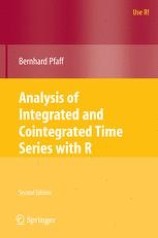
Analysis of integrated and cointegrated time series with R
The analysis of integrated and co-integrated time series can be considered as the main methodology employed in applied econometrics. This book not only introduces the reader to this topic but enables him to conduct the various unit root tests and co-integration methods on his own by utilizing the free statistical programming environment R. The book encompasses seasonal unit roots, fractional integration, coping with structural breaks, and multivariate time series models. The book is enriched by numerous programming examples to artificial and real data so that it is ideally suited as an accompanying text book to computer lab classes.
