



Page 205
Page 205
Algorithms and Complexity ; 6th Italian Conference, CIAC 2006, Rome, Italy, May 29-31, 2006, Proceedings
Here are the refereed proceedings of the 6th Italian Conference on Algorithms and Computation, CIAC 2006. The 33 revised full papers presented together with 3 invited papers address such topics as sequential, parallel and distributed algorithms, data structures, approximation algorithms, randomized algorithms, on-line algorithms, graph algorithms, analysis of algorithms, algorithm engineering, algorithmic game theory, computational biology, computational complexity, communication networks, computational geometry, cryptography, discrete optimization, graph drawing, mathematical programming, and quantum algorithms.
Algorithms – ESA 2005 ; 13th Annual European Symposium, Palma de Mallorca, Spain, October 3-6, 2005, Proceedings
This volume contains the 75 contributed papers and the abstracts of the threeinvited lectures presented at the 13th Annual European Symposium on Algo-rithms (ESA 2005), held in Spain, 2005. respectively.Papers were solicited in all areas of algorithmic research, including but notlimited to algorithmic aspects of networks, approximation and on-line algo-rithms, computational biology, computational geometry, computational financeand algorithmic game theory, data structures, database and information re-trieval, external memory algorithms, graph algorithms, graph drawing, machinelearning, mobile computing, pattern matching and data compression, quantumcomputing, and randomized algorithms. The algorithms could be sequential,distributed, or parallel. Submissions were especially encouraged in the area ofmathematical programming and operations research, including combinatorialoptimization, integer programming, polyhedral combinatorics, and semidefiniteprogramming.Each extended abstract was submitted to one of the two tracks.

Algorithmic number theory ; 8th International Symposium, ANTS-VIII Banff, Canada, May 17-22, 2008 Proceedings
This book constitutes the refereed proceedings of the 8th International Algorithmic Number Theory Symposium, ANTS 2008, held in Banff, Canada, in May 2008.
Algorithmic number theory ; 7th International Symposium, ANTS-VII, Berlin, Germany, July 23-28, 2006, Proceedings
This book constitutes the refereed proceedings of the 7th International Algorithmic Number Theory Symposium, ANTS 2006, held in Berlin, July 2006. The book presents 37 revised full papers together with 4 invited papers selected for inclusion. The papers are organized in topical sections on algebraic number theory, analytic and elementary number theory, lattices, curves and varieties over fields of characteristic zero, curves over finite fields and applications, and discrete logarithms.
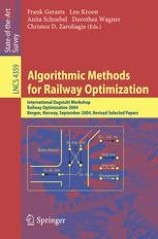
Algorithmic methods for railway optimization ; International Dagstuhl workshop, railway optimization 2004, Dagstuhl Castle, Germany, June 20-25, 2004, Bergen, Norway, September 16-17, 2004, Revised Selected Papers
This state-of-the-art survey features papers that were selected after an open call following the International Dagstuhl Seminar on Algorithmic Methods for Railway Optimization. The second part of the volume constitutes the refereed proceedings of the 4th International Workshop on Algorithmic Methods and Models for Optimization of Railways.
Algorithmic learning theory ; Vol.4264 : 17th International Conference, ALT 2006, Barcelona, Spain, October 7-10, 2006, Proceedings
This book constitutes the refereed proceedings of the 17th International Conference on Algorithmic Learning Theory, ALT 2006, held in Barcelona, Spain in October 2006, colocated with the 9th International Conference on Discovery Science, DS 2006.The 24 revised full papers presented together with the abstracts of five invited papers were carefully reviewed and selected from 53 submissions. The papers are dedicated to the theoretical foundations of machine learning.
Algorithmic learning theory ; 18th International conference, ALT 2007, Sendai, Japan, October 1-4, 2007, Proceedings
This volume contains the papers presented at the 18th International Conf- ence on Algorithmic Learning Theory.The main objective of the conference was to provide an interdisciplinary forum for high-quality talks with a strong theore- cal background and scientiبهc interchange in areas such as query models, on-line learning, inductive inference, algorithmic forecasting, boosting, support vector machines, kernel methods, complexity and learning, reinforcement learning, - supervised learning and grammatical inference.
Algorithmic Learning in a Random World
This new monograph integrates mathematical theory and revealing experimental work. It demonstrates mathematically the validity of the reliability claimed by conformal predictors when they are applied to independent and identically distributed data, and it confirms experimentally that the accuracy is sufficient for many practical problems. Later chapters generalize these results to models called repetitive structures, which originate in the algorithmic theory of randomness and statistical physics. The approach is flexible enough to incorporate most existing methods of machine learning, including newer methods such as boosting and support vector machines and older methods such as nearest neighbors and the bootstrap.
Algorithmic Foundations of Robotics VI
Robot algorithms are abstractions of computational processes that control or reason about motion and perception in the physical world. Because actions in the physical world are subject to physical laws and geometric constraints, the design and analysis of robot algorithms raises a unique combination of questions in control theory, computational and differential geometry, and computer science. Algorithms serve as a unifying theme in the multi-disciplinary field of robotics. This volume consists of selected contributions to the sixth Workshop on the Algorithmic Foundations of Robotics. This is a highly competitive meeting of experts in the field of algorithmic issues related to robotics and automation.
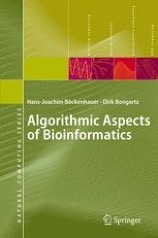
Algorithmic Aspects of Bioinformatics
Advances in bioinformatics and systems biology require improved computational methods for analyzing data, while progress in molecular biology is in turn influencing the development of computer science methods. This book introduces some key problems in bioinformatics, discusses the models used to formally describe these problems, and analyzes the algorithmic approaches used to solve them. After introducing the basics of molecular biology and algorithmics, Part I explains string algorithms and alignments; Part II details the field of physical mapping and DNA sequencing; and Part III examines the application of algorithmics to the analysis of biological data. Exciting application examples include predicting the spatial structure of proteins, and computing haplotypes from genotype data. This book describes topics in detail and presents formal models in a mathematically precise, yet intuitive manner, with many figures and chapter summaries, detailed derivations, and examples. It is well suited as an introduction into the field of bioinformatics, and will benefit students and lecturers in bioinformatics and algorithmics, while also offering practitioners an update on current research topics.

Algorithmic Aspects in Information and Management ; Second International Conference, AAIM 2006, Hong Kong, China, June 20-22, 2006, Proceedings
This book constitutes the refereed proceedings of the Second International Conference on Algorithmic Aspects in Information and Management, AAIM 2006, held in Hong Kong, June 2006. The book presents 34 revised full papers together with abstracts of 2 invited talks. The papers cover topics from areas such as online scheduling, game and finance, data structures and algorithms, computational geometry, optimization, graph, and string, and more.

Algorithmic Aspects in Information and Management ; 3rd International Conference, AAIM 2007, Portland, OR, USA, June 6-8, 2007, Proceedings
This Book is intended for or- inal algorithmic research on immediate applications and/or fundamental pr- lems pertinent to information management and management science, broadly construed.

Algorithmic applications in management ; 1st international conference, AAIM 2005, Xian, China, June 22-25, 2005, Proceedings
The papers in this volume were presented at the 1st International Conference onAlgorithmic Applications in Management (AAIM 2005), in China. The topics cover algorithmic applications in most management-related areas.including Programming Techniques Business Strategy/Leadership Theory of Computation Algorithm Analysis and Problem Complexity Data Structures Discrete Mathematics in Computer Science
Algorithm Theory - SWAT 2008 ; 11th Scandinavian Workshop on Algorithm Theory, Gothenburg, Sweden, July 2-4, 2008. Proceedings
his book constitutes the refereed proceedings of the 11th Scandinavian Workshop on Algorithm Theory, SWAT 2008, held in Gothenborg, Sweden, in July 2008.

Algorithm Theory - SWAT 2006 ; 10th Scandinavian Workshop on Algorithm Theory, Riga, Latvia, July 6-8, 2006, Proceedings
This book constitutes the refereed proceedings of the 10th Scandinavian Workshop on Algorithm Theory, SWAT 2006, held in Riga, Latvia, in July 2006. The proceedings includes 36 revised full papers presented together with 3 invited papers, addressing issues of theoretical algorithmics and applications in various fields including graph algorithms, computational geometry, scheduling, approximation algorithms, network algorithms, data storage and manipulation, combinatorics, sorting, searching, online algorithms, optimization, amd more.

Algèbre, Chapitres 1 à 3 = Algebra, Chapters 1 to 3
To do algebra is essentially to calculate, that is to say to perform, on elements of a set, (<algebraic operations n, the best-known example of which is provided by the (<four rules)) of elementary arithmetic. This is not the place to retrace the slow process of progressive abstraction by which the notion of algebraic operation, initially restricted to natural integers and to measurable quantities, gradually widened its field, as it grew. at the same time generalized the notion of ((number O, until, going beyond the latter, it came to apply to elements which no longer had any character ((numeric)>, for example to permutations of a - seems (see Historical Note in chap. 1).
Algèbre, Chapitre 9 = Algebra, Chapter 9
Sesquilinear and quadratic forms : The Mathematics Elements of Nicolas BOURBAKI aim to provide a rigorous, systematic presentation without prerequisites of mathematics from their foundations. This ninth chapter of the Book of Algebra, the second Book of the treatise, is devoted to quadratic, symplectic or Hermitian forms and to associated groups.
Algèbre commutative, Chapitre 10 = Commutative Algebra, Chapter 10
Depth, Regularity, Duality The Mathematics Elements of Nicolas BOURBAKI aim to provide a rigorous, systematic presentation without prerequisites of mathematics from their foundations. This volume of the Book of Commutative Algebra, Book 7 of the treatise, is a continuation of the earlier chapters. It introduces in particular the notions of depth and smoothness, fundamental in algebraic geometry. It ends with the introduction of the dualizing modules and the Grothendieck duality.

Algèbre commutative : Chapitres 5 à 7 = Commutative algebra : Chapters 5 to 7
The Mathematics Elements of Nicolas BOURBAKI aim to provide a rigorous, systematic presentation without prerequisites of mathematics from their foundations.This second volume of the Book of Commutative Algebra, Seventh Book of the treatise, introduces two fundamental notions in commutative algebra, that of algebraic integer and that of valuation, which have many applications in number theory and algebraic geometry.
Algebraic Theory of Locally Nilpotent Derivations
This book explores the theory and application of locally nilpotent derivations, which is a subject of growing interest and importance not only among those in commutative algebra and algebraic geometry, but also in fields such as Lie algebras and differential equations. The author provides a unified treatment of the subject, beginning with 16 First Principles on which the entire theory is based. These are used to establish classical results, such as Rentschler’s Theorem for the plane, right up to the most recent results, such as Makar-Limanov’s Theorem for locally nilpotent derivations of polynomial rings.
