



Page 202
Page 202

Bacterial resistance to disinfectants
Bacterial resistance to disinfection is an escalating concern within healthcare facilities, as it poses a significant threat to patient safety and infection control. This research paper aims to explore the various mechanisms underlying bacterial resistance to disinfection, including intrinsic and acquired resistance, as well as the phenomenon of cross-resistance to antibiotic which poses a serious threat worldwide...

Bacterial regulatory RNA : Methods and protocols
Details new and updated methods used for studying prokaryotic non-coding RNAs and their protein accomplices. Chapters detail discovery of ncRNAs, characterization of their structure, functions, and their interactomes. Written in the highly successful Methods in Molecular Biology series format, chapters include introductions to their respective topics, lists of the necessary materials and reagents, step-by-step, readily reproducible laboratory protocols, and tips on troubleshooting and avoiding known pitfalls.

Baby milk in Syria
Breastfeeding is one of the most effective ways to ensure child health and survival. However, contrary to WHO recommendations, fewer than half of infants under 6 months old are exclusively breastfed. Infant formulas are liquids or reconstituted powders fed to infants and young children to serve as substitutes for human milk. Infant formulas have a special role in the diet because they are the only source of nutrients for some infants...

B 2007 : Formal Specification and Development in B ; 7th International Conference of B Users, Besancon, France, January 7-19, 2007, Proceedings
These proceedingsrecordthe papers presented at the Seventh InternationalC- ference of B Users (B 2007), held in the city of Besan¸ con in the east of France. All the submitted papers in these proceedings were peer reviewed by at least three reviewers drawn from the B committee, depending on the subject matter of the paper. The authorsof the papersforB 2007werefrom Australia,Canada, Finland, Germany, France, Switzerland, and the UK. The conference featured a rangeof contributions by distinguished invited speakers drawn from both ind- try and academia.

Azaheterocycles Based on -, ß-Unsaturated Carbonyls
Devoted to heterocyclizations of aliphatic and aromatic, -unsaturated carbonyls with various binucleophiles leading to three-, five-, six and seven-membered partially hydrogenated nitrogen-containing heterocycles. During the last decade interest in these classes of organic c- pounds has been experiencing a scientific renaissance owing to their significant role in biological processes in living cells and diverse effects on physiological activities. In addition, such compounds are also more prevalent from the vi- point of ''classical'' problems of organic chemistry, among them reactivity, chemo- and regioselectivity, tautomerism, conformational analysis and features of their electronic structure. The character of these problems in the case of partially hydrogenated heterocycles differs sufficiently from that for hetero- omatized and perhydrogenated heterocyclic compounds and investigations in this field very often lead to interesting and unusual results. Extensively characterized cyclocondensations of, -unsaturated carbonyls, their synthetic equivalents and their precursors are the most widespread, facile and generally valid pathway to dihydroazaheterocycles.
Axon growth and guidance
The complexarchitectureofneuronal networks togetherwith the extraordinary associated functions make the nervous system a fascinating biological structure. The considerable work performed to explore this cellular machinery is nowadays successfulbecause the mysteryofnervous system developmentisbeing unravelled. As described in their outstanding review published 10 years ago in Science.' Marc Tessier-Lavigne and Corey Goodman-the pioneers of the molecular era of axon guidance-summarized the assembly of nervous system connections as a subtle game of attraction and repulsion of neuronal growth cones. The cellular ballet ensuring the formation of billions of synapses, which ultimately gives rise to the highest cognitive functions, is primarily orchestrated by a step-by-step mechanism of growth driven by multiple molecular cues. While our general concept of axon guidance remains identical, a profound evolution ofour knowledge ofthe molecular identityofthe guidance cues together with their interactions and signalling pathways occurred over the past ten years.

Axiom of Choice
AC, the axiom of choice, because of its non-constructive character, is the most controversial mathematical axiom, shunned by some, used indiscriminately by others. This treatise shows paradigmatically that:Disasters happen without AC: Many fundamental mathematical results fail (being equivalent in ZF to AC or to some weak form of AC).Disasters happen with AC: Many undesirable mathematical monsters are being created (e.g., non measurable sets and undeterminate games).Illuminating examples are drawn from diverse areas of mathematics, particularly from general topology, but also from algebra, order theory, elementary analysis, measure theory, game theory, and graph theory.
Avoiding Medical Malpractice : A Physician's Guide to the Law
Avoiding Medical Malpractice: A Physician's Guide to the Law is a reader-friendly, physician oriented, handbook on how to avoid malpractice lawsuits. As both a practicing surgeon and an attorney, Dr. Choctaw provides real world perspectives into both the medical and legal aspects of malpractice issues.
Avatars at Work and Play : Collaboration and Interaction in Shared Virtual Environments
examining uses of shared virtual environments in practical settings such as scientific collaboration, distributed meetings, building models together, and others. It also covers online gaming in virtual environments, which has attracted hundreds of thousands of users and presents an opportunity for studying a myriad of social issues. Covering both ‘work’ and ‘play’, the volume brings together issues common to the two areas.

Autonomy oriented computing : From problem solving to complex systems modeling
Autonomy Oriented Computing explores the important theoretical and practical issues in AOC, by analyzing methodologies and presenting experimental case studies. The book serves as a comprehensive reference source for researchers, scientists, engineers, and professionals in all fields concerned with this promising new development in computer science. It can also be used as a main or supplementary text in graduate and undergraduate programs across a broad range of computer-related disciplines, including Robotics and Automation, Amorphous Computing, Image Processing and Computer Vision, Programming Paradigms, Computational Biology, and many others. The first part of the book, Fundamentals, describes the basic concepts and characteristics of an AOC system, and then it enumerates the critical design and engineering issues faced in AOC system development. The second part of the book, AOC in Depth, provides a detailed analysis of methodologies and case studies to evaluate the use of AOC in problem solving and complex system modeling. The final chapter reviews the essential features of the AOC paradigm and outlines a number of possibilities for future research and development.
Autonomy and human rights in health care : An international perspective
Autonomy and Human Rights in Healthcare: An International Perspective is a group of essays published in memory of David Thomasma, one of the leading humanists in the field of bioethics during the twentieth century. A pioneer in the field of multidisciplinary research, having integrated major theological and philosophical traditions in the west with modern science, Thomasma was a role model to the authors who have devoted essays to his major avenues of inquiry. The authors represent many different countries and disciplines throughout the globe. The volume deals with the pressing issue of how to ground a universal bioethics in the context of the conflicted world of combative cultures and perspectives.

Autonomous vehicles technological trends
The automotive industry has always been synonymous with research and innovation, but nowadays the industry is adding pressure and is establishing the agenda of the researchers from the field. Visions have been provided, and the hardware and the software exist; the only question remaining is: “who is going to deliver”? To answer this question, we encouraged scientists, researchers, industry specialists, and academics to share their vision of autonomous vehicles. What will the platform look like? What kind of hardware and software is most suitable? Who will make the connection between these two interdependent environments (and how), so that in the end the AI will define the process? These are the pressing issues of the current moment, and this Special Issue will help all those interested in the topic to promote their vision and ideas.
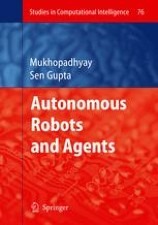
Autonomous Robots and Agents
This book deals with the theoretical and methodological aspects of incorporating intelligence in Autonomous Robots and Agents. Challenges faced in the real world to accomplish complex tasks, which require collaborative efforts, and methods to overcome them, are detailed. Several informative articles deal with navigation, localization and mapping of mobile robots, a problem that engineers and researchers are grappling with all the time.This edited volume is targeted to present the latest state-of-the-art methodologies in Robotics. It is a compilation of the extended versions of the very best papers selected from the many that were presented at the 3rd International Conference on Autonomous Robots and Agents (ICARA 2006) which was held at Palmerston North, New Zealand from 11-14 December, 2006. Scientists and engineers who work with mobile robots will find this book very useful and stimulating.
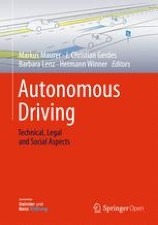
Autonomous driving : Technical, legal and social aspects
This book takes a look at fully automated, autonomous vehicles and discusses many open questions: How can autonomous vehicles be integrated into the current transportation system with diverse users and human drivers? Where do automated vehicles fall under current legal frameworks? What risks are associated with automation and how will society respond to these risks? How will the marketplace react to automated vehicles and what changes may be necessary for companies?

Autonomic networking ; 1st International IFIP TC6 Conference, AN 2006, Paris, France, September 27-29, 2006, Proceedings
The autonomic communication paradigm has been defined mainly through the Autonomic Communications Forum (ACF) and particularly as follows: Autonomic communication is centered on selfware – an innovative approach to perform known and emerging tasks of a network control plane, both end-to-end and middle box communication-based. Selfware assures the capacity to evolve; however, it requires generic network instrumentation. Selfware principles and technologies borrow largely from well-established research on distributed systems, fault tolerance among others, from emerging research on non-conventional networking (multihop ad hoc, sensor, peer-to-peer, group communication, etc.

Autonomic and Trusted Computing ; 5th International Conference, ATC 2008, Oslo, Norway, June 23-25, 2008 Proceedings
This book constitutes the refereed procedings of the 5th International Conference on Autonomic and Trusted Computing, ATC 2008, held in Oslo, Norway, in June 2008, co-located with UIC 2008, the 5th International Conference on Ubiquitous Intelligence and Computing.

Autonomic and Trusted Computing ; 4th International Conference, ATC 2007, Hong Kong, China, July 11-13, 2007, Proceedings
To cope with the growing and ubiquitous complexity, autonomic computing (AC) focuses on se- manageable computing and communication systems that exhibit self-awareness, self-configuration, self-optimization, self-healing, self-protection and other self-x operations to the maximum extenteven without human interventionor guidance. Organiccomputing(OC)additionally emphasizes natural-analogueconceptslike self-organization and controlled emergence. Any autonomic ororganic system must be trus tworthy to avoid the risk of l- ing control and to retain confidence that the system will not fail. Trust and/or distrust relationships on the Internet and in pervasive infrastructures are key factors to enable dynamic interaction and cooperation of various users, systems and services. Trusted/trustworthy computing (TC) aims at making computing and communication systems as well as services available, predictable, traceable, controllable, assessable, sustainable, dependable, persist-able, security/privacy protect-able, etc.
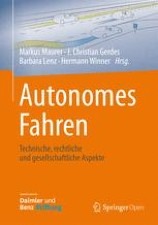
Autonomes fahren : Technische, rechtliche und gesellschaftliche aspekte = Autonomous driving : Technical, legal and social aspects
This book provides answers to a wide range of these and other questions. Experts from Germany and the USA describe central topics related to the automation of vehicles on public roads from an engineering and social science perspective. They show which "decisions" are required of an autonomous vehicle or which "ethics" must be programmed. The authors discuss expectations and concerns that characterize the individual and societal acceptance of autonomous driving. An increased safety potential through autonomous vehicles is compared to the challenges and solution approaches that play a role in securing the safety concept. In addition, they explain what possibilities for change and opportunities arise for our mobility and the reorganization of traffic, not least for freight traffic. The book thus offers an up-to-date, comprehensive and scientifically sound examination of the topic of "autonomous driving".
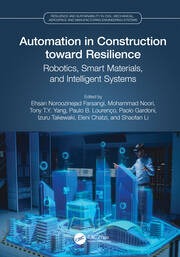
Automation in construction toward resilience : Robotics, smart materials and intelligent systems
Presents all aspects of automation in construction pertaining to the use of information technologies in design, engineering, construction technologies, and maintenance and management of constructed facilities. The broad scope encompasses all stages of the construction life cycle from initial planning and design, through the construction of the facility, its operation, and maintenance, to the eventual dismantling and recycling of buildings and engineering structures
Automating business modelling : A guide to using logic to represent Informal methods and support reasoning
Enterprise Modelling (EM) methods are frequently used by entrepreneurs as an analysis tool for describing and redesigning their businesses. The resulting product, an enterprise model, is commonly used as a blueprint for reconstructing organizations and such effort is often a part of business process re-engineering and improvement initiatives. Automating Business Modelling describes different techniques of providing automated support for enterprise modelling methods and introduces universally used approaches. A running example of a business modelling method is included; providing a framework and detailed explanation as to how to construct automated support for modelling, allowing readers to follow the method to create similar support. Suitable for senior undergraduates and postgraduates of Business Studies, Computer Science and Artificial Intelligence, practitioners in the fields of Knowledge Management, Enterprise Modelling and Software Engineering, this book offers insight and know-how to both student and professional.
