



Page 2
Page 2

Database and Expert Systems Applications ; 19th International Conference, DEXA 2008, Turin, Italy, September 1-5, 2008. Proceedings
This book constitutes the refereed proceedings of the 19th International Conference on Database and Expert Systems Applications, DEXA 2008, held in Turin, Italy, in September 2008.

Data Engineering Issues in E-Commerce and Services ; 2nd International Workshop, DEECS 2006, San Francisco, CA, USA, June 26, 2006
The purpose of the DEECS workshop is to provide an annual forum for exchange of state-of-the-art research and development in e-commerce and services. Since the increasing demand on e-commerce and services, we are witnessing a continuing growth of interest in the workshop. The increased number of submissions this year includes a record number from Asia.

Creating Web-based Laboratories
Remote web-based experimentation, enabling students and researchers to access the laboratory anytime via the Internet, is becoming an increasingly attractive way to complement or even replace traditional laboratory sessions. Placing a video camera & microphone before the equipment and apparatus to capture what is actually happening in the laboratory allows the images and audio data to be streamed to the client side. Researchers in different countries can share equipment and conduct research cooperatively and remotely. The authors summarise their research and discuss the development of the 5 web-based laboratories launched from the National University of Singapore. The principles, structure, and technologies required for the creation of Internet remote experimentation systems are discussed with particular emphasis on the integration of hardware and software systems. Also highlighted is the design and development of interfaces and components for use in typical web-based laboratories or similar web-control applications.

Cooperative Information Agents XI ; Matthias Klusch, Koen V. Hindriks, Mike P. Papazoglou, Leon Sterling
In today’s world of ubiquitously connected heterogeneous information systems and computing devices, the intelligent coordination and provision of relevant added-value information at any time, anywhere is of key importance to a va- ety of applications. This challenge is envisioned to be coped with by means of appropriate intelligent and cooperative information agents. An information agent is a computational software entity that has access to one or multiple heterogeneous and geographically dispersed data and infor- tion sources. It pro-actively searches for and maintains information on behalf of its human users, or other agents preferably just in time. In other words, it is managing and overcoming the di?culties associated with information overload in open, pervasive information and service landscapes. Each component of a modern cooperative information system is represented by an appropriate intelligent information agent capable of resolving system and semantic heterogeneities in a given context on demand. Cooperative infor- tion agents are supposed to accomplish both individual and shared joint goals depending on the actual user preferences in line with given or deduced limits of time, budget and resources available.

Cooperative Design, Visualization, and Engineering ; 4th International Conference, CDVE 2007, Shanghai,China, September 16-20, 2007
The cooperative design, visualization and engineering community sensed the economic pulse of a new giant economy where cooperation is vital for its success. This year we received a large number of papers from all over the world.From a technical point of view, as a major trend in cooperative design, vi- alization, engineering and other applications, advanced Web-based cooperation technology stands out by itself. Web-based cooperative working applications have been emerging strongly since the wide availability and accessibility of the WWW. It is a form of sharing and collaborating by its nature.

Consumer Health Informatics : Informing Consumers and Improving Health Care
This comprehensive volume the inclusion of several case studies serves to examine pertinent topics, namely computer-based information for cancer; National Library of Medicine initiatives; and web-based patient preferences and utilities. Designed for use by medical IT specialists, physicians, nurses, healthcare providers, and professors and students of medical informatics, the book's chapter highlights include patient empowerment; frameworks and models for health behavior change and patient education; patient to patient communication; patient to provider communication; privacy and confidentiality; ethical issues; evaluation methods, and more.

Condition Monitoring and Control for Intelligent Manufacturing
Manufacturing systems and processes are becoming increasingly complex, making more rational decision-making in process control a necessity. The book presents a wide and comprehensive review of the key areas of research in machine condition monitoring and control, before focusing on an in-depth treatment of each important technique, from multi-domain signal processing for defect diagnosis to web-based information delivery for real-time control.

Conceptual Modeling - ER 2007 ; 26th International Conference on Conceptual Modeling, Auckland, New Zealand, November 5-9, 2007, Proceedings
Conceptual modeling is fundamental to the development of complex systems, because it provides the key communication means between systems developers, end-users and customers.Conceptua lmodeling provides languages,methods and tools to understand and represent the application domain;to elicitate,concepalize and formalize system requirements and user needs;to communicate systems designs to all stakeholders; to formally verify and validate system designs on high levels of abstractions; and to minimize ambiguities in system development. Initially, conceptual modeling mainly addressed data-intensive information s- tems and contributed to data modeling and database application engineering. The area of conceptual modeling has now matured to encompass all kinds of application areas such as e-applications (including e-business and e-learning), web-based systems (including the semantic web and ubiquitous systems), life science and geographic applications.
Conceptual Modeling - ER 2006 ; 25th International Conference on Conceptual Modeling, Tucson, AZ, USA, November 6-9, 2006, Proceedings
The International Conference on Conceptual Modeling provides the premiere - rum for presenting and discussing current research and applications in which the - jor emphasis is on conceptual modeling. Topics of interest span the entire spectrum of conceptual modeling including research and practice in areas such as theories of c- cepts and ontologies underlying conceptual modeling, methods and tools for devel- ing and communicating conceptual models, and techniques for transforming conc- tual models into effective implementations.

Computer-based Design and Manufacturing
This book offers a comprehensive overview of the latest methods and state-of-the-art technologies in intelligent product design. Including but not limited to: - Discussion of applied methods developed in field of the product design - Discussion on the need and solutions for new engineering paradigm and philosophy required for product design - Coverage of advances in information systems and technology in support of CFPD - Discussion of how to use web-based design environments

Computer Music Modeling and Retrieval ; Vol. 3310
This volume contains the final proceedings for the 2004 Computer Music Model-ing and Retrieval Symposium (CMMR 2004). CMMR is an annualevent focusing on important aspects of computer music. CMMR 2004 is the sec-ond event in this series. The use of computers in music is well established. CMMR 2004 provided aunique opportunity to meet and interact with peers concerned with the cross-influence of the technological and creative in computer music. The field of com-puter music is interdisciplinary by nature and closely related to a number of com-puter science and engineering areas such as information retrieval, programming,human computer interaction, digital libraries, hypermedia, artificial intelligence,acoustics, signal processing, etc. The event gathered many interesting people(researchers, educators, composers, performers, and others). There were manyhigh-quality keynote and paper presentations, that fostered inspiring discussions.
Law and the Semantic Web : Legal Ontologies, Methodologies, Legal Information Retrieval, and Applications
As part of this objective, ICT (information and communication technologies) services should become available for every citizen, and for all schools, homes and businesses. The book you have in front of you is about Semantic Web technology and law. Law is something omnipresent; all citizens — at some points in their lives — have to deal with it. In addition, law involves a large group of professionals, and is a mul- billion business world wide. Information technology is important because it that can improve citizens’ interaction with law, as well as improve legal professionals’ work environment. Legal professionals dedicate a significant amount of their time to finding, reading, analyzing and synthesizing information in order to take decisions, and prepare advice and trials, among other tasks. As part of the “Semantic-Based Knowledge and Content Systems” Strategic Objective, the European Commission is funding projects to construct technology to make the Semantic Web vision come true. 1 The articles in this book are related to two current foci of the Strategic Objective : • Knowledge acquisition and modelling, capturing knowledge from raw information and multimedia content in webs and other distributed repositories to turn poorly structured information into machi- processable knowledge.

Languages, Methodologies and Development Tools for Multi-Agent Systems ; 1st International Workshop, LADS 2007, Durham, UK, September 4-6, 2007. Revised Selected Papers
Constitutes the thoroughly refereed post-workshop proceedings of the First International Workshop on Languages, Methodologies and Development Tools for Multi-Agent Systems, LADS 2007, held in Durham, UK, in September 2007. The workshop was part of MALLOW 2007, a federation of workshops on Multi-Agent Logics, Languages, and Organizations.
JDBC Recipes : A Problem-Solution Approach
JDBC Recipes provides easy-to-implement, usable solutions to problems in relational databases that use JDBC. You will be able to integrate these solutions into your web-based applications, such as Java servlets, JavaServer Pages, and Java server-side frameworks. This handy book allows you to cut and paste the solutions without any code changes. This book focuses on topics that have been ignored in most other JDBC books, such as database and result set metadata. It will help you develop database solutions, like adapters, connectors, and frameworks using Java/JDBC. The insightful solutions will enable you to handle all data types, including large binary objects. A unique feature of the book is that it presents JDBC solutions (result sets) in XML.

Canadian Semantic Web
This book covers a variety of well known topics of interest to practitioners in industry and research scientists. The range of topics includes languages, tools and methodologies for the semantic Web, semantic Web-based ontology management and engineering, semantic Web services, practical applications of the semantic Web techniques, artificial intelligence methods and tools for the semantic Web, software agents on the semantic Web, visualization and modeling of the semantic Web. The goal of this book is to provide a state-of-the-art review of the research as well as to introduce topics of interest to experts.
Bioinformatics
In this textbook present mathematical models in bioinformatics and they describe the biological problems that inspire the computer science tools used to handle the enormous data sets involved. The first part of the book covers the mathematical and computational methods, while the practical applications are presented in the second part. The mathematical presentation is descriptive and avoids unnecessary formalism, and yet remains clear and precise. Emphasis is laid on motivation through biological problems and cross applications. Each of the four chapters in the first part is accompanied by exercises and problems to support an understanding of the techniques presented. Each of the six chapters of the second part is devoted to some specific application domain: sequence alignment, molecular phylogenetics and coalescence theory, genomics, proteomics, RNA, and DNA microarrays. Each chapter concludes with a problems and projects section, to deepen the reader's understanding and to allow for the design of derived methods. Many of the projects involve publicly available software and/or Web-based bioinformatics depositories. Finally, the book closes with a thorough bibliography, reaching from classic research results to very recent findings, providing many pointers for future research.Overall, this volume is ideally suited for a senior undergraduate or graduate course on bioinformatics, with a strong focus on its mathematical and computer science background.
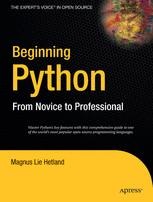
Beginning Python : From novice to professional
Ten different projects illustrate the concepts introduced in the book. You will learn how to create a P2P file-sharing application and a web-based bulletin board, and how to remotely edit web-based documents and create games. Author Magnus Lie Hetland is an authority on Python and previously authored Practical Python. He also authored the popular online guide, Instant Python Hacking, on which both books are base
Beginning Google Maps Applications with PHP and Ajax : From novice to professional
Until recently, building interactive web-based mapping applications has been a cumbersome affair. This changed when Google released its powerful Maps API. Beginning Google Maps Applications with PHP and Ajax was written to help you take advantage of this technology in your own endeavorswhether you're an enthusiast playing for fun or a professional building for profit. This book covers version 2 of the API, including Google's new Geocoding service. As well as providing hands-on examples of real mapping projects, this book supplies a complete reference for the Maps API, along with the relevant aspects of JavaScript, CSS, PHP, and SQL. Visit the authors' website for additional tips and advice.

Applications of declarative programming and knowledge management ; 15th international conference on applications of declarative programming and knowledge management, INAP 2004, and 18th workshop on logic programming, WLP 2004, Potsdam, Germany, March 4-6, 2004, Revised Selected Papers
This volume contains a selection of papers presented at the 15th International Conference on Applications of Declarative Programming and Knowledge M- agement, INAP 2004, and the 18th Workshop on Logic Programming, WLP 2004, Declarative programming is an advanced paradigm for the modeling and solving of complex problems. This speci?cation method has become more and more attractive in recent years, Thetopicsoftheselectedpapersofthisyear’sjointconferenceconcentrateon three currently important ?elds: knowledge management and decision support, constraint programming and constraint solving, and declarative programming and Web-based systems.
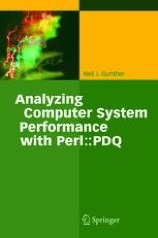
Analyzing computer system performance with Perl::PDQ
Analyzing computer system performance is often regarded by most system administrators, IT professionals and software engineers as a black art that is too time consuming to learn and apply. Finally, this book by acclaimed performance analyst Dr. Neil Gunther makes this subject understandable and applicable through programmatic examples. The means to this end is the open-source performance analyzer Pretty Damn Quick (PDQ) written in Perl As the epigraph in this book points out, Common sense is the pitfall of performance analysis. The performance analysis framework that replaces common sense is revealed in the first few chapters of Part I. The important queueing concepts embedded in PDQ are explained in a very simple style that does not require any knowledge of formal probability theory. Part II begins with a full specification of how to set up and use PDQ replete with examples written in Perl. Subsequent chapters present applications of PDQ to the performance analysis of multicomputer architectures, benchmark results, client/server scalability, and Web-based applications.
