



Page 2
Page 2

Faith, finance, and economy : Beliefs and economic well-being
This book seeks to foster a multidisciplinary understanding of the ties between faith, financial intermediation, and economic progress by drawing on research across economics, finance, history, philosophy, ethics, theology, public policy, law, and other disciplines.

Experimenting with Dynamic Macromodels : Growth and Cycles
This book presents a macroeconomic dynamic model à la Solow-Swan, including the market for labour, in a discrete time structure. Labour supply is modelled as a reversed S curve (derived in the appendix). The models are expanded to include expenditure on R&D (thus endogenous technical progress), and public expenditure on infrastructures. For each of the three models, numerical simulations are implemented in MAPLE, and the results are shown in time series figures, which make it easy to detect that even small changes in the parameters produce responses in the time behaviour of the main variables: from steady growth, to regular cycles, to chaotic-like time paths. The simulations show that cycles do not promote material welfare, as measured by total undiscounted consumption along the time horizon, and that the comparative action of R&D versus public expenditure is strictly linked to the values assigned to the parameters.

EU-Turkey Relations : Theories, Institutions, and Policies
This book explores the new complexities and ambiguities that epitomize EU-Turkey relations. With a strong focus on the developments in the last decade, the book provides full access to a comprehensive understanding of the multifaceted relationship through three entry points: (1) Theories and Concepts, (2) Institutions, and (3) Policies. Part I brings together complementary and competing analytical approaches to study the evolution of EU-Turkey relations, ranging from traditional integration theories to novel concepts. Part II investigates the institutional machinery of EU-Turkey relations by analyzing the roles and perspectives of the European Council, the European Commission, and the European Parliament. Part III offers analyses of the policies most relevant for the relationship: enlargement policy, trade and macroeconomic policies, foreign and security policy, migration and asylum policies, and energy policy. In Part IV, the volume closes with a systematic survey of the conditions under which cooperative trends in EU-Turkey relations could be (re)invigorated. The systematic setup and the balanced combination of distinguished experts from EU- and Turkey-based institutions make this book a fundamental reading for students, researchers, lecturers, and practitioners of EU-Turkey relations, European integration and Turkish foreign policy.

Encyclopedia of Finance
The Encyclopedia of Finance, Second Edition, comprised of over 1000 individual definitions and chapters, is the most comprehensive and up-to-date resource in the field, integrating the most current terminology, research, theory, and practical applications. Showcasing contributions from an international array of experts, the revised edition of this major reference work is unparalleled in the breadth and depth of its coverage.

Emergent Macroeconomics : An Agent-Based Approach to Business Fluctuations
This book contributes substantively to the current state-of-the-art of macroeconomics by providing a method for building models in which business cycles and economic growth emerge from the interactions of a large number of heterogeneous agents. Drawing from recent advances in agent-based computational modeling, the authors show how insights from dispersed fields like the microeconomics of capital market imperfections, industrial dynamics and the theory of stochastic processes can be fruitfully combined to improve our understanding of macroeconomic dynamics. This book should be a valuable resource for all researchers interested in analyzing macroeconomic issues without recurring to a fictitious representative agent.

Economics: Complex Windows
This volume contains papers that provide an analysis of topics in the following areas: Agent Based Models, Non-linear Time Series Analysis, Financial Market Dynamics, Econo-physics, Deterministic Chaos, Macroeconomic Dynamics. Economics: Complex Windows, does not present contributions to the sterile debate as to the merits of the different grand, or potentially grand paradigms of economics. Rather it offers a balanced collection of methodological advances which can be applied to concrete economic problems. Starting with a presentation of the "complexity approach" to economics, it goes on to provide a collection of applications to areas such as the analysis of market imperfections, risk assessment, non-linear dynamics, forecasting and highly irregular fluctuations. The tools used help to provide a clearer understanding and a more accurate analysis of these areas of economics. They also highlight the gulf which exists between current economic theory and real economic practice. The basic idea is to encourage economic researchers to embrace a more open and pragmatic approach to economics rather than to reluctantly move in this direction as if it were somehow a betrayal of established dogma. We hope, in this way, to open up avenues which will lead to progress beyond the "holy trinity", (rationality, equilibrium and greed) of modern economics.

Economic spillovers, structural reforms and policy coordination in the Euro area
This book analyses economic interdependence in the Euro Area and provides estimates of the sign and size of economic spillovers and the impact of economic policy coordination concerning structural and budgetary policies on economic performance in the Euro Area. In the different chapters of the book, the following topics are studied: (i) the link between fiscal and monetary policies in the Euro Area; (ii) the link between public debt and long-term interest rates in the Euro Area; (iii) the link between budgetary stabilisation and the level of public debt in the Euro Area; (iv) the spillovers from structural reforms in the Euro Area, (v) the scope for the coordination of fiscal policies and of structural reforms in the Euro Area, and (vi) wage flexibility in the Euro Area.

Economic Liberalization and Integration Policy : Options for Eastern Europe and Russia
The authors of this book analyze the dynamics of macroeconomic and structural developments in Eastern Europe and Russia, with special attention paid to problems of international and national integration, "Dutch disease" and natural resource dependency, and distortions in institutional reforms. The analysis also sheds light on how these problems have implications for cooperation among OECD-countries. A critical focus is on institutional adjustment and learning, human capital formation, trade and foreign investment.

Dynamic Modeling of Monetary and Fiscal Cooperation Among Nations
The first four chapters introduce the reader to the dynamics of fiscal and monetary policy cooperation. Issues covered include: fiscal coordination, fiscal stringency requirements, structural and bargaining power asymmetries and the design of monetary and fiscal policymaking in a monetary union. In the four last chapters multiple-player settings with aspects of fiscal and/or monetary coordination are analyzed using the endogenous coalition formation approach. The analysis is focused on shock and model asymmetries and issues of multi-country coordination in the presence of (possibly many) monetary unions.

Consumption structure and macroeconomics : Structural change and the relationship between inequality and growth
This book offers a novel perspective that allows to incorporate changing consumption and production structure into models of economic growth. Starting from the empirical observation that income and consumption structure are closely related, it develops a tractable theoretical framework which enables to analyze macroeconomic models consistent with these empirical facts. As a result, central macroeconomic phenomena are better understood: the reasons behind long-run growth, structural change, and the influence of inequality on innovations and growth.

Consumer behavior, organizational strategy and financial economics ; Proceedings of the 21st eurasia business and economics society conference
Shows selected articles from the 21st Eurasia business and economics society (EBES) conference, Which was held in Budapest (Hungary) in 2017. The theoretical and empirical papers in this volume cover various areas of business, economics, and finance from a diverse range of regions. In particular, this volume focuses on the latest trends in consumer behavior, New questions in the development of organizational strategy, And the interaction of financial economics with industrial economics and policy.

Computational Methods in Financial Engineering : Essays in Honour of Manfred Gilli
The focus of this book is the development of computational methods and analytical models in financial engineering that rely on computation. The book contains eighteen chapters written by leading researchers in the area on portfolio optimization and option pricing; estimation and classification; banking; risk and macroeconomic modelling. It explores and brings together current research tools and will be of interest to researchers, analysts and practitioners in policy and investment decisions in economics and finance. "This book collects frontier work by researchers in computational economics in a tribute to Manfred Gilli, a leading member of this community. Contributions cover many of the topics researched by Gilli during his career: portfolio optimization and option pricing, estimation and classification, as well as banking, risk and macroeconomic modeling. The editors have put together a remarkable panorama of the rapidly growing and diversifying field of computational economics and finance

Cognitive Wireless Communication Networks
this book offers a wide range of information on the subject. Topics covered include the fundamental challenges and issues in designing cognitive radio systems to the information-theoretic analysis of such systems, spectrum sensing and co-existence issues, adaptive physical layer protocols and link adaptation techniques for cognitive radio, orthogonal frequency division multiple access (OFDM) and ultra wide band (UWB)-based cognitive radio, different techniques for spectrum access by distributed cognitive radio, cognitive medium access control (MAC) protocols, decentralized learning-based dynamic spectrum access methods as well as macroeconomic models for spectrum management in cognitive radio.
Macroeconomics of Monetary Union
This book, unlike other books, provides readers with a practical yet sophisticated grasp of the macroeconomic principles necessary to understand a monetary union. By definition, a monetary union is a group of countries that share a common currency. The most important case in point is the Euro area. Policy makers are the central bank, national governments, and national labour unions. Policy targets are price stability and full employment. Policy makers follow cold-turkey or gradualist strategies. Policy decisions are taken sequentially or simultaneously. The countries can differ in size or behaviour. Policy expectations are adaptive or rational. To illustrate all of this there are numerical simulations of monetary policy, fiscal policy, and wage policy.

Macroeconomic Risk Management Against Natural Disasters : Analysis focussed on governments in developing countries
Natural disasters cause considerable economic damage. While developed countries usually are able to cope with the impacts of natural hazards, developing countries are faced with severe consequences for their resources. In order to prevent long-term macroeconomic repercussions, governments need a comprehensive disaster risk management strategy.Budgetary resources are allocated to pre-disaster risk management strategies to reduce the probability of financing gaps. The framework and model approach allows cross country comparisons as well as the assessment of financial vulnerability, macroeconomic risk, and risk management strategies.
Macroeconomic modelling of R&D and innovation policies
This book encompasses a collection of in-depth analyses showcasing the challenges and ways forward for macroeconomic modelling of R&D and innovation policies. Based upon the proceedings of the EC-DG JRC-IEA workshop held in Brussels in 2017, it presents cutting-edge contributions from a number of leading economists in the field. It provides a comprehensive overview of the current academic and policy challenges surrounding R&D as well as of the state-of-the-art modelling techniques.
Macroeconomic analysis for economic growth
Discusses the essential principles that guide macroeconomic policy formulation and implementation to stimulate strong economic growth for sustainable development, especially for emerging economies. it includes twelve chapters over three sections: "macroeconomics of economic growth", "labour market and employment", and "the financial system and macroeconomic performance". key conclusions illustrate that the efficacy of regulatory frameworks to create enabling conditions for nurturing and bolstering robust value-adding production structures anchored on appropriate macroeconomic management are the fundamental building blocks of strong economic growth.
Long Memory in Economics
When applying the statistical theory of long range dependent (LRD) processes to economics, the strong complexity of macroeconomic and financial variables, compared to standard LRD processes, becomes apparent. In order to get a better understanding of the behaviour of some economic variables, the book assembles three different strands of long memory analysis: statistical literature on the properties of, and tests for, LRD processes; mathematical literature on the stochastic processes involved; models from economic theory providing plausible micro foundations for the occurence of long memory in economics. Each chapter of the book will give a comprehensive survey of the state of the art and the directions that future developments are likely to take. Taken as a whole the book provides an overview of LRD processes which is accessible to economists, econometricians and statisticians.

Liquidity, markets and trading in action : An interdisciplinary perspective
This book addresses four standard business school subjects: microeconomics, macroeconomics, finance and information systems as they relate to trading, liquidity, and market structure. It provides a detailed examination of the impact of trading costs and other impediments of trading that the authors call “frictions”. It also presents an interactive simulation model of equity market trading, TraderEx, that enables students to implement trading decisions in different market scenarios and structures. Addressing these topics shines a bright light on how a real-world financial market operates, and the simulation provides students with an experiential learning opportunity that is informative and fun.
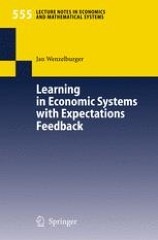
Learning in Economic Systems with Expectations Feedback
Recently economists have more and more focussed on scenarios in which agents' views of the world may be erroneous. These notes introduce the concept of perfect forecasting rules which provide best least-squares predictions along the evolution of an economic system.
