



Page 2
Page 2

Knowledge Representation Techniques : A Rough Set Approach
The basis for the material in this book centers around a long term research project with autonomous unmanned aerial vehicle systems. One of the main research topics in the project is knowledge representation and reasoning. The focus of the research has been on the development of tractable combinations of approximate and nonmonotonic reasoning systems. The techniques developed are based on intuitions from rough set theory. Efforts have been made to take theory into practice by instantiating research results in the context of traditional relational database or deductive database systems.
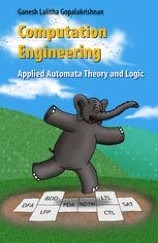
Computation Engineering : Applied Automata Theory and Logic
This book covers automata in depth, providing good intuitions along the way, and culminating with applications that are used every day in the field. In this respect, it is a departure from the conventional textbooks on complexity and computability, although these 'tradtional' aspects remain well represented.
Building intuition : Insights from basic operations management models and principles
"‘This user-friendly book will help the reader to develop insights with respect to a number of models that are important in the study and practice of operations management’. … all the chapters are extremely well written and a pleasure to read. … This would be a good book to use as a text in any operations management course, and in particular for operations management courses which are part of a ‘liberal studies’ program. It would also be good book for managers … ." (R Bharath, Journal of the Operational Research society, Vol. 60 (7), 2009)

Brouwer meets Husserl : On the Phenomenology of Choice Sequences
Can the straight line be analysed mathematically such that it does not fall apart into a set of discrete points, as is usually done but through which its fundamental continuity is lost? And are there objects of pure mathematics that can change through time? The mathematician and philosopher L.E.J. Brouwer argued that the two questions are closely related and that the answer to both is "yes''. To this end he introduced a new kind of object into mathematics, the choice sequence. But other mathematicians and philosophers have been voicing objections to choice sequences from the start. This book aims to provide a sound philosophical basis for Brouwer's choice sequences by subjecting them to a phenomenological critique in the style of the later Husserl.
Automated Reasoning with Analytic Tableaux and Related Methods ; 16th International Conference, TABLEAUX 2007, Aix en Provence, France, July 3-6, 2007, Proceedings
It covers the wide range of logics, from intuitionistic and substructural logics to modal logics (including temporal and dynamic logics), from many-valued logics to nonmonotonic logics, and from classical first-order logic to description logics.

Automated deduction – CADE-21 ; 21st International Conference on automated deduction, Bremen, Germany, July 17-20, 2007, Proceedings
All current aspects of automated deduction are addressed, ranging from theoretical and methodological issues to presentation and evaluation of theorem provers and logical reasoning systems. The papers are organized in topical sections on higher-order logic, description logic, intuitionistic logic, satisfiability modulo theories, induction, rewriting, and polymorphism, first-order logic, model checking and verification, termination, as well as tableaux and first-order systems.

Applications of Fuzzy Sets Theory ; 7th International Workshop on Fuzzy Logic and Applications, WILF 2007, Camogli, Italy, July 7-10, 2007, Proceedings
The book is organized in topical sections on fuzzy set theory, fuzzy information access and retrieval, fuzzy machine learning, fuzzy architectures and systems; and special sessions on intuitionistic fuzzy sets and soft computing in image processing.
Analytic Methods for Design Practice
In the competitive world of modern engineering, rigorous and definite design methodologies are needed. However, many parts of engineering design are performed in either an ad-hoc manner or based on the intuition of the engineer.Analytic Methods for Design Practice is the first book to look at both stages of the design process – conceptual design and detailed design – and detail design methodologies for every step of the entire design process. The book introduces the following analytic design methodologies and explores their usefulness with many mathematical and practical examples: Axiomatic design; Optimization; Design of experiments; Robust design; Structural optimization; Dynamic response optimization; and Multidisciplinary optimization. A chapter of the book is devoted to case studies showing how practical design problems can be solved with analytic design methods based on Professor Park’s experiences of teaching design engineering over the past ten years.
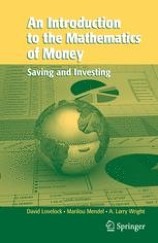
An Introduction to the Mathematics of Money : Saving and Investing
This is an undergraduate textbook on the basic aspects of personal savings and investing with a balanced mix of mathematical rigor and economic intuition. It uses routine financial calculations as the motivation and basis for tools of elementary real analysis rather than taking the latter as given. Proofs using induction, recurrence relations and proofs by contradiction are covered. Inequalities such as the Arithmetic-Geometric Mean Inequality and the Cauchy-Schwarz Inequality are used. Basic topics in probability and statistics are presented.
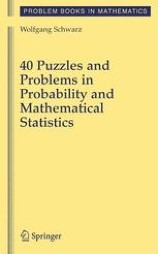
40 Puzzles and Problems in Probability and Mathematical Statistics
"40 Puzzles and Problems in Probability and Mathematical Statistics" is intended to teach the reader to think probabilistically by solving challenging, non-standard probability problems. The motivation for this clearly written collection lies in the belief that challenging problems help to develop, and to sharpen, our probabilistic intuition much better than plain-style deductions from abstract concepts. The selected problems fall into two broad categories. Problems related to probability theory come first, followed by problems related to the application of probability to the field of mathematical statistics. All problems seek to convey a non-standard aspect or an approach which is not immediately obvious.
