



Page 2
Page 2
Modeling and Using Context ; 5th International and Interdisciplinary Conference, CONTEXT 2005, Paris, France, July 5-8, 2005, Proceedings
Context is of crucial importance for research and applications in many disciplines, as evidenced by many workshops, symposia, seminars, and conferences on specific aspects of context. The International and Interdisciplinary Conference on Modeling and Using Context (CONTEXT), the oldest conference series focusing on context, provides a unique interdisciplinary emphasis, bringing together participants from a wide range of disciplines, including artificial intelligence, cognitive science, computer science, linguistics, organizational science, philosophy, psychology, ubiquitous computing, and application areas such as medicine and law, to discuss and report on context-related research and projects. Previous CONTEXT conferences were held in Rio de Janeiro, Brazil (1997), Trento, Italy (1999, LNCS 1688), Dundee, UK (2001, LNCS 2116), and Palo Alto, USA (2003, LNCS 2680). CONTEXT 2005 was held in Paris, France during July 5–8, 2005. There was a strong response to the CONTEXT 2005 Call for Papers, with 120 submissions received. A careful review process assessed all submissions, with each paper first reviewed by the international Program Committee, and then reviewer discussions were initiated as needed to assure that the final decisions carefully considered all aspects of each paper. Reviews of submissions by the Program Chairs were supervised independently and anonymously, to assure fair consideration of all work. Out of the 120 submissions, 23 were selected as full papers for oral presentation, and 20 were selected as full papers for poster presentation. These outstanding papers are presented in this proceedings.
Model-Driven Development of Reliable Automotive Services ; 2nd Automotive Software Workshop, ASWSD 2006, San Diego, CA, USA, March 15-17, 2006, Revised Selected Papers
This book constitutes the thoroughly refereed post-workshop proceedings of the Second Automotive Software Workshop, ASWSD 2006, held in San Diego, CA, USA in March 2006.The 11 revised full papers presented were carefully reviewed and selected from 18 lectures held at the workshop, that brought together experts from industry and academia, working on highly complex, distributed, reactive software systems related to the automotive domain. The papers are organized in topical sections on modeling techniques and infrastructures, model transformations, quality assurance, real-time control, as well as services and components.

Model-Driven Architecture - Foundations and Applications ; 2nd European Conference, ECMDA-FA 2006, Bilbao, Spain, July 10-13, 2006, Proceedings
The goal of the European Conference on Model-Driven Architecture — Foundations and Applications (ECMDA-FA) is to bring together industry and academia to tackle the problems in model-driven development. This volume includes 18 foundation papers and 12 application papers, which is a fine balance between both worlds. ECMDA-FA 2006 also hosted six workshops on both theoretical and practical aspects of MDA. Furthermore, the keynote speakers, David Frankel and Bran Selic, from some of the world’s largest IT companies proved that industry is very much involved in MDA. This second ECMDA-FA conference is the result of the work of the authors who submitted a total of 78 papers, the Program Committee members who took the effort to review the papers, the people organizing the workshops, and of course the Steering Committee. All in all, several hundreds of people have worked hard to make this conference a success.
Model-Based Engineering of Collaborative Embedded Systems : Extensions of the SPES Methodology
This book presents the results of the "Collaborative Embedded Systems" (CrESt) project, aimed at adapting and complementing the methodology underlying modeling techniques developed to cope with the challenges of the dynamic structures of collaborative embedded systems (CESs) based on the SPES development methodology.

Model Driven Architecture : Foundations and Applications ; 1st European Conference, ECMDA-FA 2005, Nuremberg, Germany, November 7-10, 2005, Proceedings
Constitutes the refereed proceedings of the First European Conference, Workshops on Model Driven Architecture - Foundations and Applications, ECMDA-FA 2005, held in Nuremberg, Germany, in November, 2005. The papers are organized in topical sections on MDA development processes, MDA for embedded and real-time systems, and more.
Model Driven Architecture - Foundations and Applications ; 4th European Conference, ECMDA-FA 2008, Berlin, Germany, June 9-13, 2008. Proceedings
The 31 revised full papers presented - 21 research papers and 10 industry papers - were carefully reviewed and selected from 87 submissions. The papers address all current issues of model-driven architecture, i.e. model management, executable models, concrete syntaxes, aspects, and concerns, validation and testing, model-based systems engineering, model-driven development and service-oriented architectures, and the application of model-driven development. The papers are organized in topical sections on model management, executable models, concrete syntaxes, aspects and concerns, validation and testing, model-based systems engineering, model-driven development and service-oriented architectures, as well as surveys on applying model-driven development.

MICAI 2008 : Advances in Artificial Intelligence ;7th Mexican International Conference on Artificial Intelligence, Atizapán de Zaragoza, Mexico, October 27-31, 2008 Proceedings
The 96 revised full papers presented together with 2 invited lectures were carefully reviewed and selected from 363 submissions. The papers are organized in topical sections on logic and reasoning, knowledge-based systems, knowledge representation and acquisition, ontologies, natural language processing, machine learning, pattern recognition, data mining, neural networks, genetic algorithms, hybrid intelligent systems, computer vision and image processing, robotics, planning and scheduling, uncertainty and probabilistic reasoning, fuzzy logic, intelligent tutoring systems, multi-agent systems and distributed ai, intelligent organizations, bioinformatics and medical applications, as well as applications.
Introduction to Data Mining and its Applications
This book explores the concepts of data mining and data warehousing, a promising and flourishing frontier in data base systems and new data base applications and is also designed to give a broad, yet in-depth overview of the field of data mining. Data mining is a multidisciplinary field, drawing work from areas including database technology, AI, machine learning, NN, statistics, pattern recognition, knowledge based systems, knowledge acquisition, information retrieval, high performance computing and data visualization.

Introducing Blockchain Applications : Understand and Develop Blockchain Applications Through Distributed Systems
Deepen your understanding of blockchain technology and develop your own blockchain applications. This book provides a thorough review of distribution-based systems on blockchain technology, starting from the fundamental concepts that underlie it, all the way through the implementation of a blockchain network for business purposes. ou will: Learn the concept of blockchains by way of a practical example Grasp the connection between distributed systems and blockchain technology Learn the design of blockchain with hyperledger fabric Learn the design of cyber-physical systems in a distributed environment

Interval / Probabilistic Uncertainty and Non-Classical Logics
Contains proceedings of the first international workshop that brought together researchers working on interval and probabilistic uncertainty and on non-classical logics. We hope that this workshop will lead to a boost in the much-needed collaboration between the uncertainty analysis and non-classical logic communities, and thus, to better processing of uncertainty.

Internet of things. information processing in an increasingly connected world ; First IFIP International Cross-Domain Conference, IFIPIoT 2018, Held at the 24th IFIP World Computer Congress, WCC 2018, Poznan, Poland, September 18-19, 2018, Revised Selected Papers
This book cover a wide range of topics from a technology to a business perspective and include among others hardware, software and management aspects, process innovation, privacy, power consumption, architecture, applications.

Interactive storytelling ; 1st Joint International Conference on interactive digital storytelling, ICIDS 2008 Erfurt, Germany, November 26-29, 2008 Proceedings
This book constitutes the refereed proceedings of the First Joint International Conference on Interactive Digital Storytelling, ICIDS 2008, held in Erfurt, Germany, in November 2008.The 19 revised full papers, 5 revised short papers, and 5 poster papers presented together with 3 invited lectures and 8 demo papers were carefully reviewed and selected from 62 submission. The papers are organized in topical sections on future perspectives on interactive digital storytelling, interactive storytelling applications, virtual characters and agents, user experience and dramatic immersion, architectures for story generation, models for drama management and interacting with stories, as well as authoring and creation of interactive narrative.

Intelligent Human Computer Interaction ; 9th International Conference, IHCI 2017, Evry, France, December 11-13, 2017, Proceedings
This book constitutes the thoroughly refereed proceedings of the 9th International Conference on Intelligent Human Computer Interaction, IHCI 2017, held in Evry, France, in December 2017.The 15 papers presented together with three invited papers were carefully reviewed and selected from 25 submissions. The conference is forum for the presentation of technological advances and research results at the crossroads of human-computer interaction, artificial intelligence, signal processing and computer vision.

Intelligent Educational Machines : Methodologies and Experiences
Artificial Intelligence and Education is an ever-growing research area. It uses artificial intelligence tools and techniques to provide the foundations for intelligent tutoring and learning systems. The main concern is taking advantage of computer-based technology to examine, discuss and foster the processes of cognition, learning, teaching and related subjects. This book supports and develops innovative teaching methods and learning systems. The goal of this volume has been to offer a wide spectrum of sample works developed in leading research throughout the world about innovative methodologies of artificial intelligence in education and foundations of engineering educational intelligent systems as well as applications and interesting experiences in the field. The book should be useful both for beginners and experienced researchers interested in applying computational intelligence to the educational process.
Intelligent Agents and Multi-Agent Systems ; 7th Pacific Rim International Workshop on Multi-Agents, PRIMA 2004, Auckland, New Zealand, August 8-13, 2004, Revised Selected Papers
A Combined System for Update Logic and Belief Revision.- Using Messaging Structure to Evolve Agents Roles in Electronic Markets.- Specifying DIMA Multi-agents Models Using Maude.- picoPlangent: An Intelligent Mobile Agent System for Ubiquitous Computing.- An Approach to Safe Continuous Planning.- Modeling e-Procurement as Co-adaptive Matchmaking with Mutual Relevance Feedback.- Price Determination and Profit Sharing for Bidding Groups in Agent-Mediated Auctions.- Agent Based Risk Management Methods for Speculative Actions.- Handling Emergent Resource Use Oscillations.- The Role of Agents in Intelligent Mobile Services.

Intelligent Agents and Multi-Agent Systems ; 11th Pacific Rim International Conference on Multi-Agents, PRIMA 2008, Hanoi, Vietnam, December 15-16, 2008. Proceedings
This book constitutes the proceedings of the the 11th Pacific Rim International Conference on Multi-Agents, PRIMA 2008, held in Hanoi, Vietnam, in December 2008.The 19 regular papers and 22 short papers presented together with 3 keynote speeches, were carefully reviewed and selected from 56 submissions. Many current subjects in multi-agent research and development are addressed, ranging from theoretical and methodological issues to various applications in different fields. There was a track on multi-issue negotiation and agents and HCI.

Innovative Learning Environments in STEM Higher Education : Opportunities, Challenges, and Looking Forward
As explored in this book, higher education in STEM fields is influenced by many factors, including education research, government and school policies, financial considerations, technology limitations, and acceptance of innovations by faculty and students.

Innovative Internet Computing Systems ; 2nd International Workshop, IICS 2002, Kühlungsborn, Germany, June 20-22, 2002, Proceedings
Constitutes the proceedings of the second international workshop on Innovative Internet Computing Systems, held in Germany in 2002. The 20 papers cover large-scale distributed computing infrastructures, management and retrieval of web-based information, content classification and more.

Innovative Concepts for Autonomic and Agent-Based Systems ; 2nd International Workshop on Radical Agent Concepts, WRAC 2005, Greenbelt, MD, USA, September 20-22, 2005, Revised Papers
This volume includes revised versions of papers presented at the workshop. The workshop was structured so as to allow adequate time for discussion and interaction, to exchange ideas and reflect on the motivations, scientific grounds and practical consequences of the concepts presented. Many of the ideas are truly “radical”, and so authors were given time to revise their papers to reflect further thoughts on the ideas presented and to reflect feedback received at the workshop. We are grateful to Jeff Kephart for a very interesting keynote speech describing IBM’s current and future work in this field, which fit very well with the aims and scope of the workshop.
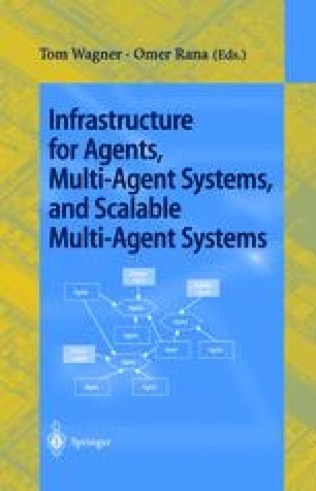
Infrastructure for Agents, Multi-Agent Systems, and Scalable Multi-Agent Systems ; International Workshop on Infrastructure for Scalable Multi-Agent Systems, Barcelona, Spain, June 3-7, 2000 Revised Papers
Building research grade multi-agent systems usually involves a broad variety of software infrastructure ingredients like planning, scheduling, coordination, communication, transport, simulation, and module integration technologies and as such constitutes a great challenge to the individual researcher active in the area. The book presents a collection of papers on approaches that will help make deployed and large scale multi-agent systems a reality. The first part focuses on available infrastructure and requirements for constructing research-grade agents and multi-agent systems. The second part deals with support in infrastructure and software development methods for multi-agent systems that can directly support coordination and management of large multi-agent communities; performance analysis and scalability techniques are needed to promote deployment of multi-agent systems to professionals in software engineering and information technology.
