



Page 192
Page 192
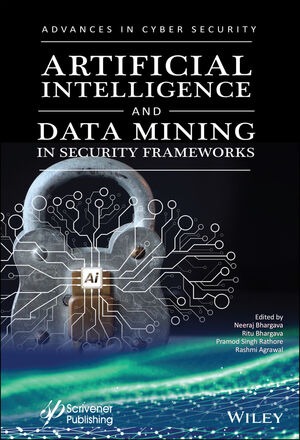
Artificial intelligence and data mining approaches in security frameworks
Offers solutions to the problems of security, outlining the concepts behind allowing computers to learn from experience and understand the world in terms of a hierarchy of concepts, with each concept defined through its relation to simpler concepts. provides state of the art approaches of artificial intelligence and data mining in these areas. It includes areas of detection, prediction, as well as future framework identification, development, building service systems and analytical aspects. In all these topics, applications of AI and data mining, such as artificial neural networks, fuzzy logic, genetic algorithm and hybrid mechanisms, are explained and explored. This book is aimed at the modeling and performance prediction of efficient security framework systems, bringing to light a new dimension in the theory and practice. This groundbreaking new volume presents these topics and trends, bridging the research gap on AI and data mining to enable wide-scale implementation. Whether for the veteran engineer or the student, this is a must-have for any library. This groundbreaking new volume: Clarifies the understanding of certain key mechanisms of technology helpful in the use of artificial intelligence and data mining in security frameworks ; Covers practical approaches to the problems engineers face in working in this field, focusing on the applications used every day ; Contains numerous examples, offering critical solutions to engineers and scientists ; Presents these new applications of AI and data mining that are of prime importance to human civilization as a whole
Artificial intelligence : Methodology, systems, and applications ; 13th International Conference, AIMSA 2008, Varna, Bulgaria, September 4-6, 2008. Proceedings
This book constitutes the refereed proceedings of the 13th International Conference on Artificial Intelligence: Methodology, Systems, and Applications, AIMSA 2008, held in Varna, Bulgaria in September 2008.

Artificial intelligence : Methodology, systems, and applications ; 12th International Conference, AIMSA 2006, Varna, Bulgaria, September 12-15, 2006, Proceedings
This book constitutes the refereed proceedings of the 12th International Conference on Artificial Intelligence: Methodology, Systems, and Applications, AIMSA 2006. The 28 revised full papers presented together with the abstracts of 2 invited lectures were carefully reviewed and selected from 81 submissions. The papers are organized in topical sections on agents, constraints and optimization, user concerns, decision support, models and ontologies, machine learning, ontology manipulation, natural language processing, and applications.

Artificial intelligence : Methodology, systems, and applications ; 10th International Conference, AIMSA 2002, Varna, Bulgaria, September 4-6, 2002. Proceedings
The AIMSA conference series was frst conceived in 1984 as a gathering of AI researchers and students from Eastern and Central Europe.Sincethenthecon- rence has followed a biennial schedule of meetings in Bulgaria, attracting parti- pantsfrom awidergeographicalarea.The AIMSA organizers are delighted to present you with another exciting program, coveringmostareasof Artifcial Intelligence.Inkeepingwithitsm- sion to inform the research community and excite the commercial sector, AIMSA presents this year two invited contributions from world-leading European rese- chersworkingoncutting-edgeAIresearch: Prof.CaroleGoble, ontheSemantic Web.

Artificial immune systems ; Vol. 3627 ; 4th International conference, ICARIS 2005, Banff, Alberta, Canada, August 14-17, 2005, Proceedings
Your immune system is unique. It is in many ways as complex as your brain, butit is not centred in one location, like the brain. It is not a single organ—it consistsof many different cell types, diverse methods of intercellular communication, andmany different organs. Its functionality is blurred throughout you—we can’textract the immune system, or point to where it begins and ends. The immunesystem is not separable from the system it protects. It has integral links to everyorgan of our bodies.This has radical implications for the field of Artificial Immune Systems (AIS),that we are only now beginning to comprehend. One of the first insights is thatmodelling the immune system, or developing any kind of immune algorithm, isdifficult. The immune system is one aspect of biology that we find difficult toapply simple reductionist explanations to. We can very successfully extract sub-processes of the whole and create immune algorithms based on those processes.

Artificial immune systems ; 7th International Conference, ICARIS 2008, Phuket, Thailand, August 10-13, 2008. Proceedings
This book constitutes the refereed proceedings of the 7th International Conference on Artificial Immune Systems, ICARIS 2008, held in Phuket, Thailand, in August 2008.
Artificial economics : Agent-based methods in finance, game theory and their applications
The purpose of this book is to give an up-to date view of the scientific production in the fields of Agent-based Computational Economics (mainly in Market Finance and Game Theory). Based on communications given at AE'2005 (Lille, USTL, France), this book offers a wide panorama of recent advances in ACE (both theoretical and methodological) that will interest academics as well as practitioners.

Articulated Motion and Doformable Objects ; 4th International Conference, AMDO 2006, Port d'Andratx, Mallorca, Spain, July 11-14, 2006, Proceedings
The subject of the conference was ongoing research in articulated motionon a sequence of images and sophisticated models for deformable objects. Thegoals of these areas are to understand and interpret the motion of complexobjects that can be found in sequences of images in the real world. The maintopics considered as priority were: geometric and physical deformable models,motion analysis, articulated models and animation, modelling and visualizationof deformable models, deformable models applications, motion analysis applica-tions, single or multiple human motion analysis and synthesis, face modelling,tracking, recovering and recognition models, virtual and augmentedreality, haptics devices, biometrics techniques.

Articulated motion and deformable objects ; 5th International Conference, AMDO 2008, Port d’Andratx, Mallorca, Spain, July 9-11, 2008. Proceedings
This book constitutes the refereed proceedings of the 5th International Conference on Articulated Motion and Deformable Objects, AMDO 2008, held in Port d'Andratx, Mallorca, Spain, in July 2008.

Artery guidebook : Artery - transforming riversides for the future
"Artery" is an initiative on a European scale, funded by the INTERREG IIIB NWE programme, which puts riverside restoration and regeneration at the heart of regional strategies, helping communities across Europe ‘turn back to face the water’. In this book the implemented strategies will be discussed, including public-private-partnership, public participation, awareness programs and regional development strategies. The book functions as a guide to facilitate similar future projects in other regions. The valuable experience and methods of trans-national cooperation should be made available to other developers, regional planners, project managers and politicians.
Aritmetica, crittografia e codici = Arithmetic, cryptography and codes
The basic techniques of algebra and number theory useful in recent applications to cryptography and codes are developed, with the aim of being elementary and self-sufficient. The emphasis is on computational problems. This part of the volume can be useful as a textbook for a first course in algebra for mathematicians, computer scientists or engineers. Important applications of algebra and geometry to cryptography and codes are then illustrated. Both, cryptography and codes have significant applications in daily life which are illustrated here. Cryptography is developed in detail in much of its classic and current aspects, and both private and public key cryptography are developed. Cryptography with the use of elliptic curves on finite fields is also illustrated. A chapter introducing the subject is dedicated to linear codes.
Aritmetica : Un approccio computazionale = Arithmetic : A computational approach
Intended to be a contribution to the algorithmic re-reading of some classic topics of elementary number theory and an invitation to more demanding reading, according to the indications provided by the bibliography annexed to it.
Arithmetical investigations : Representation theory, orthogonal polynomials, and quantum interpolations
In this volume the author further develops his philosophy of quantum interpolation between the real numbers and the p-adic numbers. The p-adic numbers contain the p-adic integers Zp which are the inverse limit of the finite rings Z/pn. This gives rise to a tree, and probability measures w on Zp correspond to Markov chains on this tree. From the tree structure one obtains special basis for the Hilbert space L2(Zp,w). The real analogue of the p-adic integers is the interval [-1,1], and a probability measure w on it gives rise to a special basis for L2([-1,1],w) - the orthogonal polynomials, and to a Markov chain on "finite approximations" of [-1,1]. For special (gamma and beta) measures there is a "quantum" or "q-analogue" Markov chain, and a special basis, that within certain limits yield the real and the p-adic theories. This idea can be generalized variously. In representation theory, it is the quantum general linear group GLn(q)that interpolates between the p-adic group GLn(Zp), and between its real (and complex) analogue -the orthogonal On (and unitary Un )groups. There is a similar quantum interpolation between the real and p-adic Fourier transform and between the real and p-adic (local unramified part of) Tate thesis, and Weil explicit sums.

Arithmetic of finite fields ; 8th International Workshop, WAIFI 2020, Rennes, France, July 6–8, 2020, Revised Selected and Invited Papers
This book constitutes the thoroughly refereed post-workshop proceedings of the 8th International Workshop on the Arithmetic of Finite Field, WAIFI 2020, held in Rennes, France in July 2020.
Arithmetic of finite fields ; 2nd International Workshop, WAIFI 2008 Siena, Italy, July 6-9, 2008 Proceedings
This book constitutes the refereed proceedings of the Second International Workshop on the Arithmetic of Finite Fields, WAIFI 2008, held in Siena, Italy, in July 2008.

Arithmetic of finite fields ; 1st International Workshop, WAIFI 2007, Madrid, Spain, June 21-22, 2007, Proceedings
This book presented structures in finite fields, efficient implementation and architectures, efficient finite field arithmetic, classification and construction of mappings over finite fields, curve algebra, cryptography, codes, and discrete structures.
Arithmetic and geometry around hypergeometric functions : Lecture notes of a CIMPA Summer School held at Galatasaray University, Istanbul, 2005
This volume comprises the Lecture Notes of the CIMPA Summer School "Arithmetic and Geometry around Hypergeometric Functions" held at Galatasaray University, Istanbul in 2005. It contains lecture notes, a survey article, research articles, and the results of a problem session.
ARIS design platform : Getting started with BPM
Containing tips, techniques and short cuts gained from practical experience, this book show how to use ARIS in an easy way, supporting smart methods and smart models, and displays how ARIS can be used as a powerful tool for BPM.
Argumentation Methods for Artificial Intelligence in Law
In this book, Walton presents his perspective on argumentation methods for artificial intelligence and law. … the different tools are combined in a way that makes them potentially useful for understanding legal reasoning. … this book offers a valuable perspective on the current state and future research directions of argumentation methods for artificial intelligence and law." (Jelle van Veenen, Artificial Intelligence and Law,
Argumentation in Science Education : Perspectives from Classroom-Based Research
This book brings together the work of leading experts in argumentation in science education. It presents research combining theoretical and empirical perspectives relevant for secondary science classrooms. Since the 1990s, argumentation studies have increased at a rapid pace, from stray papers to a wealth of research exploring ever more sophisticated issues. This volume constitutes a unique collection and covers fundamental issues in argumentation such as cognitive, methodological and epistemological aspects; classroom-based research in teaching and learning of argumentation in science classrooms; and argumentation in context such as in socio-scientific and moral contexts. The book’s underlying premise is that argumentation is a significant aspect of scientific inquiry and plays an important role in teaching and learning of science.
