



Page 154
Page 154

Foundation Website Creation with CSS, XHTML, and JavaScript
Foundation Website Creation with CSS, XHTML, and JavaScript covers the entire process of building a website. This process involves much more than just technical knowledge, and this book provides you with all the information you'll need to understand the concepts behind designing and developing for the Web, as well as the best means to deliver professional, best-practice-based results. There is far more to building a successful website than knowing a little Hypertext Markup Language (HTML). The process starts long before any coding takes place, and this book introduces you to the agile development process, explaining why this method makes so much sense for web projects and how best to implement it. Planning is vital, so you'll also learn how to use techniques such as brainstorming, wireframes, mockups, and prototypes to get your project off to the best possible start and help ensure smooth progress as it develops.

Foundation PHP5 for Flash
This latest, completely rewritten, edition again brings together three of the web's hottest technologies—Flash, the server-side language PHP, and the MySQL database system. We've brought things back up to date, using ActionScript 2.0, PHP 5.0, and MySQL 4.1, the book has been designed to be version-neutral. In other words, you can be confident that you're working with the latest standards, but that your applications won't break if deployed on an older server. The book also provides a brief introduction to an alternative database system, SQLite, which is now automatically bundled with PHP 5 and requires no installation.

Foundation PHP for Dreamweaver 8
In this book, we look specifically at using Dreamweaver's built-in server behaviors to build dynamic web sites using PHP and MySQL, the world's most popular open source server-side language and database server combination, which are both reliable, powerful, and open source (and therefore free to use). This version of Dreamweaver includes more powerful support for PHP and MySQL than ever before, and we'll show you how to make this work for you. No previous experience of PHP or MySQL is necessary to use this book. Examples built throughout the book include a content management system, and an online image gallery. All examples are designed to meet modern usability requirements and be web standards-compliant.

Foundation of semantic web technologies
Concentrates on Semantic Web technologies standardized by the World Wide Web Consortium: RDF and SPARQL enable data exchange and querying, RDFS and OWL provide expressive ontology modeling, and RIF supports rule-based modeling. The text also describes methods for specifying, querying, and reasoning with ontological information. In addition, it explores topics that are clearly beyond foundations, such as tools, applications, and engineering aspects.

Foundation models for natural language processing : pre-trained language models integrating media
Covers basic natural language processing models, pre-trained language models BERT, GPT, and sequence-to-sequence converters, as well as the concepts of self-attention and context-sensitive embedding. Various approaches to improving these models are then discussed, such as expanding the pre-training parameters, increasing the length of input texts, or incorporating additional knowledge. An overview of the best performing models is then provided for about twenty application areas, e.g., question answering, translation, story generation, dialogue systems, image generation from text, etc. For each application area, the strengths and weaknesses of existing models are discussed, and an overview of further developments is provided. In addition, links to freely available code are provided. The concluding chapter summarizes the economic opportunities, risk mitigation, and potential developments of AI.

Foundation Mathematics for Computer Science : A Visual Approach
In this second edition of Foundation Mathematics for Computer Science, John Vince has reviewed and edited the original book and written new chapters on combinatorics, probability, modular arithmetic and complex numbers. These subjects complement the existing chapters on number systems, algebra, logic, trigonometry, coordinate systems, determinants, vectors, matrices, geometric matrix transforms, differential and integral calculus. During this journey, the author touches upon more esoteric topics such as quaternions, octonions, Grassmann algebra, Barrycentric coordinates, transfinite sets and prime numbers.

Foundation Flex for Developers : Data-Driven Applications with PHP, ASP.NET, ColdFusion, and LCDS
Flex is a very powerful and versatile technology for creating web application front-ends. But what every good web application needs is a robust data source, be it XML, or a database. Flex is very adaptable in terms of connecting to data sources, and that is the main focus of this book. In Foundation Flex for Developers, author Sas Jacobs assumes that you've got the basics of Flex down already, and explores in detail how to create professional data-centric Flex 2 and Flex 3 applications. In the first half of the book, she starts off with a brief exploration of Flex and ActionScript 3.0, before looking at application essentials in detail—creating custom components, user and web browser interactions, binding, formatting, and validating data, debugging, and more. In the second half of the book, the focus is on connecting Flex to data sources, and covers XML, LiveCycle Data Services, PHP, ASP.NET, and ColdFusion in detail, via a series of step-by-step case studies.

Foundation Flex for Designers
All Flex applications look the same—a blue-gray background and silver-skinned components—right? That doesn't have to be the case, though. This book shows you how to ensure that your Flex 2 and 3 projects stand out from the crowd and provide your users with an application that is both visually stunning and beautifully functional. Flex Builder, coupled with the Adobe Creative Suite (CS3), is a powerful combination, providing all the tools you need to create compelling, vibrant interfaces. This book guides you through creating applications with Flex Builder, designing layouts in Fireworks, creating custom skins for your components in Photoshop and Illustrator, and using CSS to enhance the appearance of your rich Internet applications (RIAs).

Foundation Flash CS3 Video
Video is one of the most exciting features on today's Internet, with widespread adoption being made possible by advances in bandwidth and software. But simply streaming video clips to Web users is only the tip of the iceberg! Flash CS3 offers a whole host of advanced video features, allowing you to create breathtaking user experiences. And this book, the second edition of the critically-acclaimed Foundation Flash 8 Video, shows you how to make the most of video in Flash CS3. The authors start with the basics of creating video ready for use on the web using popular applications such as Windows Movie Maker and iMovie, creating FLV (Flash video) using both Flash and other applications such as Sorenson Squeeze, and importing that video into Flash.

Foundation Flash 8 Video
This book is the ultimate guide to Flash 8 video it offers practical advice, technical guidance, and a full series of creative projects ranging from the dead simple to the complex in a manner that talks to you as an equal and makes only one assumption: basic familiarity with the Flash interface. We start with the basicshow to edit video in some of the most popular packages available (such as iMovie and Movie Maker 2) and create a Flash video file and import it into Flash.

Foundation Flash 8
The fourth edition of friends of ED's legendary beginner Flash book, Foundation Flash 8 uses a series of structured exercises and detailed discussions to help you start your exploration of Flash. The detailed tutorial style will ensure that you retain the knowledge you gain and are able to draw upon it throughout your Flash career. Foundation Flash 8 features a running case study that evolves into a fully-functional Flash website as you work through the tutorials, so you'll immediately see everything that you learn being used in a practical project. This book focuses on the core skills that you need to get started working with Flash 8: understanding the interface, becoming familiar with the creative tools and their capabilities, grasping the relationships between the different components that make up a Flash movie, and getting insight into how to put all the pieces together to create your own Flash-based website.
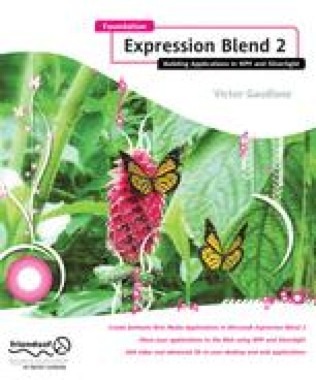
Foundation Expression Blend 2 : Building applications in WPF and silverlight
This book shows you how to take full advantage of Blend's interface, together with and Silverlight's vastly improved designer-developer workflow, guiding you through every step of development from downloading and installing of the development environment through creating finished, functional projects. You'll learn how to create simple drawing applications with the InkCanvas, make tabbed and scrollable interfaces, as well as build fully featured media players, photo galleries, and interactive 3D designs. Each chapter discusses major WPF and Silverlight features, provides a hands-on tutorial, and explains how that feature is implemented in the real world. In the end, you will have a collection of impressive WPF and Silverlight applications that can be added to your portfolio.

Foundation ASP.NET for Flash
If you're a reasonably experienced Flash user who has mastered the basics but wants to empower your SWFs, taking them further toward rich Internet applications, then you've come to the right place! Foundation ASP.NET for Flash will teach you everything you need to know to integrate two of the most exciting technologies used on the Web today. Using Flash and ASP.NET, it's possible to utilize the amazing user interface capabilities of Flash along with the extensive power of ASP.NET to create dynamic, data-driven web applications. In this book, advanced topics are made easy by providing intuitive step-by-step examples. This book covers Flash MX 2004 and Flash 8, ASP.NET 2.0, Visual Studio 2005, and Access and SQL Server 2005. It is an essential part of any Flash or ASP.NET web developer's arsenal.
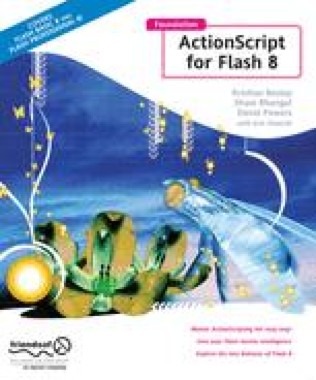
Foundation ActionScript for Flash 8
This book contains all you need to understand and make use of ActionScript, and to have some fun while learning. The Foundation series teaching style is ideal if you're a non-programmer who wants to learn Flash programming quickly and thoroughly. The authors teach the basics, and provide an all-around proficiency in ActionScript, as well as Flash components within Flash 8. You'll gain the practical skills to build ActionScript based Flash projects, including making initial design decisions, structuring code, and testing. An ongoing case study means that by the end of the book, you'll have constructed a cutting-edge Flash site to showcase your newly learned skills.
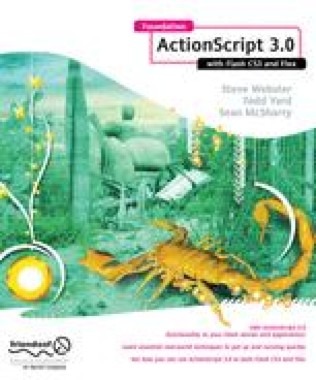
Foundation ActionScript 3.0 with Flash CS3 and Flex
If you want to create exciting dynamic web sites that will amaze your online audience, then the Flash platform is a great way to go, with it's many features, including powerful graphical and sound and video capabilities. To really harness the power of Flash though, you need to make use of ActionScript to provide dynamic effects, enable user interaction, and manipulate data. ActionScript 3.0, the Flash Platform's scripting language, offers a lot of new and powerful features. ActionScript is now a full-fledged programming language, with complete object-oriented capabilities, improved event handling, sound and video support, drawing capabilities, support for regular expressions, and much more. This book covers all the essential techniques from the ground up, allowing you to get up and running quickly and easily. Starting with the fundamentals, you'll learn about using ActionScript objects, manipulating sound and video, and harnessing the power of regular expressions and XML.

Foundation ActionScript 3 Animation : Making Things Move!
The material inside this book covers everything you need to know to harness the power of ActionScript 3.0. The book goes on to provide information on all the relevant trigonometry you will need, before moving on to physics concepts such as acceleration, velocity, easing, springs, collision detection, conservation of momentum, 3D, and forward and inverse kinematics.

Foundation 3ds Max 8 Architectural Visualization
Welcome to the world of 3D architectural visualizations using the most powerful and versatile 3D software package on the planet: 3ds Max. In just the last few years, the visualization industry has arguably become the fastest-growing 3D industry, and may soon overtake all others in total number of users. Just as the use of computer-aided design became the norm for nearly all architectural, engineering, and construction firms in the 1990s, 3D visualizations have become standard practice today. This book takes you through the challenge of learning one of the most complex computer programs ever created, by way of easy-to-follow tutorials and instruction. It specifically focuses on those parts of the program you need to know to produce stunning architectural visualizations.

Fostering transformative change for sustainability in the context of socio-ecological production landscapes and seascapes (SEPLS)
This book is a compilation of case studies that provide useful knowledge and lessons that derive from on-the-ground activities and contribute to policy recommendations, focusing on the relevance of social-ecological production landscapes and seascapes (SEPLS) to “transformative change.” The concept of “transformative change” has been gaining more attention to deal with today’s environmental and development problems, whereas both policy and scientific communities have been increasingly calling for transformative change toward sustainable society. The Intergovernmental Science-Policy Platform on Biodiversity and Ecosystem Services (IPBES) has planned to start the so-called “assessment on transformative change” if approved by the IPBES plenary to be held in 2021
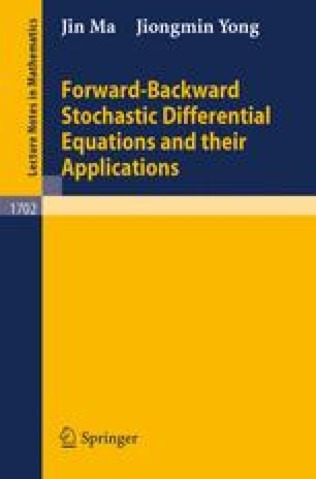
Forward-backward stochastic differential equations and their applications
This volume is a survey/monograph on the recently developed theory of forward-backward stochastic differential equations (FBSDEs). Basic techniques such as the method of optimal control, the "Four Step Scheme", and the method of continuation are presented in full. Related topics such as backward stochastic PDEs and many applications of FBSDEs are also discussed in detail. The volume is suitable for readers with basic knowledge of stochastic differential equations, and some exposure to the stochastic control theory and PDEs. It can be used for researchers and/or senior graduate students in the areas of probability, control theory, mathematical finance, and other related fields.

Fortschritte der Chemie organischer Naturstoffe 89 = Progress in the chemistry of organic natural products
The volumes of this classic series, now referred to simply as "Zechmeister" after its founder, L. Zechmeister, have appeared under the Springer Imprint ever since the series' inauguration in 1938. The volumes contain contributions on various topics related to the origin, distribution, chemistry, synthesis, biochemistry, function or use of various classes of naturally occurring substances ranging from small molecules to biopolymers. Each contribution is written by a recognized authority in his field and provides a comprehensive and up-to-date review of the topic in question. Addressed to biologists, technologists, and chemists alike, the series can be used by the expert as a source of information and literature citations and by the non-expert as a means of orientation in a rapidly developing discipline.
