



Page 147
Page 147

Database and Expert Systems Applications ; 18th International Conference, DEXA 2007, Regensburg, Germany, September 3-7, 2007, Proceedings
This volume represent the state of the art of - search in the domain of data, information and knowledge management, intelligent systems, and their applications.

Database and expert systems applications ; 16th international conference, DEXA 2005, Copenhagen, Denmark, August 22-26, 2005, Proceedings
DEXA 2005, the 16th International Conference on Database and Expert Systems Applications, was held at the Copenhagen Business School, Copenhagen, Denmark, from August 22 to 26, 2005. The success of the DEXA series has partly been due to the way in which it has kept abreast of recent developments by spawning specialized workshops and conferences each with its own proceedings. In 2005 the DEXA programme was co-located with the 7th International Conference on Data Warehousing and Knowledge Discovery [DaWaK 2005], the 6th International Conference on Electronic Commerce and Web Technologies [EC-Web 2005], the 4th International Conference on Electronic Government [EGOV 2005], the 2nd International Conference on Trust, Privacy, and Security in Digital Business [TrustBus 2005], the 2nd International Conference on Industrial Applications of Holonic and Multi-agent Systems [HoloMAS 2005], as well as 19 specialized workshops. These proceedings are the result of a considerable amount of hard work.

Database and expert systems and Aapplications ; 17th International Conference, DEXA 2006, Krakow, Poland, September 4-8, 2006, Proceedings
The annual international conference on Database and Expert Systems Applications (DEXA) is now well established as a reference scientific event. The reader will find in this volume a collection of scientific papers that represent the state of the art of research in the domain of data, information and knowledge management, intelligent systems, and their applications.
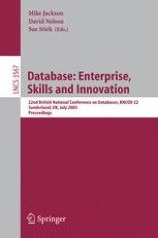
Database : Enterprise, skills and innovation; 22nd British national conference on databases, BNCOD 22, Sunderland, UK, July 5-7, 2005, Proceedings
The British National Conference on Databases (BNCOD) was established in 1980 as a forum for research into the theory and practice of databases. The original conference in the series took place at the University of Aberdeen. To be precise, this conference was in fact entitled ICOD which stood for International Conference on Databases. It was the intention, when the series began, that an ICOD would take place every two years, whilst a BNCOD would run in the years in between. As the record shows ICOD was only held in 1980 and 1983. The more junior conference has managed to acquire a lifetime much longer than that of its senior relative! If truth wereknown,however,BNCOD has,overthe years,growninto ICOD and although the conference is still titled “British National,” it is, in fact, an international conference that takes place on a yearly basis. Proof of this can be obtained simply by looking at the table of contents of these proceeding which clearlyshowthatthe majorityofpaperspresentedatthis year’sconferencecame from contributors whose a?liations are outside the UK. Despitetherangeofpapersono?er,BNCODstillretainsitsuniquelyBritish ?avor. The Programme Committee is drawn from UK academics and the c- ference is always held at a British university (or in earlier years a polytechnic!).

Data Warehousing and Knowledge Discovery ; 9th International Conference, DaWaK 2007, Regensburg, Germany, September 3-7, 2007, Proceedings
Data Warehousing and Knowledge Discovery have been widely accepted as key te- nologies for enterprises and organizations to improve their abilities in data analysis, decision support, and the automatic extraction of knowledge from data. With the exponentially growing amount of information to be included in the decision-making process, the data to be processed become more and more complex in both structure and semantics. Consequently, the process of retrieval and knowledge discovery from this huge amount of heterogeneous complex data constitutes the reality check for research in the area.

Data Warehousing and Knowledge Discovery ; 10th International Conference, DaWaK 2008 Turin, Italy, September 2-5, 2008 Proceedings
This book constitutes the refereed proceedings of the 10th International Conference on Data Warehousing and Knowledge Discovery, DaWak 2008, held in Turin, Italy, in September 2008.
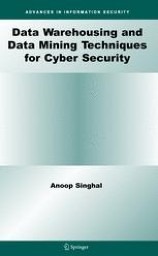
Data Warehousing and Data Mining Techniques for Cyber Security
It provide techniques for collecting information from distributed databases and for performing data analysis. The ever expanding, tremendous amount of data collected and stored in large databases has far exceeded our human ability to comprehend--without the proper tools. There is a critical need for data analysis that can automatically analyze data, summarize it and predict future trends. In the modern age of Internet connectivity, concerns about denial of service attacks, computer viruses and worms are extremely important. Data Warehousing and Data Mining Techniques for Cyber Security contributes to the discipline of security informatics. The author discusses topics that intersect cyber security and data mining, while providing techniques for improving cyber security. Since the cost of information processing and internet accessibility is dropping, an increasing number of organizations are becoming vulnerable to cyber attacks. This volume introduces techniques for applications in the area of retail, finance, and bioinformatics, to name a few.

Data visualization and analysis in second language research
This introduction to visualization techniques and statistical models for second language research focuses on three types of data (continuous, binary, and scalar), helping readers to understand regression models fully and to apply them in their work. Garcia offers advanced coverage of Bayesian analysis, simulated data, exercises, implementable script code, and practical guidance on the latest R software packages.
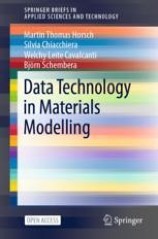
Data Technology in Materials Modelling
This book discusses advances in semantic interoperability for materials modelling, aiming at integrating data obtained from different methods and sources into common frameworks, and facilitating the development of platforms where simulation services in computational molecular engineering can be provided as well as coupled and linked to each other in a standardized and reliable way.

Data structures and algorithm : Analysis in C++
An advanced algorithms book that bridges the gap between traditional CS2 and Algorithms Analysis courses. As the speed and power of computers increases, so does the need for effective programming and algorithm analysis. By approaching these skills in tandem, Mark Allen Weiss teaches readers to develop well-constructed, maximally efficient programs using the C++ programming language

Data structure and algorithms using C++ : A practical implementation
Intended to flow from the basic concepts of C++ to technicalities of the programming language, its approach and debugging. The chapters of the book flow with the formulation of the problem, it's designing, finding the step-by-step solution procedure along with its compilation, debugging and execution with the output. Keeping in mind the learner’s sentiments and requirements, the exemplary programs are narrated with a simple approach so that it can lead to creation of good programs that not only executes properly to give the output, but also enables the learners to incorporate programming skills in them. The style of writing a program using a programming language is also emphasized by introducing the inclusion of comments wherever necessary to encourage writing more readable and well commented programs. As practice makes perfect, each chapter is also enriched with practice exercise questions so as to build the confidence of writing the programs for learners.

Data security : Technical and organizational protection measures against data loss and computer Crime
Offers an easy-to understand introduction to technical and organizational data security. It provides an insight into the technical knowledge that is mandatory for data protection officers. Data security is an inseparable part of data protection, which is becoming more and more important in our society. It can only be implemented effectively if there is an understanding of technical interrelationships and threats.

Data science, AI, and machine learning in drug development
The confluence of big data, AI, and machine learning has led to a paradigm shift in how innovative medicines are developed and healthcare delivered. To fully capitalize on these technological advances, it is essential to systematically harness data from diverse sources and leverage digital technologies and advanced analytics to enable data-driven decisions. Data science stands at a unique moment of opportunity to lead such a transformative change. Intended to be a single source of information, Data Science, AI, and Machine Learning in Drug Research and Development covers a wide range of topics on the changing landscape of drug R&D, emerging applications of big data, AI and machine learning in drug development, and the build of robust data science organizations to drive biopharmaceutical digital transformations

Data science on the Google cloud platform : Implementing end-to-end real-time data pipelines : From ingest to machine learning
Learn how easy it is to apply sophisticated statistical and machine learning methods to real-world problems when you build using Google Cloud Platform (GCP). This hands-on guide shows data engineers and data scientists how to implement an end-to-end data pipeline with cloud native tools on GCP. You'll work through a sample business decision by employing a variety of data science approaches. Follow along by building a data pipeline in your own project on GCP, and discover how to solve data science problems in a transformative and more collaborative way. Employ best practices in building highly scalable data and ML pipelines on Google Cloud Automate and schedule data ingest using Cloud Run Create and populate a dashboard in Data Studio Build a real-time analytics pipeline using Pub/Sub, Dataflow, and BigQuery Conduct interactive data exploration with BigQuery Create a Bayesian model with Spark on Cloud Dataproc Forecast time series and do anomaly detection with BigQuery ML Aggregate within time windows with Dataflow Train explainable machine learning models with Vertex AI Operationalize ML with Vertex AI Pipelines

Data science in theory and practice : Techniques for big data analytics and complex data sets
Delivers a comprehensive treatment of the mathematical and statistical models useful for analyzing data sets arising in various disciplines, like banking, finance, health care, bioinformatics, security, education, and social services. Written in five parts, the book examines some of the most commonly used and fundamental mathematical and statistical concepts that form the basis of data science. The authors go on to analyze various data transformation techniques useful for extracting information from raw data, long memory behavior, and predictive modeling. Readers will also learn from topics like: Analyses of foundational theoretical subjects, including the history of data science, matrix algebra and random vectors, and multivariate analysis A comprehensive examination of time series forecasting, including the different components of time series and transformations to achieve stationarity Introductions to both the R and Python programming languages, including basic data types and sample manipulations for both languages An exploration of algorithms, including how to write one and how to perform an asymptotic analysis A comprehensive discussion of several techniques for analyzing and predicting complex data sets

Data science for economics and finance : Methodologies and applications
The book starts with an introduction on the use of data science technologies in economics and finance and is followed by thirteen chapters showing success stories of the application of specific data science methodologies, touching on particular topics related to novel big data sources and technologies for economic analysis (e.g. social media and news); big data models leveraging on supervised/unsupervised (deep) machine learning; natural language processing to build economic and financial indicators; and forecasting and nowcasting of economic variables through time series analysis.

Data science ; 6th International Conference of Pioneering Computer Scientists, Engineers and Educators, ICPCSEE 2020, Taiyuan, China, September 18-21, 2020, Proceedings, Part II
This two volume set (CCIS 1257 and 1258) constitutes the refereed proceedings of the 6th International Conference of Pioneering Computer Scientists, Engineers and Educators, ICPCSEE 2020 held in Taiyuan, China, in September 2020. The 98 papers presented in these two volumes were carefully reviewed and selected from 392 submissions. The papers are organized in topical sections: database, machine learning, network, graphic images, system, natural language processing, security, algorithm, application, and education.
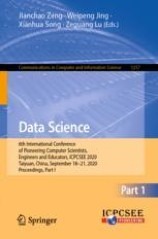
Data Science ; 6th International Conference of Pioneering Computer Scientists, Engineers and Educators, ICPCSEE 2020, Taiyuan, China, September 18-21, 2020, Proceedings, Part I
This two volume set (CCIS 1257 and 1258) constitutes the refereed proceedings of the 6th International Conference of Pioneering Computer Scientists, Engineers and Educators, ICPCSEE 2020 held in Taiyuan, China, in September 2020. The 98 papers presented in these two volumes were carefully reviewed and selected from 392 submissions. The papers are organized in topical sections: database, machine learning, network, graphic images, system, natural language processing, security, algorithm, application, and education.

Data rights in transition
Maps the development of data rights that formed and reformed in response to the socio-technical transformations of the postwar twentieth century. The authors situate these rights, with their early pragmatic emphasis on fair information processing, as different from and less symbolically powerful than utopian human rights of older centuries

Data Processing in Precise Time and Frequency Applications
The book describes the data processing at various levels: design of the time and frequency references, characterization of the time and frequency references, applications involving precise time and/or frequency references. The metrological properties stability, accuracy and reproducibility are defined and the processes leading to their characterization are shown.
