



Page 114
Page 114

Distributed systems : Concepts and design
Aims to provide an understanding of the principles on which the Internet and other distributed systems are based; their architecture, algorithms and design; and how they meet the demands of contemporary distributed applications.
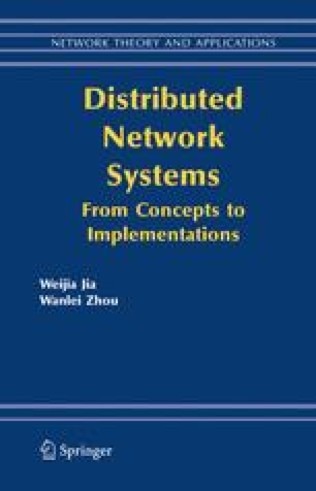
Distributed network systems : From concepts to implementations
This textbook covers both theoretical and practical aspects of distributed computing. It describes the client-server model for developing distributed network systems, the communication paradigms used in a distributed network system, and the principles of reliability and security in the design of distributed network systems. Based on theoretical introductions, the book presents various implementation strategies and techniques for building distributed network systems, including examples in TCP/IP communications, the use of remote procedure call and remote method invocation techniques, and the development of web-based applications, distributed databases, and mobile computing systems.

Distributed embedded systems : Design, middleware and resources ; IFIP 20th World computer congress, TC10 Working conference on distributed and parallel embedded systems (DIPES 2008), September 7-10, 2008, Milano, Italy
The IFIP series publishes state-of-the-art results in the sciences and technologies of information and communication. The principal aim of the IFIP series is to encourage education and the dissemination and exchange of information about all aspects of computing.

Distributed Embedded Control Systems : Improving Dependability with Coherent Design
Distributed Embedded Control Systems handles the domains encountered when designing a distributed embedded computer control system as an integrated whole. First to be discussed are some basic issues about real-time systems and their properties, specifically safety. Then, system and hardware architectures are dealt.

Distributed Cooperative Laboratories : Networking, Instrumentation, and Measurements
This is a highly interdisciplinary topic, where various aspects converge: multimedia communications and networking, sensor networks, Grid technology, Quality of Service (QoS) provisioning and control, network management, measurement instrumentation and methodology, architecture of measurement systems. The material is organized into six parts: Technologies for Real-Time Interactive Multimedia Communications; Monitoring, Management and Configuration of Networks and Networking Devices; Data Acquisition and Aggregation in Sensor Networks; Grid Structures for Distributed Cooperative Laboratories; Architectures and Techniques for Tele-Measurements; Virtual Immersive Communications and Distance Learning. Each contribution presents a self-contained treatment, within a framework that provides the reader with an up-to-date picture of the most recent state-of-the-art developments.

Distributed computing in sensor systems Vol. 4026 ; 2nd IEEE International Conference, DCOSS 2006, San Francisco, CA, USA, June 18-20, 2006, Proceedings
The book constitutes the refereed proceedings of the Second International Conference on Distributed Computing in Sensor Systems, DCOSS 2006, held in San Francisco, California, USA in June 2006. The papers focus on distributed computing issues in large-scale networked sensor systems, including systematic design techniques and tools; they cover topics such as distributed algorithms and applications, programming support and middleware, data aggregation and dissemination, security, information fusion, lifetime maximization, and localization.
Distributed computing and networking ; 8th International conference, ICDCN 2006, Guwahati, India, December 27-30, 2006, Proceedings
VI realm between distributed computing and networking, namely, Modeling Biological Networks, Network Security, Algorithmic Issues in Wireless Sensor Networks, and Optical Networking. This was made possible by the efforts of the Tutorial Chairs, Sr- har Iyer and Pinaki Mitra. The Organizing Committee worked hard to ensure that the participants enjoyed a comfortable stay and the technical meetings proceeded as smoothly as possible.

Distributed computing and internet Technology ; Vol. 3816 ; 2nd International conference, ICDCIT 2005, Bhubaneswar, India, December 22-24, 2005, Proceedings
The opening ceremony and pre-conference tutorials on various related topics were held on December 21. The technical program started on December 22 and continued for three days. The program was arranged in single track so as to enable participants to attend sessions of di?erent tracks. Papers from the DM, IT, SE, and SS tracks were divided into two sessions, whereas DC track sessions were held on the ?rst two days of the conference. The program also included two plenary talks. The ?rst talk was delivered by S. S. Iyengar from Louisiana State University, USA. The second talk was delivered by He Jifeng from the International Institute for Software Technology (IIST) Macau. Prof. Iyenger’s talk on “The Distributed Sensor Networks — An Emerging Technology” was focused on new ideas about the use of distributed systems for emerging technology, while Prof. Jifeng’s talk on “Linking Theories of Concurrency by Retraction” dealt with semantics of concurrency.

Distributed computing and Internet Technology ; 1st International Conference, ICDCIT 2004, Bhubaneswar, India, December 22-24, 2004, Proceedings
Taming the Dynamics of Disributed Data - DISTRIBUTED COMPUTING -- Data in Your Space -- Enabling Technologies for Harnessing Information Explosion -- Fair Leader Election by Randomized Voting -- An Efficient Leader Election Algorithm for Mobile Ad Hoc Networks -- Distributed Balanced Tables: A New Approach - Performance Evaluation of Gigabit Ethernet and SCI in a Linux Cluster -- Performance Evaluation of a Modified-Cyclic-Banyan Based ATM / IP Switching Fabric -- A Scalable and Robust QoS Architecture for WiFi P2P Networks -- NEC: Node Energy Based Clustering Protocol for Wireless Sensor Networks with Guaranteed Connectivity,and other

Distributed computing and internet technology ; 17th International Conference, ICDCIT 2021, Bhubaneswar, India, January 7–10, 2021, Proceedings
This book constitutes the proceedings of the 17th International Conference on Distributed Computing and Internet Technology, ICDCIT 2020, held in Bhubaneswar, India, in January 2021. The 13 full papers presented together with 4 short papers were carefully reviewed and selected from 99 submissions. The papers were organized in topical sections named: invited talks, cloud computing and networks, distributed algorithms, concurrency and parallelism, graph algorithms and security, social networks and machine learning, and short papers.

Distributed computing -- IWDC 2004 ; 6th International Workshop, Kolkata, India, December 27-30, 2004, Proceedings
Last, but not least, thanks to all the participants and authors. We hope that they enjoyed the workshop as much as the wonderful and culturally vibrant city of Kolkata! Bhabani P. Sinha Indian Statistical Institute, Kolkata, India December 2004 Sajal K. Das University of Texas, Arlington, USA December 2004 Program Chairs’ Message On behalf of the Technical Program Committee of the 6th International Wo- shop on Distributed Computing, IWDC 2004, it was our great pleasure to w- come the attendees to Kolkata, India. Over the last few years, IWDC has emerged as an internationally renowned forum for interaction among researchers from academia and industries around the world.

Distributed Autonomous Robotic Systems 7
This book collects papers selected by an international program committee for presentation at the 8th International Symposium on Distributed Autonomous Robotic Systems. What makes this book distinctive is the emphasis on using multiple robots and on making them autonomous, as opposed to being teleoperated.
Distributed Applications and Interoperable Systems ; Vol. 4025 ; 6th IFIP WG 6.1 International Conference, DAIS 2006, Athens, Greece, June 14-16, 2006
This volume contains the proceedings of the IFIP WG 6.1 International Working Conference on Distributed Applications and Interoperable Systems VI held in Bologna, Italy, on June 14-16, 2006. The conference program presents the state of the art in research on d- tributed and interoperable systems. In recent years, distributed applications have indeed gained a practical and widely-known footing in everyday computing.
Distributed applications and interoperable systems ; Vol. 3543 ; 5th IFIP WG 6.1 International conference, DAIS 2005, Athens, Greece, June 15-17, 2005, Proceedings
ThisvolumecontainstheproceedingsoftheIFIPWG6. 1InternationalWorking Conference on Distributed Applications and Interoperable Systems V held in Athens, Greece, on June 15–17, 2005. The conference program presented the state of the art in research concerning distributed and interoperable systems. The emergence of 4th-generation c- munication systems, the evolution of Internet technologies, the convergence of telecom and datacom, wireless and ?xed communication systems and appli- tions pave the path for ubiquitous service and application provision. Innovative solutions are required for the development, implementation and operation of distributed applications in complex IT environments full of diversity and h- erogeneity. Today, the emerging wide spectrum of distributed systems.

Distributed Applications and Interoperable Systems ; 8th IFIP WG 6.1 International Conference, DAIS 2008, Oslo, Norway, June 4-6, 2008. Proceedings
This volume contains the proceedings of DAIS 2008, the 8th IFIP International Conference on Distributed Applications and Interoperable Systems.

Distributed Applications and Interoperable Systems ; 7th IFIP WG 6.1 International Conference, DAIS 2007, Paphos, Cyprus, June 6-8, 2007, Proccedings
This book presented context-awareness, adaptation, mobility, distributed applications and peer-to-peer computing, all of which relate to the sustainability of distributed applications and integrated systems.

Distinguished Figures in Mechanism and Machine Science
This is the first volume of a series of edited books whose aim is to collect contributed papers in a framework that can serve as a dictionary of names of individuals who have made contributions to the discipline of MMS (Me- anism and Machine Science). This dictionary project has the peculiarity that, through descriptions of the ideas and work of these individuals, the papers will illustrate mainly technical developments in the historical evolution of the individual fields that today de?ne the scope of MMS. Thus the core of each contribution will be a survey of biographical notes describing the efforts and experiences of these people. Finding appropriate technical experts as authors for such papers and - couraging them to write them has been a challenge; it is a demanding and time-consuming effort to produce such in-depth articles that delve deeply into the historical background of their topics of expertise.

Distillation : Principles and practice
Distillation Principles and Practice Second Edition covers all the main aspects of distillation including the thermodynamics of vapor/liquid equilibrium, the principles of distillation, the synthesis of distillation processes, the design of the equipment, and the control of process operation.

Dissonant Heritages and Memories in Contemporary Europe
This book discusses political, economic, social, and humanitarian challenges that influence both how people deal with their past and how they build their identities in contemporary Europe. Ongoing debates on migration, on local, national, inter- and transnational levels, prove that it is a divisive issue with regards to understanding European integration and identity. At the same time, the European Union increasingly invests in projects related to European heritage, museums, and cultural memory networks, while having to take dissonant heritages into account. These processes in their combination offer an interesting dynamic and form the complex puzzle that poses challenging questions for anyone involved in academic research, heritage practices, and policy debates. With this puzzle at its core, this book explicitly focuses on slippery and transforming notions of Europe and critically discusses ongoing and transforming power structures of heritage and memory in today’s Europe.

Dissipative Systems Analysis and Control : Theory and Applications
Dissipative Systems Analysis and Control (second edition) presents a fully revised and expanded treatment of dissipative systems theory, constituting a self-contained, advanced introduction for graduate students, researchers and practising engineers. It examines linear and nonlinear systems with examples of both in each chapter; some infinite-dimensional examples are also included. Throughout, emphasis is placed on the use of the dissipative properties of a system for the design of stable feedback control laws. The theory is substantiated by experimental results and by reference to its application in illustrative physical cases (Lagrangian and Hamiltonian systems and passivity-based and adaptive controllers are covered thoroughly).
