



Page 1
Page 1

Numerical Solution of Partial Differential Equations on Parallel Computers
The scientific fields of Ma- ematics and Physics provide a powerful vehicle for such descriptions in terms of Partial Differential Equations (PDEs). Formulated as such equations, physical laws can become subject to computational and analytical studies. In the computational setting, the equations can be discreti ed for ef?cient solution on a computer, leading to valuable tools for simulation of natural and man-made processes. Numerical so- tion of PDE-based mathematical models has been an important research topic over centuries, and will remain so for centuries to come. In the context of computer-based simulations, the quality of the computed results is directly connected to the model’s complexity and the number of data points used for the computations. Therefore, computational scientists tend to ?ll even the largest and most powerful computers they can get access to, either by increasing the si e of the data sets, or by introducing new model terms that make the simulations more realistic, or a combination of both. Today, many important simulation problems can not be solved by one single computer, but calls for parallel computing.

Network and Parallel Computing ; IFIP International Conference, NPC 2008, Shanghai, China, October 18-20, 2008. Proceedings
This book constitutes the refereed proceedings of the IFIP International Conference on Network and Parallel Computing, NPC 2008, held in Shanghai, China in October 2008.The 32 revised full papers presented were carefully selected from over 140 submissions. The papers are organized in topical sections on network technologies; network applications; network and parallel architectures; parallel and distributed software.
Network and Parallel Computing ; IFIP International Conference, NPC 2007, Dalian, China, September 18-21, 2007, Proceedings
The goal of NPC is to establish an international forum for researchers and practitioners to present their - cellent ideas and experiences in all system fields of network and parallel computing. The main focus of NPC 2007 was on the most critical areas of network and parallel computing: network applications, network technologies, network and parallel arc- tectures, and parallel and distributed software.
Network and Parallel Computing ; IFIP International Conference, NPC 2005, Beijing, China, November 30 - December 3, 2005, Proceedings
These proceedings contain the papers presented at the 2005 IFIP International Conference on Network and Parallel Computing (NPC 2005), held in Beijing, China, between November 30 and December 3, 2005. The goal of the conference was to establish an international forum for engineers and scientists to present their ideas and experiences in network and parallel computing. A total of 320 submissions were received in response to our Call for Papers. These papers were from the following countries or regions: Australia, Canada, China, France, Germany, Hong Kong, India, Iran, Italy, Japan, Korea, Lux- burg, Nepal, Netherlands, Taiwan, United Arab Emirates, and United States.

Modeling, Simulation and Optimization of Complex Processes HPSC 2018 ; Proceedings of the 7th International Conference on High Performance Scientific Computing, Hanoi, Vietnam, March 19-23, 2018
The contributions cover a broad, interdisciplinary spectrum of scientific computing and showcase recent advances in theory, methods, and practical applications. Subjects covered include numerical simulation, methods for optimization and control, machine learning, parallel computing and software development, as well as the applications of scientific computing in mechanical engineering, airspace engineering, environmental physics, decision making, hydrogeology, material science and electric circuits.

Modeling, Simulation and Optimization of Complex Processes ; Proceedings of the Third International Conference on High Performance Scientific Computing, March 6–10, 2006, Hanoi, Vietnam
This proceedings volume contains a selection of papers presented at the Third International Conference on High Performance Scientific Computing held at the Hanoi Institute of Mathematics, Vietnamese Academy of Science and Technology (VAST), March 6-10, 2006. The conference has been organized by the Hanoi Institute of Mathematics, Interdisciplinary Center for Scientific Computing (IWR), Heidelberg, and its International PhD Program ``Complex Processes: Modeling, Simulation and Optimization'', and Ho Chi Minh City University of Technology. The contributions cover the broad interdisciplinary spectrum of scientific computing and present recent advances in theory, development of methods, and applications in practice. Subjects covered are mathematical modelling, numerical simulation, methods for optimization and control, parallel computing, software development, applications of scientific computing in physics, chemistry, biology and mechanics, environmental and hydrology problems, transport, logistics and site location, communication networks, production scheduling, industrial and commercial problems.

Modeling, Simulation and Optimization of Complex Processes ; Proceedings of the International Conference on High Performance Scientific Computing, March 10-14, 2003, Hanoi, Vietnam
This proceedings volume contains a selection of papers presented at the symposium "International Conference on High Performance Scientific Computing'' held at the Hanoi Institute of Mathematics of the Vietnam National Center for Natural Science and Technology (NCST). The contributions cover the broad interdisciplinary spectrum of scientific computing and present recent advances in theory, development of methods, and applications in practice. Subjects covered are mathematical modelling, numerical simulation, methods for optimization and optimal control, parallel computing, symbolic computing, software development, applications of scientific computing in physics, chemistry, biology and mechanics, environmental and hydrology problems, transport, logistics and site location, communication networks, production scheduling, industrial and commercial problems.
High performance computing - HiPC 2008 ; 15th International Conference, Bangalore, India, December 17-20, 2008. Proceedings
This book constitutes the refereed proceedings of the 15th International Conference on High-Performance Computing, HiPC 2008, held in Bangalore, India, in December 2008.The 46 revised full papers presented together with the abstracts of 5 keynote talks were carefully reviewed and selected from 317 submissions. The papers are organized in topical sections on applications performance optimizazion, parallel algorithms and applications, scheduling and resource management, sensor networks, energy-aware computing, distributed algorithms, communication networks as well as architecture.
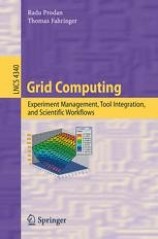
Grid computing : Experiment management, Tool Integration, and Scientific Workflows
Grid computing has become a topic of significant interest in the scientific community as a means of enabling application developers to aggregate resources scattered around the globe for solving large-scale scientific problems. This monograph addresses four critical software development aspects for the engineering and execution of applications on parallel and Grid architectures.

Finite element methods : Parallel-sparse statics and Eigen-Solutions
FEM, and the associated computer software are widely recognized as some of the most effective tools for solutions of large-scale engineering applications. Efficient equation and eigen-solvers play critical roles in solving these problems. Sparse matrix technologies have evolved and are now mature enough that all popular and commercialized FEM codes have inserted sparse solvers into their software. So far, however, few books include detailed discussion and explanation of sparse equation-solvers and Lanczos domain decomposition (DD) or finite element formulation for parallel computing purposes. The material in Finite Element Methods: Parallel-Sparse Statics and Eigen-Solutions has evolved over the past several years from the author's research work and his graduate courses.
Euro-Par 2008 - Parallel Processing ; 14th International Euro-Par Conference, Las Palmas de Gran Canaria, Spain, August 26-29, 2008. Proceedings
This book constitutes the refereed proceedings of the 14th International Conference on Parallel Computing, Euro-Par 2008, held in Las Palmas de Gran Canaria, Spain, in August 2008.The 86 revised papers presented were carefully reviewed and selected from 264 submissions. The papers are organized in topical sections on support tools and environments; performance prediction and evaluation; scheduling and load balancing; high performance architectures and compilers; parallel and distributed databases; grid and cluster computing; peer-to-peer computing; distributed systems and algorithms; parallel and distributed programming.
Euro-Par 2006 Parallel Processing ; 12th International Euro-Par Conference, Dresden, Germany, August 28-September 1, 2006, Proceedings
This book constitutes the refereed proceedings of the 12th International Conference on Parallel Computing, Euro-Par 2006. parallel and distributed databases, data mining and knowledge discovery; grid and cluster computing: models, middleware and architectures; parallel computer architecure and instruction-level parallelism.
Euro-Par 2005 Parallel Processing ; 11th International Euro-Par Conference, Lisbon, Portugal, August 30 - September 2, 2005, Proceedings
This book constitutes the refereed proceedings of the 11th International Conference on Parallel Computing, Euro-Par 2005, held in Lisbon, Portugal, in August/September 2005. The 120 revised papers presented together with 4 invited papers were carefully reviewed and selected from 388 submissions. The papers are organized in topical sections on support tools and environments, performance prediction and evaluation, scheduling and load balancing, compilers for high performance, parallel and distributed databases, data mining and knowledge discovery, grid and cluster computing: models, middleware and architectures, parallel computer architecture and instruction distributed systems and algorithms, parallel programming: models, methods, and languages, parallel numerical algorithms.

Domain Decomposition Methods in Science and Engineering XVII
This volume contains a selection of papers presented at the 17th International Conference on Domain Decomposition Methods in Science and Engineering held at St. Wolfgang / Strobl, Austria, July 3 - 7, 2006. Domain decomposition is an active, interdisciplinary research area concerned with the development, analysis, and implementation of coupling and decoupling strategies in mathematical and computational models. Domain decomposition techniques provide efficient tools for treating problems in all Computational Sciences. The reader will become familiar with the newest domain decomposition technologies and their use for modeling and simulating of complex problems from different fields of applications.

Distributed and Parallel Systems : In Focus : Desktop Grid Computing
In this book contributors investigate parallel and distributed techniques, algorithms, models and applications; present innovative software tools, environments and middleware; focus on various aspects of grid computing; and introduce novel methods for development, deployment, testing and evaluation.

Distributed and Parallel Systems : Cluster and Grid Computing
DAPSY (Austrian-Hungarian Workshop on Distributed and Parallel Systems) is an international conference series with biannual events dedicated to all aspects of distributed and parallel computing. DAPSY started under a different name in 1992 (Sopron, Hungary) as regional meeting of Austrian and Hungarian researchers focusing on transputer-related parallel computing; a hot research topic of that time. A second workshop followed in 1994 (Budapest, Hungary). As transputers became history, the scope of the workshop widened to include parallel and distributed systems in general and the 1st DAPSYS in 1996 (Miskolc, Hungary) reflected the results of these changes.

Distributed and parallel computing ; 6th International conference on algorithms and architectures for parallel processing, ICA3PP, Melbourne, Australia, October 2-3, 2005, Proceedings
There are many applications that require parallel and distributed processing to allow complicated engineering, business and research problems to be solved in a reasonable time. Parallel and distributed processing is able to improve company profit, lower costs of design, production, and deployment of new technologies, and create better business environments. The major lesson learned by car and aircraft engineers, drug manufacturers, genome researchers and other specialist is that a computer system is a very powerful tool that is able to help them solving even more complicated problems. That has led computing specialists to new computer system architecture and exploiting parallel computers, clusters of clusters, and distributed systems in the form of grids.

Current Trends in High Performance Computing and Its Applications ; Proceedings of the International Conference on High Performance Computing and Applications, August 8-10, 2004, Shanghai, P.R. China
This book contains variety of subjects in modern high performance computing and its applications, such as numerical and software algorithm design and analysis, grid computing advance, adaptive and par- lel algorithm development, distributing debugging tools, computational grid and network environment design, computer simulation and visualization, and computational language study and their applications to science, engineering, and medicine.

CONCUR 2007 – Concurrency Theory ; 18th International Conference, CONCUR 2007, Lisbon, Portugal, September 3-8, 2007, Proceedings
This book includes model checking, process calculi, minimization and equivalence checking, types, semantics, probability, bisimulation and simulation, real time, and formal languages.

Languages and Compilers for Parallel Computing ; Vol. 2481 : 15th Workshop, LCPC 2002, College Park, MD, USA, July 25-27, 2002, Revised Papers
LCPC 2002 brought together over 60 researchers from academia and research institutions from many countries. The program of 26 papers was selected from 32 submissions. Each paper was reviewed by at least three Program Committee members and sometimes by additional reviewers. Prior to the workshop, revised versions of accepted papers were informally published on the workshop’s website and in a paper proceedings that was distributed at the meeting. This year, the workshopwas organizedinto sessions of papers on related topics, and each session consisted of two to three 30-minute presentations.Based on feedback from the workshop,the papers were revised and submitted for inclusion in the formal proceedings published in this volume. Two papers were presented at the workshop but later withdrawn from the ?nal proceedings by their authors. We were very lucky to have Bill Carlson from the Department of Defense give the LCPC 2002 keynote speech on “UPC: A C Language for Shared M- ory Parallel Programming.” Bill gave an excellent overview of the features and programming model of the UPC parallel programming language.
