




Data Monitoring in Clinical Trials : A Case Studies Approach
Randomized clinical trials are the gold standard for establishing many clinical practice guidelines and are central to evidence based medicine. Obtaining the best evidence through clinical trials must be done within the boundaries of rigorous science and ethical principles. One fundamental principle is that trials should not continue longer than necessary to reach their objectives. Therefore, trials must be monitored for recruitment progress, quality of data, adherence to patient care or prevention standards, and early evidence of benefit or harm. Frequently, a group of external experts, independent from the investigators and trial sponsor, is charged with this monitoring responsibility, especially for safety and early benefit. This group is referred to by various names, such as a data monitoring committee or a data and safety monitoring board. This book, through a series of case studies presented by many distinguished clinical trial experts, illustrates the complexity of this monitoring process.No other text has as extensive a collection of cases which provide insight into the many issues, often conflicting, that must be examined before recommendations to continue or discontinue a trial can be made. While depth in statistical methods is not required, some familiarity with statistical design and analysis issues in clinical trials is helpful. The cases cover trials which were terminated early for convincing evidence of benefit, or for harmful effects. Cases with complex issues are also included. This series of cases should provide broad background information for potential monitoring committee members and better prepare them for the challenges that may exist in the trials for which they are responsible.
Related Books
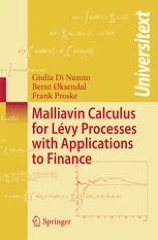
Malliavin Calculus for Lévy Processes with Applications to Finance
While the original works on Malliavin calculus aimed to study the smoothness of densities of solutions to stochastic differential equations, this book has another goal. It portrays the most important and innovative applications in stochastic control and finance, such as hedging in complete and incomplete markets, optimisation in the presence of asymmetric information and also pricing and sensitivity analysis. In a self-contained fashion, both the Malliavin calculus with respect to Brownian motion and general Lévy type of noise are treated. Besides, forward integration is included and indeed extended to general Lévy processes. The forward integration is a recent development within anticipative stochastic calculus that, together with the Malliavin calculus, provides new methods for the study of insider trading problems.

Basic Probability Theory with Applications
This book presents elementary probability theory with interesting and well-chosen applications that illustrate the theory. An introductory chapter reviews the basic elements of differential calculus which are used in the material to follow. The theory is presented systematically, beginning with the main results in elementary probability theory. This is followed by material on random variables. Random vectors, including the all important central limit theorem, are treated next. The last three chapters concentrate on applications of this theory in the areas of reliability theory, basic queuing models, and time series. Examples are elegantly woven into the text and over 400 exercises reinforce the material and provide students with ample practice.

Numerical solution of Variational Inequalities by Adaptive Finite Elements
Franz-Theo Suttmeier describes a general approach to a posteriori error estimation and adaptive mesh design for finite element models where the solution is subjected to inequality constraints. This is an extension to variational inequalities of the so-called Dual-Weighted-Residual method (DWR method) which is based on a variational formulation of the problem and uses global duality arguments for deriving weighted a posteriori error estimates with respect to arbitrary functionals of the error. In these estimates local residuals of the computed solution are multiplied by sensitivity factors which are obtained from a numerically computed dual solution. The resulting local error indicators are used in a feed-back process for generating economical meshes which are tailored according to the particular goal of the computation.

Numerical Methods for Controlled Stochastic Delay Systems
The Markov chain approximation methods are widely used for the numerical solution of nonlinear stochastic control problems in continuous time. This book extends the methods to stochastic systems with delays. Because such problems are infinite-dimensional, many new issues arise in getting good numerical approximations and in the convergence proofs. Useful forms of numerical algorithms and system approximations are developed in this work, and the convergence proofs are given. All of the usual cost functions are treated as well as singular and impulsive controls. A major concern is on representations and approximations that use minimal memory.
