



Page 1
Page 1

Foundation 3ds Max 8 Architectural Visualization
Welcome to the world of 3D architectural visualizations using the most powerful and versatile 3D software package on the planet: 3ds Max. In just the last few years, the visualization industry has arguably become the fastest-growing 3D industry, and may soon overtake all others in total number of users. Just as the use of computer-aided design became the norm for nearly all architectural, engineering, and construction firms in the 1990s, 3D visualizations have become standard practice today. This book takes you through the challenge of learning one of the most complex computer programs ever created, by way of easy-to-follow tutorials and instruction. It specifically focuses on those parts of the program you need to know to produce stunning architectural visualizations.

EndNote 1 - 2 - 3 Easy! : Reference Management for the Professional
EndNote® 1-2-3 Easy!: Reference Management for the Professional is a valuable educational resource for biomedical and healthcare professionals, including researchers, physicians, students, information systems professionals, managers, teachers, librarians, and other professionals engaged in scientific manuscript writing. It offers a practical, "how to" manual providing easy-to-follow, step-by-step advice on using EndNote®, a popular reference management software package.
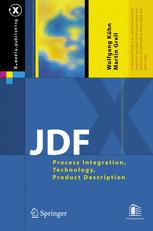
JDF : Process Integration, Technology, Product Description
The arrival of PDF has successfully optimized certain elements of the production workflow – the next challenge facing the print media industry is to resolve the problem of non-networked software packages that exist in isolation. Businesses today need to identify process inefficiencies to ensure the successful process integration of the entire value added chain. The PDF document format and the vendor-independent JDF (Job Definition Format) provide the technical platform for devising new, fully integrated workflow solutions. Networking decisions involve virtually every department of a print service provider and lay down the direction of the company over the long term. These decisions offer opportunities, but they also harbor risks. If businesses are to make the right investment decisions, it is vital they have extensive background information on technical and business management issues. The authors provide focused information for decision makers looking for support in implementing networking projects successfully. This book is couched in straightforward language, explains and highlights relevant terms, and provides readers with numerous practical illustrations, graphics and checklists that they can apply to real-life applications.
Java Design Patterns : A Hands-On Experience with Real-World Examples
Covers classical design patterns with the latest editions of Java and Eclipse Includes implementation of the Java design patterns in real-world applications Each chapter has a Q&A section to help you understand the pros and cons of each design pattern
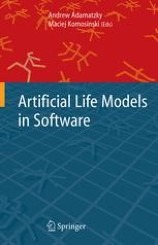
Artificial life models in software
Artificial Life Models in Software presents software tools, environments and realities dealing with creation, imitation and analysis of artefactual, virtual and living forms, written by those who personally design and produce software, hardware and art installations in artificial life, simulated complex systems and virtual worlds. This timely volume offers a nearly exhaustive overview and original analysis of major non-profit artificial life software packages. The carefully selected topics include: · simulation of real and imaginary life forms and their evolution · self-organization · emergent behaviours · swarm intelligence · evolutionary robotics · agent-based simulations · adaptive, complex and biologically inspired ecosystems · creative computer art There has long been a need within the academic and research community for an informal introduction and guidance to modern software tools for modelling and simulation of life-like phenomena – Artificial Life Models in Software fills this gap and provides invaluable information to both professional and amateur readers, offering detailed reviews of contemporary software for artificial life.
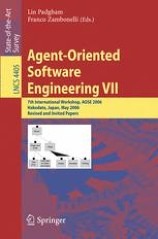
Agent-oriented software engineering VII ; 7th International Workshop, AOSE 2006, Hakodate, Japan, May 8, 2006, Revised and Invited Papers
Software architectures that contain many dynamically interacting components, each with their own thread of control, and engaging in complex coordination protocols, are difficult to correctly and efficiently engineer. Agent-oriented modelling techniques are important for supporting the design and development of such applications.The book is organized in topical sections on modelling and design of agent systems, modelling open agent systems, formal reasoning about designs, as well as testing, debugging and evolvability.
Agent-oriented software engineering V ; 5th International workshop, AOSE 2004, New York, NY, USA, July 2004, revised selected papers
The explosive growth of application areas such as electronic commerce, ent- prise resource planning and mobile computing has profoundly and irreversibly changed our views on software systems. Nowadays, software is to be based on open architectures that continuously change and evolve to accommodate new components and meet new requirements. Software must also operate on di?- ent platforms, without recompilation, and with minimal assumptions about its operating environment and its users. Furthermore, software must be robust and ¨ autonomous, capable of serving a naive user with a minimum of overhead and interference. Agent concepts hold great promise for responding to the new realities of software systems. They o?er higher-level abstractions and mechanisms which address issues such as knowledge representation and reasoning, communication, coordination, cooperation among heterogeneous and autonomous parties, p- ception, commitments, goals, beliefs, and intentions, all of which need conceptual modelling. On the one hand, the concrete implementation of these concepts can lead to advanced functionalities.

Advances in computer systems architecture ; Vol. 3740 ; 10th Asia-Pacific conference, ACSAC 2005, Singapore, October 24-26, 2005, Proceedings
The papers are organized in topical sections on energy efficient and power aware techniques, methodologies and architectures for application-specific systems, processor architectures and microarchitectures, high-reliability and fault-tolerant architectures, compiler and OS for emerging architectures, data value predictions, reconfigurable computing systems and polymorphic architectures, interconnect networks and network interfaces, parallel architectures and computation models, hardware-software partitioning, verification, and testing of complex architectures, architectures for secured computing, simulation and performance evaluation, architectures for emerging technologies and applications, and memory systems hierarchy and management
