



Page 1
Page 1

New horizons for a data-driven economy : A roadmap for usage and exploitation of big data in Europe
The book is structured in four parts: Part I “The Big Data Opportunity” explores the value potential of big data with a particular focus on the European context. It also describes the legal, business and social dimensions that need to be addressed, and briefly introduces the European Commission’s BIG project. Part II “The Big Data Value Chain” details the complete big data lifecycle from a technical point of view, ranging from data acquisition, analysis, curation and storage, to data usage and exploitation. Next, Part III “Usage and Exploitation of Big Data” illustrates the value creation possibilities of big data applications in various sectors, including industry, healthcare, finance, energy, media and public services. Finally, Part IV “A Roadmap for Big Data Research” identifies and prioritizes the cross-sectorial requirements for big data research, and outlines the most urgent and challenging technological, economic, political and societal issues for big data in Europe.

New Algorithms for Macromolecular Simulation
Molecular simulation is a widely used tool in biology, chemistry, physics and engineering. This book contains a collection of articles by leading researchers who are developing new methods for molecular modelling and simulation. Topics addressed here include: multiscale formulations for biomolecular modelling, such as quantum-classical methods and advanced solvation techniques; protein folding methods and schemes for sampling complex landscapes; membrane simulations; free energy calculation; and techniques for improving ergodicity. The book is meant to be useful for practitioners in the simulation community and for those new to molecular simulation who require a broad introduction to the state of the art.

Network Control and Optimization ; 1st EuroFGI International Conference, NET-COOP 2007, Avignon, France, June 5-7, 2007, Proceedings
This volume 4465 of the Lecture Notes in Computer Science series is a coll- tion of the papers of the NET-COOP 2007. This conference aims at developing research on control and op- mization of the Internet, ranging from performance evaluation and optimization of general stochastic networks to more speci?c targets such as lower-layer fu- tionalities in mobile networks, routing for computational grids, game theoretic approaches to access control, cooperation, competition and adversary capacities in diverse environments.

Multi-body Dynamic Modeling of Multi-legged Robots
This book describes the development of an integrated approach for generating the path and gait of realistic hexapod robotic systems. It discusses in detail locomation with straight-ahead, crab and turning motion capabilities in varying terrains, like sloping surfaces, staircases, and various user-defined rough terrains. It also presents computer simulations and validation using Virtual Prototyping (VP) tools and real-world experiments.

Modern Control Systems ; 13th ed.
Presents the structure of feedback control theory and to provide a sequence of exciting discoveries. The book demonstrates various real-world, global engineering problems while touching on evolving design strategies like green technology. Some of the themes at-hand include climate change, clean water, sustainability, waste management, emissions reduction, and minimizing energy. Throughout the text, students apply theory to the design and analysis of control systems.

Mobile and Wireless Communications Networks ; IFIP TC6 / WG6.8 Conference on Mobile and Wireless Communication Networks (MWCN 2004) October 25-27, 2004 Paris, France
Mobile Ad hoc NETworks (MANETs) has attracted great research interest in recent years. A Mobile Ad Hoc Network is a self-organizing multi-hop wireless network where all hosts (often called nodes) participate in the routing and data forwarding process. The dependence on nodes to relay data packets for others makes mobile ad hoc networks extremely susceptible to various malicious and selfish behaviors. This point is largely overlooked during the early stage of MANET research. Many works simply assume nodes are inherently cooperative and benign. However, experiences from the wired world manifest that the reverse is usually true; and many works [3] [10] [9] [8] [12] [19] have pointed out that the impact of malicious and selfish users must be carefully investigated. The goal of this research is to address the cooperation problem and related security issues in wireless ad hoc networks. As a rule of thumb, it is more desirable to include security mechanisms in the design phase rather than continually patching the system for security breaches. As pointed out in [2] [1], there can be both selfish and malicious nodes in a mobile ad hoc network. Selfish nodes are most concerned about their energy consumption and intentionally drop packets to save power. The purpose of malicious nodes, on the other hand, is to attack the network using various intrusive techniques. In general, nodes in an ad hoc network can exhibit Byzantine behaviors.

Mobile Ad-hoc and Sensor Networks ; Vol. 4325 ; 2nd International Conference, MSN 2006, Hong Kong, China, December 13-15, 2006, Proceedings
This book constitutes the refereed proceedings of the Second International Conference on Mobile Ad-hoc and Sensor Networks, MSN 2006, held in Hong Kong, China in December 2006. The 73 revised full papers address all current issues in mobile ad hoc and sensor networks and are organized in topical sections on routing, network protocols, security, energy efficiency, data processing, and deployment.

Intelligent Network Management and Control : Intelligent Security, Multi-criteria Optimization, Cloud Computing, Internet of Vehicles, Intelligent Radio
The management and control of networks can no longer be envisaged without the introduction of artificial intelligence at all stages. Deals with topical issues related mainly to intelligent security of computer networks, deployment of security services in SDN (software-defined networking), optimization of networks using artificial intelligence techniques and multi-criteria optimization methods for selecting networks in a heterogeneous environment. Focuses on selecting cloud computing services, intelligent unloading of calculations in the context of mobile cloud computing, intelligent resource management in a smart grid-cloud system for better energy efficiency, new architectures for the Internet of Vehicles (IoV), the application of artificial intelligence in cognitive radio networks and intelligent radio input to meet the on-road communication needs of autonomous vehicles.

Home Networking ; 1st IFIP WG 6.2 Home Networking Conference (IHN’2007), Paris, France, December 10–12, 2007
The IFIP series publishes state-of-the-art results in the sciences and technologies of information and communication. The scope of the series includes: foundations of computer science; software theory and practice; education; computer applications in technology; communication systems; systems modeling and optimization; information systems; computers and society; computer systems technology; security and protection in information processing systems; artificial intelligence; and human-computer interaction. Proceedings and post-proceedings of referred international conferences in computer science and interdisciplinary fields are featured.

High performance computing - HiPC 2008 ; 15th International Conference, Bangalore, India, December 17-20, 2008. Proceedings
This book constitutes the refereed proceedings of the 15th International Conference on High-Performance Computing, HiPC 2008, held in Bangalore, India, in December 2008.The 46 revised full papers presented together with the abstracts of 5 keynote talks were carefully reviewed and selected from 317 submissions. The papers are organized in topical sections on applications performance optimizazion, parallel algorithms and applications, scheduling and resource management, sensor networks, energy-aware computing, distributed algorithms, communication networks as well as architecture.

Handbook of smart cities
This Handbook presents a comprehensive and rigorous overview of the state-of-the-art on Smart Cities. It provides the reader with an authoritative, exhaustive one-stop reference on how the field has evolved and where the current and future challenges lie. From the foundations to the many overlapping dimensions (human, energy, technology, data, institutions, ethics etc.)

Forecasting and Assessing Risk of Individual Electricity Peaks
The overarching aim of this open access book is to present self-contained theory and algorithms for investigation and prediction of electric demand peaks. A cross-section of popular demand forecasting algorithms from statistics, machine learning and mathematics is presented, followed by extreme value theory techniques with examples.

Flexitranstore ; Special session in the 21st International symposium on high voltage engineering (ISH 2019)
This book comprises 10 high-level papers on research and innovation within the Flexitranstore Project that were presented at the FLEXITRANSTORE special session organized as part of the 21st International Symposium on High Voltage Engineering.

Energy minimization methods in computer vision and pattern recognition ; 6th International Conference, EMMCVPR 2007, Ezhou, China, August 27-29, 2007, Proceedings
Contains critical issues of representation, learning, and inference. Important new themes include pr- abilistic grammars, image parsing, and the use of datasets with ground-truth to act as benchmarks for evaluating algorithms and as a way to train learning algorithms. Other themes include the development of efficient inference algorithms using advanced techniques from statistics, computer science, and applied mathematics. This book makes no distinction between oral and poster papers. It also contiants sections on al- rithms, applications, image parsing, image processing, motion, shape, and thr- dimensional processing.
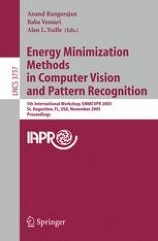
Energy minimization methods in computer vision and pattern recognition ; 5th International Workshop, EMMCVPR 2005, St. Augustine, FL, USA, November 9-11, 2005, Proceedings
Constitutes the refereed proceedings of the 5th International Workshop on Energy Minimization Methods in Computer Vision and Pattern Recognition, EMMCVPR 2005, in St Augustine, FL, USA, in November 2005. This book consists of 24 papers and 18 poster papers organized in topical sections on different approaches.

Energy Efficient Servers : Blueprints for Data Center Optimization
The book includes a deep examination of different features used in processors, memory, interconnects, I/O devices, and other platform components. It outlines the power and performance impact of these features and the role firmware and software play in initialization and control. Using examples from cloud, HPC, and enterprise environments, the book demonstrates how various power management technologies are utilized across a range of server utilization. It teaches the reader how to monitor, analyze, and optimize their environment to best suit their needs. It shares optimization techniques used by data center administrators and system optimization experts at the world’s most advanced data centers.

Emerging Directions in Embedded and Ubiquitous Computing ; EUC 2007 Workshops: TRUST, WSOC, NCUS, UUWSN, USN, ESO, and SECUBIQ, Taipei, Taiwan, December 1-4, 2007, Proceedings
This volume contains discuss and exchange state-of-the-art research results and experience, case studies and on-going research activities in the areas of embedded and ubiquitous computing, networking and communications.

Emerging Directions in Embedded and Ubiquitous Computing ; EUC 2006 Workshops : NCUS, SecUbiq, USN, TRUST, ESO, and MSA, Seoul, Korea, August 1-4, 2006, Proceedings
Constitutes the refereed proceedings of the EUC 2006 workshops, held in conjunction with the IFIP International Conference on Embedded and Ubiquitous Computing in Seoul, Korea, August 2006.

Embedded systems design : The ARTIST roadmap for research and development
Embedded systems now include a very large proportion of the advanced products designed in the world, spanning transport (avionics, space, automotive, trains), electrical and electronic appliances (cameras, toys, televisions, home appliances, audio systems, and cellular phones), process control (energy production and distribution, factory automation and optimization), telecommunications (satellites, mobile phones and telecom networks), and security (e-commerce, smart cards), etc. The extensive and increasing use of embedded systems and their integration in everyday products marks a significant evolution in information science and technology. We expect that within a short timeframe embedded systems will be a part of nearly all equipment designed or manufactured in Europe, the USA, and Asia. There is now a strategic shift in emphasis for embedded systems designers: from simply achieving feasibility, to achieving optimality. Optimal design of embedded systems means targeting a given market segment at the lowest cost and delivery time possible. Optimality implies seamless integration with the physical and electronic environment while respecting real-world constraints such as hard deadlines, reliability, availability, robustness, power consumption, and cost. In our view, optimality can only be achieved through the emergence of embedded systems as a discipline in its own right.
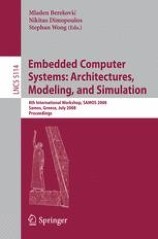
Embedded Computer Systems : Architectures, Modeling, and Simulation ; 8th International Workshop, SAMOS 2008, Samos, Greece, July 21-24, 2008. Proceedings
This book constitutes the refereed proceedings of the 8th International Workshop on Systems, Architectures, Modeling, and Simulation, SAMOS 2008, held in Samos, Greece, in July 2008.
