



Page 8
Page 8

Defence Industry Applications of Autonomous Agents and Multi-Agent Systems
In this book defense and security related applications are increasingly being tackled by researchers and practioners using technologies developed in the field of Intelligent Agent research.

Deep Learning, Machine Learning and IoT in Biomedical and Health Informatics : Techniques and Applications
Examines and demonstrates state-of-the-art approaches for IoT and Machine Learning based biomedical and health related applications. This book aims to provide computational methods for accumulating, updating and changing knowledge in intelligent systems and particularly learning mechanisms that help us to induce knowledge from the data. It is helpful in cases where direct algorithmic solutions are unavailable, there is lack of formal models, or the knowledge about the application domain is inadequately defined. In the future IoT has the impending capability to change the way we work and live. These computing methods also play a significant role in design and optimization in diverse engineering disciplines. With the influence and the development of the IoT concept, the need for AI (artificial intelligence) techniques has become more significant than ever.

Database and expert systems applications ; DEXA 2020 International workshops BIOKDD, IWCFS and MLKgraphs, Bratislava, Slovakia, September 14–17, 2020, Proceedings
This volume constitutes the refereed proceedings of the three workshops held at the 31st International Conference on Database and Expert Systems Applications, DEXA 2020, held in September 2020: The 11th International Workshop on Biological Knowledge Discovery from Data, BIOKDD 2020, the 4th International Workshop on Cyber-Security and Functional Safety in Cyber-Physical Systems, IWCFS 2020, the 2nd International Workshop on Machine Learning and Knowledge Graphs, MLKgraphs2019. Due to the COVID-19 pandemic the conference and workshop were held virtually. The 10 papers were thoroughly reviewed and selected from 15 submissions, and discuss a range of topics including: knowledge discovery, biological data, cyber security, cyber-physical system, machine learning, knowledge graphs, information retriever, data base, and artificial intelligent.

Database and Expert Systems Applications ; 18th International Conference, DEXA 2007, Regensburg, Germany, September 3-7, 2007, Proceedings
This volume represent the state of the art of - search in the domain of data, information and knowledge management, intelligent systems, and their applications.
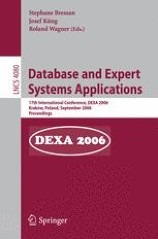
Database and expert systems and Aapplications ; 17th International Conference, DEXA 2006, Krakow, Poland, September 4-8, 2006, Proceedings
The annual international conference on Database and Expert Systems Applications (DEXA) is now well established as a reference scientific event. The reader will find in this volume a collection of scientific papers that represent the state of the art of research in the domain of data, information and knowledge management, intelligent systems, and their applications.

Data Center Handbook : Plan, Design, Build, and Operations of a Smart Data Center ; 2nd ed.
Explains the fundamentals, advanced technologies, and best practices used in planning, designing, building and operating a mission-critical, energy-efficient, sustainable data center. This handbook, in its second edition, covers anatomy, ecosystem and taxonomy of data centers that enable the Internet of Things and artificial intelligent ecosystems and encompass the following: Data center overview and strategic planning Data center technologies Data center design and construction Data center operations technologies

Current aopics in artificial intelligence ; 11th Conference of the Spanish Association for Artificial Intelligence, CAEPIA 2005, Santiago de Compostela, Spain, November 16-18, 2005, Revised Selected Papers
This book constitutes the thoroughly refered post-proceedings of the 11th Conference of the Spanish Association for Artificial Intelligence, CAEPIA 2005, held in Santiago de Compostela, Spain in November 2005.

Creative applications of artificial intelligence in education
Explores the synergy between AI and education, highlighting its potential impact on pedagogical practices. It navigates the evolving landscape of AI-powered educational technologies and suggests practical ways to personalise instruction, nurture human-AI co-creativity, and transform the learning experience. Spanning from primary to higher education, this short and engaging volume proposes concrete examples of how educational stakeholders can be empowered in their AI literacy to foster creativity, inspire critical thinking, and promote problem-solving by embracing AI as a tool for expansive learning. Structured in three parts, the book starts developing the creative engagement perspective for learning and teaching to then present practical applications of AI in K-12 and higher education, covering different fields (teacher education, professional education, business education) as well as different types of AI supported tools (games, chatbots, and AI assisted assessment).

Creating New Learning Experiences on a Global Scale ; 2nd European Conference on Technology Enhanced Learning, EC-TEL 2007, Crete, Greece, September 17-20, 2007, Proceedings
It is holding more than 500 pages of combined wisdom on Technology Enhanced Learning (TEL) in your hands! With the advance of metadata, standards, learning objects, Web 2. 0 approaches to rip, mix and burn learning, wikis, blogs, syndication, user-generated content, W- based video, games and the ubiquitous availability of computing devices we can and have to offer more flexible learning services on a global scale.It provided a unique forum for all research related to technology enhanced learning, including its interactions with knowledge management, business processes and work environments.

Cooperative Information Agents XI ; Matthias Klusch, Koen V. Hindriks, Mike P. Papazoglou, Leon Sterling
In today’s world of ubiquitously connected heterogeneous information systems and computing devices, the intelligent coordination and provision of relevant added-value information at any time, anywhere is of key importance to a va- ety of applications. This challenge is envisioned to be coped with by means of appropriate intelligent and cooperative information agents. An information agent is a computational software entity that has access to one or multiple heterogeneous and geographically dispersed data and infor- tion sources. It pro-actively searches for and maintains information on behalf of its human users, or other agents preferably just in time. In other words, it is managing and overcoming the di?culties associated with information overload in open, pervasive information and service landscapes. Each component of a modern cooperative information system is represented by an appropriate intelligent information agent capable of resolving system and semantic heterogeneities in a given context on demand. Cooperative infor- tion agents are supposed to accomplish both individual and shared joint goals depending on the actual user preferences in line with given or deduced limits of time, budget and resources available.
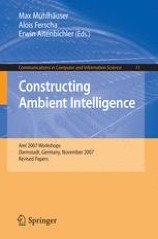
Constructing Ambient Intelligence ; AmI 2007 Workshops Darmstadt, Germany, November 7-10, 2007 Revised Papers
This book constitutes the refereed proceedings of the workshops of the First European Conference on Ambient Intelligence, AmI 2007, held in Darmstadt, Germany, in November 2007.

Conceptual Structures: Knowledge Architectures for Smart Applications ; 15th International Conference on Conceptual Structures, ICCS 2007, Sheffield, UK, July 22-27, 2007, Proceedings
Conceptual structures focus on the representation and analysis of concepts, events, actions and objects with applications in - search,softwareengineering,manufacturing and business.The book covers computer science, information technology,artificial int- ligence, philosophy and a variety of applied disciplines to explore novel ways that information technologies can be leveraged to assist human reasoning and interaction for tangible business or social benefits. Conceptual structures can be used to augment human intelligence by facilitating knowledge integration, desion making, the creation of intelligent software systems and the exploration of implicit structures.

Conceptual Structures : Knowledge Visualization and Reasoning; 16th International Conference on Conceptual Structures, ICCS 2008 Toulouse, France, July 7-11, 2008 Proceedings
This book constitutes the refereed proceedings of the 16th International Conference on Conceptual Structures, ICCS 2008, held in Toulouse, France, in July 2008.

Computer vision and machine learning for intelligent sensing systems
Offers a selection of high-quality research articles that tackle the major difficulties in computer vision and machine learning for intelligent sensing systems from both theoretical and practical standpoints. This publication includes intelligent sensing techniques, twelve foundational investigations into sense-making methods, and discusses particular uses of intelligent sensing systems in autonomous driving and virtual reality.

Computer Vision and Internet of Things : Technologies and Applications
Explores the utilization of Internet of Things (IoT) with computer vision and its underlying technologies in different applications areas. Using a series of present and future applications – including business insights, indoor-outdoor securities, smart grids, human detection and tracking, intelligent traffic monitoring, e-health departments, and medical imaging – this book focuses on providing a detailed description of the utilization of IoT with computer vision and its underlying technologies in critical application areas, such as smart grids, emergency departments, intelligent traffic cams, insurance, and the automotive industry.

Computer Aided Systems Theory – EUROCAST 2007 ; 11th International Conference on Computer Aided Systems Theory, Las Palmas de Gran Canaria, Spain, February 12-16, 2007, Revised Selected Papers
This book presented formal approaches, Computation and Simulation in Modelling Biological Systems, Intelligent Information Processing, Computers in Education, Grid Computing, Applied Formal Verification, Cellular Automata, Computer Vision, Heuristic Problem So.

Computer Aided Systems Theory – EUROCAST 2005 ; 10th International Conference on Computer Aided Systems Theory, Las Palmas de Gran Canaria, Spain, February 7-11, 2005, Revised Selected Papers
The concept of CAST, computer aided systems Theory, was introduced by F. Pichler of Linz in the late 1980s to include those computer theoretical and practical developments used as tools to solve problems in system science. It was considered as the third component (the other two being CAD and CAM) that would provide for a complete picture of the path from computer and systems sciences to practical developments in science and engineering. Selected papers were published as Springer Lecture Notes in Computer Science vols. 410, 585, 763, 1030, 1333, 1728, 2178 and 2809 and in several special issues of Cybernetics and Systems: an lnternational
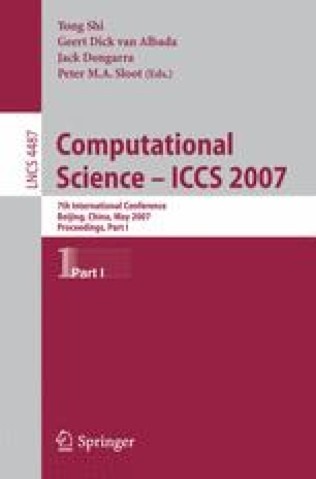
Computational Science – ICCS 2007; 7th International Conference, Beijing China, May 27-30, 2007, Proceedings, Part I
This book contiants sections on efficient data management, parallel monte carlo algorithms, simulation of multiphysics multiscale systems, dynamic data driven application systems, computer graphics and geometric modeling, computer algebra systems, computational chemistry, computational approaches and techniques in bioinformatics, computational finance and business intelligence, geocomputation, high-level parallel programming, networks theory and applications, collective intelligence for semantic and knowledge grid, collaborative and cooperative environments, tools for program development and analysis in CS, intelligent agents in computing systems, CS in software engineering, computational linguistics in HCI, internet computing in science and engineering, workflow systems in e-science, graph theoretic algorithms and applications in cs, teaching CS, high performance data mining, mining text, semi-structured, Web, or multimedia data,

Computational linguistics and intelligent text processing ; Vol. 3878 ; 7th International Conference, CICLing 2006, Mexico City, Mexico, February 19-25, 2006, Proceedings
CICLing 2006 (www.CICLing.org) was the 7th Annual Conference on Intelligent Text Processing and Computational Linguistics. The CICLing conferences are intended to provide a wide-scope forum for discussion of the internal art and craft of natural language processing research and the best practices in its applications.

Computational linguistics and intelligent text processing ; 9th International Conference, CICLing 2008, Haifa, Israel, February 17-23, 2008. Proceedings
The CICLing conferences are intended to provide a wide-scope forum for the discussion of both the art and craft of natural language processing research and the best practices in its applications. This volume contains the papers accepted for oral presentation at the c- ference, as well as several of the best papers accepted for poster presentation.
