



Page 73
Page 73
Kernel Methods for Machine Learning with Math and Python: 100 Exercises for Building Logic
Addresses the fundamentals of kernel methods for machine learning by considering relevant math problems and building Python programs. The book’s main features are as follows: Includes 100 exercises, which have been carefully selected and refined. As their solutions are provided in the main text, readers can solve all of the exercises by reading the book. / The mathematical premises of kernels are proven and the correct conclusions are provided, helping readers to understand the nature of kernels. / Source programs and running examples are presented to help readers acquire a deeper understanding of the mathematics used. / Once readers have a basic understanding of the functional analysis topics covered in Chapter 2, the applications are discussed in the subsequent chapters. Here, no prior knowledge of mathematics is assumed. / Considers both the kernel for reproducing kernel Hilbert space (RKHS) and the kernel for the Gaussian process; a clear distinction is made between the two.
Julia - Bit by Bit : Programming for Beginners
The main goal of this book is to teach fundamental programming principles to beginners using Julia, one of the fastest growing programming languages today. Julia can be classified as a "modern" language, possessing many features not available in more popular languages like C and Java.

Journal on Data Semantics XI
The LNCS Journal on Data Semantics is devoted to the presentation of notable work that, in one way or another, addresses research and development on issues related to data semantics. The scope of the journal ranges from theories supporting the formal definition of semantic content to innovative domain-specific applications of semantic knowledge. The journal addresses researchers and advanced practitioners working on the semantic web, interoperability, mobile information services, data warehousing, knowledge representation and reasoning, conceptual database modeling, ontologies, and artificial intelligence.

Journal on Data Semantics VIII
Springer's LNCS Journal on Data Semantics aims at providing a highly visible dissemination channel for most remarkable work that in one way or another addresses research and development on issues related to the semantics of data. The target domain ranges from theories supporting the formal definition of semantic content to innovative domain-specific application of semantic knowledge. This publication channel should be of the highest interest to researchers and advanced practitioners working on the Semantic Web, interoperability, mobile information services, data warehousing, knowledge representation and reasoning, conceptual database modeling, ontologies, and artificial intelligence.

Journal on Data Semantics VII
The LNCS Journal on Data Semantics is devoted to the presentation of notable work that, in one way or another, addresses research and development on issues related to data semantics. Based on the highly visible publication platform Lecture Notes in Computer Science, this new journal is widely disseminated and available worldwide. The scope of the journal ranges from theories supporting the formal definition of semantic content to innovative domain-specific applications of semantic knowledge. The journal addresses researchers and advanced practitioners working on the semantic web, interoperability, mobile information services, data warehousing, knowledge representation and reasoning, conceptual database modeling, ontologies, and artificial intelligence.

Journal on Data Semantics VI
Data warehousing and semantic data mining • Spatial, temporal, multimedia and multimodal semantics • Semantics in data visualization • Semantic services for mobile users • Supporting tools • Applications of semantic-driven approaches These topics are to be understood as speci?cally related to semantic issues. Contributions submitted to the journal and dealing with semantics of data will be considered even if they are not within the topics in the list. While the physical appearanceof the journal issues looks like the books from the well-known Springer LNCS series, the mode of operation is that of a jo- nal. Contributions can be freely submitted by authors and are reviewed by the Editorial Board. Contributions may also be invited, and nevertheless carefully reviewed, as in the case for issues that contain extended versions of best papers from major conferences addressing data semantics issues. Special issues, foc- ing on a speci?c topic, are coordinated by guest editors once the proposal for a special issue is accepted by the Editorial Board.

Journal on Data Semantics V
The LNCS Journal on Data Semantics is devoted to the presentation of notable work that, in one way or another, addresses research and development on issues related to data semantics. Based on the highly visible publication platform Lecture Notes in Computer Science, this new journal is widely disseminated and available worldwide. The scope of the journal ranges from theories supporting the formal definition of semantic content to innovative domain-specific applications of semantic knowledge. The journal addresses researchers and advanced practitioners working on the semantic web, interoperability, mobile information services, data warehousing, knowledge representation and reasoning, conceptual database modeling, ontologies, and artificial intelligence.

Journal on Data Semantics IX
The LNCS Journal on Data Semantics is devoted to the presentation of notable work that, in one way or another, addresses research and development on issues related to data semantics. The scope of the journal ranges from theories supporting the formal definition of semantic content to innovative domain-specific applications of semantic knowledge.
Journal on Data Semantics IV
• Semantics in data visualization • Semantic services for mobile users • Supporting tools • Applications of semantic-driven approaches These topics are to be understood as specifically related to semantic issues. Contributions submitted to the journal and dealing with semantics of data will be considered even if they are not within the topics in the list. While the physical appearance of the journal issues is like the books from the we- known Springer LNCS series, the mode of operation is that of a journal. Contributions can be freely submitted by authors and are reviewed by the Editorial Board. Contributions may also be invited, and nevertheless carefully reviewed, as in the case for issues that contain extended versions of the best papers from major conferences addressing data semantics issues. Special issues, focusing on a specific topic, are coordinated by guest editors once the proposal for a special issue is accepted by the Editorial Board. Finally, it is also possible that a journal issue be devoted to a single text.
Journal on Data Semantics III
– semantic caching – data warehousing and semantic data mining – spatial, temporal, multimedia and multimodal semantics – semantics in data visualization – semantic services for mobile users – supporting tools – applications of semantic-driven approaches These topics are to be understood as speci?cally related to semantic issues. Contributions submitted to the journal and dealing with semantics of data will be considered even if they are not within the topics in the list. While the physical appearance of the journal issues looks like the books from the well-known Springer LNCS series, the mode of operation is that of a journal. Contributions can be freely submitted by authors and are reviewed by the Editorial Board. Contributions may also be invited, and nevertheless carefully reviewed, as in the case for issues that contain extended versions of best papers from major conferences addressing data semantics issues. Special issues, focusing on a speci?c topic, are coordinated by guest editors once the proposal for a special issue is accepted by the Editorial Board. Finally, it is also possible that a journal issue be devoted to a single text.
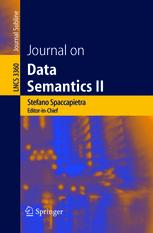
Journal on Data Semantics II
The LNCS Journal on Data Semantics is devoted to the presentation of notable work that, in one way or another, addresses research and development on issues related to data semantics. Based on the highly visible publication platform Lecture Notes in Computer Science, this new journal is widely disseminated and available worldwide. The scope of the journal ranges from theories supporting the formal definition of semantic content to innovative domain-specific applications of semantic knowledge. The journal addresses researchers and advanced practitioners working on the semantic web, interoperability, mobile information services, data warehousing, knowledge representation and reasoning, conceptual database modeling, ontologies, and artificial intelligence.

Job Scheduling Strategies for Parallel Processing ; Vol. 3277 : 10th International Workshop, JSSPP 2004, New York, NY, USA, June 13, 2004, Revised Selected Papers
Contains the papers presented at the 10th Anniversary Workshop on Job Scheduling Strategies for Parallel Processing. The workshop was held in New York City, on June 13, 2004, at Columbia University, in conjunction with the SIGMETRICS 2004 conference. Although it is a workshop, the papers were conference-reviewed, with the full versions being read and evaluated by at least five and usually seven members of the Program Committee. We refer to it as a workshop because of the very fast turnaround time, the intimate nature of the actual presentations, and the ability of the authors to revise their papers after getting feedback from workshop attendees. On the other hand, it was actually a conference in that the papers were accepted solely on their merits as decided upon by the Program Committee.

Job Scheduling Strategies for Parallel Processing ; 12th International Workshop, JSSPP 2006, Saint-Malo, France, June 26, 2006, Revised Selected Papers
Constitutes the thoroughly refereed post-proceedings of the 12th International Workshop on Job Scheduling Strategies for Parallel Processing, JSSPP 2006, held in Saint-Malo, France in June 2006 in conjunction with the Joint International Conference on Measurement and Modeling of Computer Systems SIGMETRICS/Performance 2006.
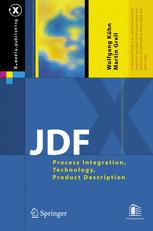
JDF : Process Integration, Technology, Product Description
The arrival of PDF has successfully optimized certain elements of the production workflow – the next challenge facing the print media industry is to resolve the problem of non-networked software packages that exist in isolation. Businesses today need to identify process inefficiencies to ensure the successful process integration of the entire value added chain. The PDF document format and the vendor-independent JDF (Job Definition Format) provide the technical platform for devising new, fully integrated workflow solutions. Networking decisions involve virtually every department of a print service provider and lay down the direction of the company over the long term. These decisions offer opportunities, but they also harbor risks. If businesses are to make the right investment decisions, it is vital they have extensive background information on technical and business management issues. The authors provide focused information for decision makers looking for support in implementing networking projects successfully. This book is couched in straightforward language, explains and highlights relevant terms, and provides readers with numerous practical illustrations, graphics and checklists that they can apply to real-life applications.

Java Methods for Financial Engineering : Applications in Finance and Investment
This book is structured around the main theories and models used by practitioners to engineer finance and investment tools. The methods developed and implemented in the text are organized as chapters which cover the core areas.

Java Challenges 100+ : Proven Tasks that Will Prepare You for Anything
Expand your knowledge of Java with this entertaining learning guide, which features 100+ exercises and programming challenges. Java Challenges will prepare you for your next exam or job interview, and covers many practical topics, such as strings, arrays, data structures, recursion, and date and time. The APIs and other material included in this book are Java 17 compatible. You will: Improve your Java knowledge by solving enjoyable but challenging programming puzzles / Solve mathematical problems, recursions, strings, arrays and more / Manage data processing and data structures like lists, sets, maps / Handle advanced recursion as well as binary trees, sorting and searching / Gamify key fundamentals for fun and easier reinforcement
Java 17 Recipes : A Problem-Solution Approach
Quickly find solutions to dozens of common programming problems encountered while building Java applications, with recipes presented in the popular problem-solution format. Look up the programming problem that you want to resolve. Read the solution. Apply the solution directly in your own code. Problem solved! covers of some of the newest features, APIs, and more such as pattern matching for switch, Restore Always-Strict-Floating-Point-Semantics, enhanced pseudo-random number generators, the vector API, sealed classes, and enhancements in the use of String. Source code for all recipes is available in a dedicated GitHub repository. This must-have reference belongs in your library. You will learn : Look up solutions to everyday problems involving Java SE 17 LTS and other recent releases / Develop Java SE applications using the latest in Java SE technology / Incorporate Java major features introduced in versions 17, 16, and 15 into your code

IUTAM Symposium on Laminar-Turbulent Transition and Finite Amplitude Solutions
This volume contains refereed papers presented symposium on "Non-Uniqueness of Solutions to the Navier-Stokes equations and their Connection with Laminar-Turbulent Transition" The central objective of the symposium was to discuss the increasing amount of experimental and numerical evidence for finite amplitude solutions to the Navier-Stokes equations and to set the work into a modern theoretical context.

ITIL® Version 3 at a Glance : Information Quick Reference
The desk reference’s unique graphical approach will take otherwise complex textual descriptions and make the information accessible in a series of consistent, simple diagrams. ITIL® Version 3 At a Glance will be of interest to organizations looking to train their staffs in a consistent and cost-effective way. Further, this book is ideal for anyone involved in planning consulting, implementing, or testing an ITIL® Version 3 implementation.

IT Security Controls : A Guide to Corporate Standards and Frameworks
Gives an overview of the major standards and frameworks, and a proposed architecture to meet them. The book identifies and describes the necessary controls and processes that must be implemented in order to secure your organization's infrastructure. The book proposes a comprehensive approach to the implementation of IT security controls with an easily understandable graphic implementation proposal to comply with the most relevant market standards (ISO 27001, NIST, PCI-DSS, and COBIT) and a significant number of regulatory frameworks from central banks across the World (European Union, Switzerland, UK, Singapore, Hong Kong, India, Qatar, Kuwait, Saudi Arabia, Oman, etc.). You will learn: Understand corporate IT security controls, including governance, policies, procedures, and security awareness Know cybersecurity and risk assessment techniques such as penetration testing, red teaming, compliance scans, firewall assurance, and vulnerability scans Understand technical IT security controls for unmanaged and managed devices, and perimeter controls Implement security testing tools such as steganography, vulnerability scanners, session hijacking, intrusion detection, and more
