



Page 6
Page 6

Data Quality and Record Linkage Techniques
This book helps practitioners gain a deeper understanding, at an applied level, of the issues involved in improving data quality through editing, imputation, and record linkage. The first part of the book deals with methods and models. Here, we focus on the Fellegi-Holt edit-imputation model, the Little-Rubin multiple-imputation scheme, and the Fellegi-Sunter record linkage model. Brief examples are included to show how these techniques work. In the second part of the book, the authors present real-world case studies in which one or more of these techniques are used. They cover a wide variety of application areas. These include mortgage guarantee insurance, medical, biomedical, highway safety, and social insurance as well as the construction of list frames and administrative lists.

Data augmented design : Embracing new data for sustainable urban planning and design
This book offers an essential introduction to a new urban planning and design methodology called Data Augmented Design (DAD) and its evolution and progresses, highlighting data driven methods, urban planning and design applications and related theories. The authors draw on many kinds of data, including big, open, and conventional data, and discuss cutting-edge technologies that illustrate DAD as a future-oriented design framework in terms of its focus on multi-data, multi-method, multi-stage and multi-scale sustainable urban planning. In four sections and ten chapters, the book presents case studies to address the core concepts of DAD, the first type of applications of DAD that emerged in redevelopment-oriented planning and design, the second type committed to the planning and design for urban expansion, and the future-oriented applications of DAD to advance sustainable technologies and the future structural form of the built environment. The book is geared towards a broad readership, ranging from researchers and students of urban planning, urban design, urban geography, urban economics, and urban sociology, to practitioners in the areas of urban planning and design.

Data Algorithms with Spark
Apache Spark's speed, ease of use, sophisticated analytics, and multilanguage support makes practical knowledge of this cluster-computing framework a required skill for data engineers and data scientists. With this hands-on guide, anyone looking for an introduction to Spark will learn practical algorithms and examples using PySpark. you will: Learn how to select Spark transformations for optimized solutions Explore powerful transformations and reductions including reduceByKey(), combineByKey(), and mapPartitions() Understand data partitioning for optimized queries Build and apply a model using PySpark design patterns Apply motif-finding algorithms to graph data Analyze graph data by using the GraphFrames API Apply PySpark algorithms to clinical and genomics data Learn how to use and apply feature engineering in ML algorithms Understand and use practical and pragmatic data design patterns

Cryptography and cryptanalysis in Java : Creating and programming advanced algorithms with Java SE 17 LTS and Jakarta EE 10
Includes challenging cryptographic solutions that are implemented in Java 17 and Jakarta EE 10. It provides a robust introduction to Java 17's new features and updates, a roadmap for Jakarta EE 10 security mechanisms, a unique presentation of the "hot points" (advantages and disadvantages) from the Java Cryptography Architecture (JCA), and more. You Will Learn : Develop programming skills for writing cryptography algorithms in Java / Dive into security schemes and modules using Java / Explore “good” vs “bad” cryptography based on processing execution times and reliability / Play with pseudo-random generators, hash functions, etc. / Leverage lattice-based cryptography methods, the NTRU framework library, and more

Cooperative Information Agents XI ; Matthias Klusch, Koen V. Hindriks, Mike P. Papazoglou, Leon Sterling
In today’s world of ubiquitously connected heterogeneous information systems and computing devices, the intelligent coordination and provision of relevant added-value information at any time, anywhere is of key importance to a va- ety of applications. This challenge is envisioned to be coped with by means of appropriate intelligent and cooperative information agents. An information agent is a computational software entity that has access to one or multiple heterogeneous and geographically dispersed data and infor- tion sources. It pro-actively searches for and maintains information on behalf of its human users, or other agents preferably just in time. In other words, it is managing and overcoming the di?culties associated with information overload in open, pervasive information and service landscapes. Each component of a modern cooperative information system is represented by an appropriate intelligent information agent capable of resolving system and semantic heterogeneities in a given context on demand. Cooperative infor- tion agents are supposed to accomplish both individual and shared joint goals depending on the actual user preferences in line with given or deduced limits of time, budget and resources available.

Control Systems Design : A New Framework
This book will be of great interest to academics and institutional researchers in control system design and to those studying for higher degrees in this area

Construction and analysis of safe, secure, and interoperable smart devices ; Vol. 3362 : International workshop, CASSIS 2004, Marseille, France, March 10-14, 2004, Revised Selected Papers
History based access control and secure information flow / The spec# programming system / Mastering test generation from smart card software formal models / A mechanism for secure, fine-grained dynamic provisioning of applications on small devices / A type system for checking applet isolation in java card / Verification of safety properties in the presence of transactions / Modelling mobility aspects of security policies / Smart devices for next generation mobile services / A flexible framework for the estimation of coverage metrics in explicit state software model checking / Combining several paradigms for circuit validation and verification / Smart card research perspectives

Constraint solving and language processing
Contains selected and thoroughly revised papers plus contributions from invited speakers presented at the First International Workshop on C- straint Solving and Language Processing, held in Roskilde, Denmark, September 1–3, 2004. Constraint Programming and Constraint Solving, in particular Constraint Logic Programming, appear to be a very promising platform, perhaps the most promising present platform, for bringing forward the state of the art in natural language processing, this due to the naturalness in speci?cation and the direct relation to e?cient implementation. Language, in the present context, may - fer to written and spoken language, formal and semiformal language, and even general input data to multimodal and pervasive systems, which can be handled in very much the same ways using constraint programming. The notion of constraints, with slightly differing meanings, apply in the characterization of linguistic and cognitive phenomena, in formalized linguistic m- els as well as in implementation-oriented frameworks. Programming techniques for constraint solving have been, and still are, in a period with rapid devel- ment of new eficient methods and paradigms from which language processing can prompt. A common metaphor for human language processing is one big c- straint solving process in which the differently specified linguistic and cognitive phases take place in parallel and with mutual cooperation, which ?ts quite well with current constraint programming paradigms.

Computer-Aided Design of User Interfaces IV
Computer-Aided Design of User Interfaces IV gathers the latest research of experts, research teams and leading organisations involved in computer-aided design of user interactive applications supported by software, with specific attention for platform-independent user interfaces and context-sensitive or aware applications. This includes: innovative model-based and agent-based approaches, code-generators, model editors, task animators, translators, checkers, advice-giving systems and systems for graphical and multimodal user interfaces. It also addresses User Interface Description Languages. This books attempts to emphasize the software tool support for designing user interfaces and their underlying languages and methods, beyond traditional development environments offered by the market. It will be of interest to software development practitioners and researchers whose work involves human-computer interaction, design of user interfaces, frameworks for computer-aided design, formal and semi-formal methods, web services and multimedia systems, interactive applications, and graphical user and multi-user interfaces.

Computer algebra in scientific computing ; Vol. 3718 ; 8th International workshop, CASC 2005, Kalamata, Greece, September 12-16, 2005, Proceedings
This volume contains the proceedings of the CASC 2005 continued a tradition — started in 1998 — of international con-ferences on the latest advances in the application of computer algebra systems(CASs) and methods to the solution of various problems in scientific computing.The methods of scientific computing play an important role in research andengineering applications in the natural and the engineering sciences. The signif-icance and impact of computer algebra methods and computer algebra systemsfor scientific computing has increased considerably in recent times. Nowadays,such general-purpose computer algebra systems as Maple, Magma, Mathematica,MuPAD, Singular, CoCoA and others enable their users to solve the followingthree important tasks within a uniform framework:(a) symbolic manipulation;(b) numerical computation;(c) visualization. The result of this job is reflected in this volume, which contains revised versionsof the accepted papers. The collection of papers included in the proceedingscovers various topics of computer algebra methods, algorithms, and softwareapplied to scientific computing:
Computational Processing of the Portuguese Language ; 7th International Workshop, PROPOR 2006, Itatiaia, Brazil, May 13-17, 2006, Proceedings
Since 1993, PROPOR Workshops have become an important forum for - searchers involved in the Computational Processing of Portuguese,both written and spoken. The workshop and this book were structured around the following main t- ics, seven for full papers: (i) automatic summarization; (ii) resources; (iii) au- matic translation; (iv) named entity recognition; (v) tools and frameworks; (vi) systems and models; and another ?ve topics for short papers; (vii) information extraction; (viii) speech processing; (ix) lexicon; (x) morpho-syntactic studies; (xi) web, corpus and evaluation.

Computational Physiology : Simula Summer School 2021 − Student Reports
Compiles student reports from the 2021 Simula Summer School in Computational Physiology. Interested readers will find herein a number of modern approaches to modeling excitable tissue. This should provide a framework for tools available to model subcellular and tissue-level physiology across scales and scientific questions.

Computational methods in systems biology ; 18th International Conference, CMSB 2020, Konstanz, Germany, September 23–25, 2020, Proceedings
This book constitutes the refereed proceedings of the 18th International Conference on Computational Methods in Systems Biology, CMSB 2020, held in Konstanz, Germany, in September 2020.* The 17 full papers and 5 tool papers were carefully reviewed and selected from 30 submissions. In addition 3 abstracts of invited talks and 2 tutorials have been included in this volume. Topics of interest include formalisms for modeling biological processes; models and their biological applications; frameworks for model verification, validation, analysis, and simulation of biological systems; high-performance computational systems biology and parallel implementations; model inference from experimental data; model integration from biological databases; multi-scale modeling and analysis methods; computational approaches for synthetic biology; and case studies in systems and synthetic biology.
Computational logic in multi-agent systems ; Vol. 3487 ; 5th International Workshop, CLIMA V, Lisbon, Portugal, September 29-30, 2004, Revised Selected and Invited Papers
The notion of agency has recently increased its in?uence in the research and - velopment of computational logic based systems, while at the same time sign- cantly gaining from decades of research in computational logic. Computational logic provides a well-de?ned, general, and rigorous framework for studying s- tax, semantics and procedures, for implementations, environments, tools, and standards, facilitating the ever important link between speci?cation and ver- cation of computational systems. The purpose of the Computational Logic in Multi-agent Systems (CLIMA) international workshop series is to discuss techniques, based on computational logic, for representing, programming, and reasoning about multi-agent systems in a formal way. Former CLIMA editions were conducted in conjunction with other major computational logic and AI events Thesubmittedpapersshowedthatthelogicalfoundationsofmulti-agent systems are felt by a large community to be a very important research topic, upon which classical AI and agent-related issues are to be addressed.

Collaborative Networks : Reference Modeling
Collaborative Networks: Reference Modeling works to establish a theoretical foundation for Collaborative Networks. Particular emphasis is put on modeling multiple facets of collaborative networks and establishing a comprehensive modeling framework that captures and structures diverse perspectives of these complex entities.

Cognition, Communication and Interaction : Transdisciplinary Perspectives on Interactive Technology
This book aims to provide a trans-disciplinary research framework and methodology for interaction design. The analysis directs attention to three human capacities that our engagement with interactive technology has made salient and open to constant redefinition.
Machine Learning for Multimedia Content Analysis
Challenges in complexity and variability of multimedia data have led to revolutions in machine learning techniques. Multimedia data, such as digital images, audio streams and motion video programs, exhibit richer structures than simple, isolated data items. A number of pixels in a digital image collectively conveys certain visual content to viewers. A TV video program consists of both audio and image streams that unfold the underlying story. To recognize the visual content of a digital image, or to understand the underlying story of a video program, we may need to label sets of pixels or groups of image and audio frames jointly.

Machine learning challenges : Evaluating predictive uncertainty, Visual Object Classification, and Recognizing Textual Entailment, 1st Pascal Machine Learning Challenges Workshop, MLCW 2005, Southampton, UK, April 11-13, 2005, Revised Selected Papers
Constitutes the refereed post-proceedings of the First PASCAL Machine Learning Challenges Workshop, MLCW 2005. 25 papers address three challenges: finding an assessment base on the uncertainty of predictions using classical statistics, Bayesian inference, and statistical learning theory; second, recognizing objects from a number of visual object classes in realistic scenes; third, recognizing textual entailment addresses semantic analysis of language to form a generic framework for applied semantic inference in text understanding.
Machine Learning and Data Mining for Computer Security : Methods and Applications
Presents research conducted in academia and industry on methods and applications of machine learning and data mining for problems in computer security and will be of interest to researchers and practitioners, as well students.
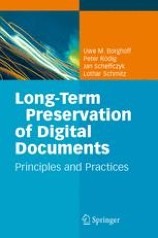
Long-Term Preservation of Digital Documents : Principles and Practices
Key to our culture is that we can disseminate information, and then maintain and access it over time. While we are rapidly advancing from vulnerable physical solutions to superior, digital media, preserving and using data over the long term involves complicated research challenges and organization efforts. Uwe Borghoff and his coauthors address the problem of storing, reading, and using digital data for periods longer than 50 years. They briefly describe several markup and document description languages like TIFF, PDF, HTML, and XML, explain the most important techniques such as migration and emulation, and present the OAIS (Open Archival Information System) Reference Model. To complement this background information on the technology issues the authors present the most relevant international preservation projects, such as the Dublin Core Metadata Initiative, and experiences from sample projects run by the Cornell University Library and the National Library of the Netherlands. A rated survey list of available systems and tools completes the book.
