



Page 51
Page 51

Active mining ; 2nd International workshop, AM 2003, Maebashi, Japan, October 28, 2003, revised selected papers
"This volume contains the papers selected for presentation at the 2nd Inter- tional Workshop on Active Mining (AM 2003) which was organized in conju- tion with the 14th International Symposium on Methodologies for Intelligent Systems (ISMIS 2003), The workshop was organized by the Maebashi Institute of Technology for shed light on the future development of active mining. "This volume contains : Topics Database Management / Artificial Intelligence / Algorithm Analysis and Problem Complexity / Health Informatics / Bioinformatics

Accelerator Programming Using Directives ; 6th International Workshop, WACCPD 2019, Denver, CO, USA, November 18, 2019, Revised Selected Papers
This book constitutes the refereed post-conference proceedings of the 6th International Workshop on Accelerator Programming Using Directives, WACCPD 2019, held in Denver, CO, USA, in November 2019. The 7 full papers presented have been carefully reviewed and selected from 13 submissions. The papers share knowledge and experiences to program emerging complex parallel computing systems. They are organized in the following three sections: porting scientific applications to heterogeneous architectures using directives; directive-based programming for math libraries; and performance portability for heterogeneous architectures.
Abstraction, refinement and proof for probabilistic systems
Probabilistic techniques are increasingly being employed in computer programs and systems because they can increase efficiency in sequential algorithms, enable otherwise nonfunctional distribution applications, and allow quantification of risk and safety in general. This makes operational models of how they work, and logics for reasoning about them, extremely important. Abstraction, Refinement and Proof for Probabilistic Systems presents a rigorous approach to modeling and reasoning about computer systems that incorporate probability. Its foundations lie in traditional Boolean sequential-program logic—but its extension to numeric rather than merely true-or-false judgments takes it much further, into areas such as randomized algorithms, fault tolerance, and, in distributed systems, almost-certain symmetry breaking. The presentation begins with the familiar "assertional" style of program development and continues with increasing specialization: Part I treats probabilistic program logic, including many examples and case studies; Part II sets out the detailed semantics; and Part III applies the approach to advanced material on temporal calculi and two-player games.
Abstract Computing Machines : A Lambda Calculus Perspective
The book addresses ways and means of organizing computations, highlighting the relationship between algorithms and the basic mechanisms and runtime structures necessary to execute them using machines. It completely abstracts from concrete programming languages and machine architectures, taking instead the lambda calculus as the basic programming and program execution model to design various abstract machines for its correct implementation. The emphasis is on fully normalizing machines based on full-fledged beta-reductions as essential prerequisites for symbolic computations that treat functions and variables truly as first-class objects. Their weakly normalizing counterparts are shown to be functional abstract machines that sacrifice the flavors of full beta-reductions for decidedly simpler runtime structures and improved runtime efficiency. Further downgrading of the lambda calculus leads to classical imperative machines that permit side-effecting operations on the runtime environment.
A Modular Calculus for the Average Cost of Data Structuring
This volume, with forewords by Greg Bollella and Dana Scott, presents novel programs based on the new advances in this area, including the first randomness-preserving version of Heapsort. Programs are provided, along with derivations of their average-case time, to illustrate the radically different approach to average-case timing. The automated static timing tool applies the Modular Calculus to extract the average-case running time of programs directly from their MOQA code.

A Matrix Algebra Approach to Artificial Intelligence
The book consists of two parts: the first discusses the fundamentals of matrix algebra in detail, while the second focuses on the applications of matrix algebra approaches in AI. Highlighting matrix algebra in graph-based learning and embedding, network embedding, convolutional neural networks and Pareto optimization theory, and discussing recent topics and advances, the book offers a valuable resource for scientists, engineers, and graduate students in various disciplines
A Guide to Graph Algorithms
Offers high-quality content in the research area of graph algorithms and explores the latest developments in graph algorithmics. The reader will gain a comprehensive understanding of how to use algorithms to explore graphs. It is a collection of texts that have proved to be trend setters and good examples of that. The book aims at providing the reader with a deep understanding of the structural properties of graphs that are useful for the design of efficient algorithms. These algorithms have applications in finite state machine modelling, social network theory, biology, and mathematics. The book contains many exercises, some up at present-day research-level. The exercises encourage the reader to discover new techniques by putting things in a clear perspective.
A Graph-Theoretic Approach to Enterprise Network Dynamics
This monograph treats the application of numerous graph-theoretic algorithms to a comprehensive analysis of dynamic enterprise networks. Network dynamics analysis yields valuable information about network performance, efficiency, fault prediction, cost optimization, indicators and warnings.
A Concise Introduction to Languages and Machines
This easy-to-follow text provides an accessible introduction to the key topics of formal languages and abstract machines within Computer Science.
A Concise Introduction to Data Compression
Compressing data is an option naturally selected when faced with problems of high costs or restricted space. Written by a renowned expert in the field, this book offers readers a succinct, reader-friendly foundation to the chief approaches, methods and techniques currently employed in the field of data compression.
A Computational Model of Natural Language Communication : Interpretation, Inference, and Production in Database Semantics
Presents a high-level description of an artificial agent which humans can freely communicate with in their accustomed language. Part II analyzes the major constructions of natural language, i.e., intra- and extrapropositional functor - argument structure, coordination, and coreference, in the speaker and the hearer mode. Part III defines declarative specifications for fragments of English, which are used for an implementation in Java.
A Classical Introduction to Cryptography Exercise Book
A Classical Introduction to Cryptography Exercise Book for A Classical Introduction to Cryptography: Applications for Communications Security covers a majority of the subjects that make up today's cryptology, such as symmetric or public-key cryptography, cryptographic protocols, design, cryptanalysis, and implementation of cryptosystems. Exercises do not require a large background in mathematics, since the most important notions are introduced and discussed in many of the exercises.

A Classical Introduction to Cryptography : Applications for Communications Security
This advanced-level textbook covers conventional cryptographic primitives and cryptanalysis of these primitives; basic algebra and number theory for cryptologists; public key cryptography and cryptanalysis of these schemes; and other cryptographic protocols, e.g. secret sharing, zero-knowledge proofs and undeniable signature schemes.

3-D Shape Estimation and Image Restoration : Exploiting Defocus and Motion-Blur
Images contain information about the spatial properties of the scene they depict. When coupled with suitable assumptions, images can be used to infer three-dimensional information. This useful volume concentrates on motion blur and defocus, which can be exploited to infer the 3-D structure of a scene—as well as its radiance properties—and which in turn can be used to generate novel images with better quality. 3-D Shape Estimation and Image Restoration presents a coherent framework for the analysis and design of algorithms to estimate 3-D shape from defocused and motion blurred images, and to eliminate defocus and motion blur to yield "restored" images. It provides a collection of algorithms that are optimal with respect to the chosen model and estimation criterion.

3D Segmentation for medical images (OsteoVision) = التقطيع ثلاثي الأبعاد للصور الطبية
With the increasing integration of AI across various sectors, artificial intelligence (AI) is already playing a significant role in the healthcare industry, and its use is expected to grow further. AI systems used in image processing and computer vision algorithms have shown a significant ability to perform many operations such as segmentation, classification, and detection. This project presents the application of computer vision algorithms in the field of medical imaging for diagnostic, therapeutic, and interventional purposes. This thesis explores the use of several computer vision algorithms to address different pathologies, specifically brain tumors (glioma) (see Appendix A) and knee osteoarthritis (OA), as well as tracking the progression of knee osteoarthritis using the Kellgren and Lawrence (KL) grading system, a common method for classifying the severity of OA into five grades. To achieve the desired impact, the project employs various techniques, including 3D segmentation for brain tumors, 2D segmentation for knee joints, and multinomial classification for determining the severity of knee OA injuries. The primary aims of the project are to enhance diagnostic accuracy, assist in creating treatment plans, provide an assistive tool for healthcare providers to make more informed decisions, leverage AI's capabilities to detect abnormalities that might escape the human eye, and streamline workflow. To facilitate these goals, the project incorporates a user-friendly UI, a website, and a Flutter-based mobile application, enabling healthcare providers to efficiently integrate these tools into their practice and improve patient care.
3D Mesh processing and character animation : with examples using OpenGL, OpenMesh and Assimp
Focusses specifically on topics that are important in three-dimensional modelling, surface design and real-time character animation. It provides an in-depth coverage of data structures and popular methods used in geometry processing, keyframe and inverse kinematics animations and shader based processing of mesh objects. It also introduces two powerful and versatile libraries, OpenMesh and Assimp, and demonstrates their usefulness through implementations of a wide range of algorithms in mesh processing and character animation respectively. This Textbook is written for students at an advanced undergraduate or postgraduate level who are interested in the study and development of graphics algorithms for three-dimensional mesh modeling and analysis, and animations of rigged character models.
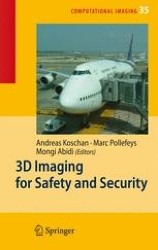
3D Imaging for Safety and Security
This book is so far the first that covers the current state of the art in 3D imaging for safety and security. Special attention was given to advanced 3D imaging technologies in the context of safety and security applications. Comparative evaluation studies showing advantages of 3D imaging over traditional 2D imaging for a given computer vision or pattern recognition task were emphasized. Moreover, additional experts in the field of 3D imaging for safety and security were invited by the editors for a contribution to this book.
3-D Computer vision : Principles, algorithms and applications
Offers advanced content on computer vision (basic content can be found in its prerequisite textbook, “2D Computer Vision: Principles, Algorithms and Applications”), including the basic principles, typical methods and practical techniques. It is intended for graduate courses on related topics, e.g. Computer Vision, 3-D Computer Vision, Graphics, Artificial Intelligence, etc. The book is mainly based on my lecture notes for several undergraduate and graduate classes I have offered over the past several years, while a number of topics stem from my research publications co-authored with my students. This book takes into account the needs of learners with various professional backgrounds, as well as those of self-learners. Furthermore, it can be used as a reference guide for practitioners and professionals in related fields.
25 Years of Model Checking : History, Achievements, Perspectives
Model checking technology is among the foremost applications of logic to computer science and computer engineering. The model checking community has achieved many breakthroughs, bridging the gap between theoretical computer science and hardware and software engineering, and it is reaching out to new challenging areas such as system biology and hybrid systems. Model checking is extensively used in the hardware industry and has also been applied to the verification of many types of software. Model checking has been introduced into computer science and electrical engineering curricula at universities worldwide and has become a universal tool for the analysis of systems.
