



Page 33
Page 33

Data Integration in the Life Sciences ; 5th International Workshop, DILS 2008, Evry, France, June 25-27, 2008. Proceedings
This book constitutes the refereed proceedings of the 5th International Workshop on Data Integration in the Life Sciences, DILS 2008, held in Evry, France in June 2008.

Data augmented design : Embracing new data for sustainable urban planning and design
This book offers an essential introduction to a new urban planning and design methodology called Data Augmented Design (DAD) and its evolution and progresses, highlighting data driven methods, urban planning and design applications and related theories. The authors draw on many kinds of data, including big, open, and conventional data, and discuss cutting-edge technologies that illustrate DAD as a future-oriented design framework in terms of its focus on multi-data, multi-method, multi-stage and multi-scale sustainable urban planning. In four sections and ten chapters, the book presents case studies to address the core concepts of DAD, the first type of applications of DAD that emerged in redevelopment-oriented planning and design, the second type committed to the planning and design for urban expansion, and the future-oriented applications of DAD to advance sustainable technologies and the future structural form of the built environment. The book is geared towards a broad readership, ranging from researchers and students of urban planning, urban design, urban geography, urban economics, and urban sociology, to practitioners in the areas of urban planning and design.

Data and applications security XXII ; 22nd Annual IFIP WG 11.3 Working Conference on data and applications security London, UK, July 13-16, 2008 Proceedings
This volume contains the papers presented at the 22nd Annual IFIP WG 11.3 Working Conference on Data and Applications Security (DBSEC) held in L- don, UK, July 13–16, 2008.

Data and applications security XXI ; 21st Annual IFIP WG 11.3 Working Conference on data and applications security, Redondo Beach, CA, USA, July 8-11, 2007, Proceedings
This book presented secure query evaluation, location-based security/mobile security, distributed security issues, cryptographic-based security, temporal access control and usage control, as well as system security issues.

Data and applications security XX ; 20th Annual IFIP WG 11.3 Working Conference on data and applications security, Sophia Antipolis, France, July 31-August 2, 2006, Proceedings
For 20 years, the IFIP WG 11. 3 Working Conference on Data and Appli- tions Security (DBSEC) has been a major forum for presenting originalresearch results, practical experiences, and innovative ideas in data and applications - curity.Like the previous conference, the 20th DBSEC has proved to be up to this challenge. DBSEC 2006 received 56 submissions, out of which the program committee selected22 high-qualitypaperscoveringanumber of diverseresearchtopicssuch as access control, privacy, and identity management.

Data and applications security XIX ; 19th Annual IFIP WG 11.3 working conference on data and applications security, Storrs, CT, USA, August 7-10, 2005, Proceedings
Constitutes the refereed proceedings of the 19th Annual Working Conference on Data and Applications Security held in Storrs, CT, USA, in August 2005. The papers present theory, technique, applications, and practical experience of data and application security with topics like cryptography, privacy, security planning and administration, and more.

Data and applications security and privacy XXXIV ; 34th Annual IFIP WG 11.3 Conference, DBSec 2020, Regensburg, Germany, June 25–26, 2020, Proceedings
This book constitutes the refereed proceedings of the 34th Annual IFIP WG 11.3 Conference on Data and Applications Security and Privacy, DBSec 2020, held in Regensburg, Germany, in June 2020.* The 14 full papers and 8 short papers presented were carefully reviewed and selected from 39 submissions. The papers present high-quality original research from academia, industry, and government on theoretical and practical aspects of information security. They are organized in topical sections named network and cyber-physical systems security; information flow and access control; privacy-preserving computation; visualization and analytics for security; spatial systems and crowdsourcing security; and secure outsourcing and privacy.

Data analytics, computational statistics, and operations research for engineers : Methodologies and applications
Presents applications of computationally intensive methods, inference techniques, and survival analysis models. It discusses how data mining extracts information and how machine learning improves the computational model based on the new information.

Data Analysis, Machine Learning and Applications ; Proceedings of the 31st Annual Conference of the Gesellschaft für Klassifikation e.V., Albert-Ludwigs-Universität Freiburg, March 7–9, 2007
This volume contains the revised versions of selected papers in the field of data analysis, machine learning and applications presented during the 31st Annual Conference of the German Classification Society (Gesellschaft für Klassifikation - GfKl).

Cybersecurity of Digital Service Chains : Challenges, Methodologies, and Tools
This book presents the main scientific results from the H2020 GUARD project. The GUARD project aims at filling the current technological gap between software management paradigms and cybersecurity models, the latter still lacking orchestration and agility to effectively address the dynamicity of the former. This book provides a comprehensive review of the main concepts, architectures, algorithms, and non-technical aspects developed during three years of investigation; the description of the Smart Mobility use case developed at the end of the project gives a practical example of how the GUARD platform and related technologies can be deployed in practical scenarios.
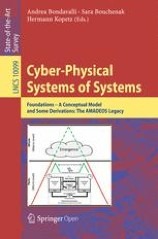
Cyber-physical systems of systems : Foundations : A conceptual model and some derivations : The AMADEOS legacy
Technical Systems-of-Systems (SoS) – in the form of networked, independent constituent computing systems temporarily collaborating to achieve a well-defined objective – form the backbone of most of today’s infrastructure. The energy grid, most transportation systems, the global banking industry, the water-supply system, the military equipment, many embedded systems, and a great number more, strongly depend on systems-of-systems. The correct operation and continuous availability of these underlying systems-of-systems are fundamental for the functioning of our modern society.

Cyber-physical systems : Foundations and techniques
Covers the various aspects associated with Cyber-Physical Systems (CPS) such as algorithms, application areas, and the improvement of existing technology such as machine learning, big data and robotics. The scope of CPS is tremendous. In CPS, one sees the applications of various emerging technologies such as artificial intelligence (AI), Internet of Things (IoT), machine learning (ML), deep learning (DL), big data (BD), robotics, quantum technology, etc. In almost all sectors, whether it is education, health, human resource development, skill improvement, startup strategy, etc., one sees an enhancement in the quality of output because of the emergence of CPS into the field.

Cyber security ; 17th China Annual Conference, CNCERT 2020, Beijing, China, August 12, 2020, revised selected papers
This book constitutes the refereed proceedings of the 16th International Annual Conference on Cyber Security, CNCERT 2020, held in Beijing, China, in August 2020.

Current aopics in artificial intelligence ; 12th Conference of the Spanish Association for Artificial Intelligence, CAEPIA 2007, Salamanca, Spain, November 12-16, 2007, Selected Papers
The book presented address all current issues of artificial intelligence ranging from methodological and foundational aspects to advanced applications in various fields.

Cryptography Arithmetic : Algorithms and Hardware Architectures
Modern cryptosystems, used in numerous applications that require secrecy or privacy - electronic mail, financial transactions, medical-record keeping, government affairs, social media etc. - are based on sophisticated mathematics and algorithms that in implementation involve much computer arithmetic. And for speed it is necessary that the arithmetic be realized at the hardware (chip) level. This book is an introduction to the implementation of cryptosystems at that level.

Cryptography and network security : principles and practices
Introduces students to the compelling and evolving field of cryptography and network security. In an age of viruses and hackers, electronic eavesdropping, and electronic fraud on a global scale, security is paramount. The purpose of this book is to provide a practical survey of both the principles and practice of cryptography and network security. In the first part of the book, the basic issues to be addressed by a network security capability are explored by providing a tutorial and survey of cryptography and network security technology. The latter part of the book deals with the practice of network security: practical applications that have been implemented and are in use to provide network security.

Cryptographics : Exploiting Graphics Cards For Security
CryptoGraphics: Exploiting Graphics Cards for Security explores the potential for implementing ciphers within graphics processing units (GPUs), and describes the relevance of GPU-based encryption and decryption to the security of applications involving remote displays.

Creative applications of artificial intelligence in education
Explores the synergy between AI and education, highlighting its potential impact on pedagogical practices. It navigates the evolving landscape of AI-powered educational technologies and suggests practical ways to personalise instruction, nurture human-AI co-creativity, and transform the learning experience. Spanning from primary to higher education, this short and engaging volume proposes concrete examples of how educational stakeholders can be empowered in their AI literacy to foster creativity, inspire critical thinking, and promote problem-solving by embracing AI as a tool for expansive learning. Structured in three parts, the book starts developing the creative engagement perspective for learning and teaching to then present practical applications of AI in K-12 and higher education, covering different fields (teacher education, professional education, business education) as well as different types of AI supported tools (games, chatbots, and AI assisted assessment).

Creating Web-based Laboratories
Remote web-based experimentation, enabling students and researchers to access the laboratory anytime via the Internet, is becoming an increasingly attractive way to complement or even replace traditional laboratory sessions. Placing a video camera & microphone before the equipment and apparatus to capture what is actually happening in the laboratory allows the images and audio data to be streamed to the client side. Researchers in different countries can share equipment and conduct research cooperatively and remotely. The authors summarise their research and discuss the development of the 5 web-based laboratories launched from the National University of Singapore. The principles, structure, and technologies required for the creation of Internet remote experimentation systems are discussed with particular emphasis on the integration of hardware and software systems. Also highlighted is the design and development of interfaces and components for use in typical web-based laboratories or similar web-control applications.

Creating Client Extranets with SharePoint 2003
Creating Client Extranets with SharePoint 2003 is a guide for creating client-facing extranets using SharePoint 2003. This book serves as a how-to for building full-featured extranets using SharePoint 2003 and .NET technologies. If you already have experience developing and deploying business applications in .NET, then this book will help you master the intricacies of SharePoint 2003 development and customization. This is the only book of its kind—one designed to help you build a functioning client extranet from start to finish, avoiding many inherent traps in SharePoint development. It contains numerous valuable tips, tricks, and traps. And it offers various working code samples to help you get up to speed quickly using the SharePoint object model and Web Services. It uniquely focuses on SharePoint as a corporate development platform, while other books tend to focus only on end-user features.
