



Page 3
Page 3

Network Control and Engineering for QoS, Security and Mobility, IV; Fourth IFIP International Conference on Network Control and Engineering for QoS, Security and Mobility, Lannion, France, November 14-18, 2005
The IFIP series publishes state-of-the-art results in the sciences and technologies of information and communication. The principal aim of the IFIP series is to encourage education and the dissemination and exchange of information about all aspects of computing.

Network and Parallel Computing ; IFIP International Conference, NPC 2008, Shanghai, China, October 18-20, 2008. Proceedings
This book constitutes the refereed proceedings of the IFIP International Conference on Network and Parallel Computing, NPC 2008, held in Shanghai, China in October 2008.The 32 revised full papers presented were carefully selected from over 140 submissions. The papers are organized in topical sections on network technologies; network applications; network and parallel architectures; parallel and distributed software.
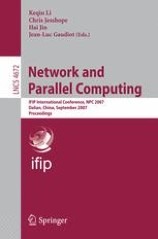
Network and Parallel Computing ; IFIP International Conference, NPC 2007, Dalian, China, September 18-21, 2007, Proceedings
The goal of NPC is to establish an international forum for researchers and practitioners to present their - cellent ideas and experiences in all system fields of network and parallel computing. The main focus of NPC 2007 was on the most critical areas of network and parallel computing: network applications, network technologies, network and parallel arc- tectures, and parallel and distributed software.

Network and Parallel Computing ; IFIP International Conference, NPC 2005, Beijing, China, November 30 - December 3, 2005, Proceedings
These proceedings contain the papers presented at the 2005 IFIP International Conference on Network and Parallel Computing (NPC 2005), held in Beijing, China, between November 30 and December 3, 2005. The goal of the conference was to establish an international forum for engineers and scientists to present their ideas and experiences in network and parallel computing. A total of 320 submissions were received in response to our Call for Papers. These papers were from the following countries or regions: Australia, Canada, China, France, Germany, Hong Kong, India, Iran, Italy, Japan, Korea, Lux- burg, Nepal, Netherlands, Taiwan, United Arab Emirates, and United States.

Negotiation, auctions, and market engineering ; International Seminar, Dagstuhl Castle, Germany, November 12-17, 2006, Revised Selected Papers
This book contains a selection of papers presented at the International Seminar "Negotiation and Market Engineering", held at Dagstuhl Castle, Germany, in November 2006.The 17 revised full papers presented in this volume were carefully selected and reviewed after the seminar. The papers deal with the complexity of negotiations, auctions, and markets as economic, social, and IT systems. The authors give a broad overview on the major issues to be addressed and the methodologies used to approach them, covering highly interdisciplinary research from computer science, economics, business administration, and mathematics.

Nature Inspired Problem-Solving Methods in Knowledge Engineering ; 2nd International Work-Conference on the Interplay Between Natural and Artificial Computation, IWINAC 2007, La Manga del Mar Menor, Spain, June 18-21, 2007, Proceedings, Part II
The second of a two-volume set, this book constitutes the refereed proceedings of the Second International Work-Conference on the Interplay between Natural and Artificial Computation, IWINAC 2007, held in La Manga del Mar Menor, Spain in June 2007.
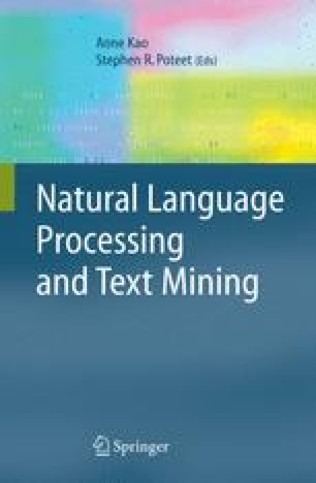
Natural Language Processing and Text Mining
Natural Language Processing and Text Mining not only discusses applications of certain NLP techniques to certain Text Mining tasks, but also the converse, i.e., use of Text Mining to facilitate NLP. It explores a variety of real-world applications of NLP and text-mining algorithms in comprehensive detail, placing emphasis on the description of end-to-end solutions to real problems, and detailing the associated difficulties that must be resolved before the algorithm can be applied and its full benefits realized.

Natural Language Processing and Information Systems ; Vol. 3513 ; 10th International Conference on Applications of Natural Language to Information Systems, NLDB 2005, Alicante, Spain, June 15-17, Proceedings
The development and convergence of computing, telecommunications and information systems has already led to a revolution in the way that we work, communicate with each other, buy goods and use services, and even in the way that we entertain and educate ourselves.The revolution continues, and one of its results is that large volumes of information will increasingly be held in a form which is more natural for users than the data presentation formats typical of computer systems of the past. Natural language processing (NLP) is crucial in solving these problems, and language technologies will make an indispensable contribution to the success of information systems. We hope that NLDB 2005 was a modest contribution to this goal. NLDB 2005 contributed to advancing the goals and the high international standing of these conferences, largely due to its Program Committee, composed of renowned researchers in the field of natural language processing and inf- mation system engineering. Papers were reviewed by three reviewers from the Program Committee. This clearly contributed to the significant number of - pers submitted (95). Twenty-nine were accepted as regular papers, while 18 were accepted as short papers.
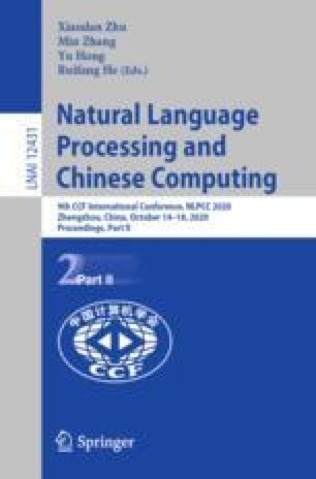
Natural Language Processing and Chinese Computing ; 9th CCF International Conference, NLPCC 2020, Zhengzhou, China, October 14–18, 2020, Proceedings, Part II
This two-volume set of LNAI 12340 and LNAI 12341 constitutes the refereed proceedings of the 9th CCF Conference on Natural Language Processing and Chinese Computing, NLPCC 2020, held in Zhengzhou, China, in October 2020. The 70 full papers, 30 poster papers and 14 workshop papers presented were carefully reviewed and selected from 320 submissions. They are organized in the following areas: Conversational Bot/QA; Fundamentals of NLP; Knowledge Base, Graphs and Semantic Web; Machine Learning for NLP; Machine Translation and Multilinguality; NLP Applications; Social Media and Network; Text Mining; and Trending Topics.
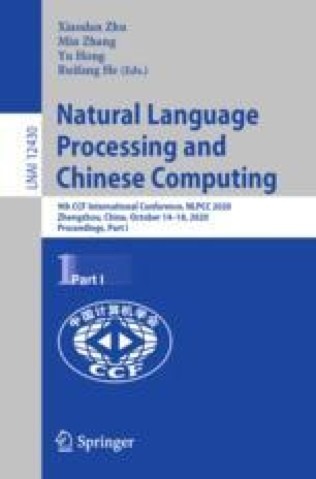
Natural language processing and chinese computing ; 9th CCF International conference, NLPCC 2020, Zhengzhou, China, October 14–18, 2020, Proceedings, Part I
This two-volume set of LNAI 12340 and LNAI 12341 constitutes the refereed proceedings of the 9th CCF Conference on Natural Language Processing and Chinese Computing, NLPCC 2020, held in Zhengzhou, China, in October 2020. The 70 full papers, 30 poster papers and 14 workshop papers presented were carefully reviewed and selected from 320 submissions. They are organized in the following areas: Conversational Bot/QA; Fundamentals of NLP; Knowledge Base, Graphs and Semantic Web; Machine Learning for NLP; Machine Translation and Multilinguality; NLP Applications; Social Media and Network; Text Mining; and Trending Topics.

Nanotechnology : Science and Computation
This book offers a unique and authoritative perspective on current research in nanoscale science, engineering and computing. Leading researchers cover the topics of DNA self-assembly in two-dimensional arrays and three-dimensional structures, molecular motors, DNA word design, molecular electronics, gene assembly, surface layer protein assembly, and membrane computing.

Multiparadigm Programming in Mozart/Oz ; 2nd International Conference, MOZ 2004, Charleroi, Belgium, October 7-8, 2004, Revised Selected Papers
Oz's concurrency model yields simplicity and clarity (because Oz makes it easier to express complex programs with many interacting components), g- erality, and better interfaces (because the data?ow model automatically makes interfaces more lightweight). Constraint programming in Oz again yields simplicity and clarity (because theprogrammercanexpresswhatneedstobetrueratherthanthemorecomplex issue of how to make it true), and o?ers a powerful mathematical notation that is di?cult to implement on top of languages that do not support it natively. Mozart's distributed computing model makes for improved interfaces and eases the evolution of systems. In my own work, one of the most important concernsistobeabletoquicklyscaleupaprototypeimplementationintoalar- scale service that can run reliably on thousands of computers, serving millions of users.

Multiobjective Problem Solving from Nature : From Concepts to Applications
he book focuses on how MOEAs and related techniques can be used to solve problems, particularly in the disciplines of science and engineering. Contributions by leading researchers show how the concepts of multiobjective optimization can be used to reformulate and resolve problems in broad areas such as constrained optimization, coevolution, classification, inverse modelling and design. The book is distinguished from other texts on MOEAs in that it is not primarily about the algorithms, nor specific applications, but about the concepts and processes involved in solving problems using a multiobjective approach. Each chapter contributes to the central, deep concepts and themes of the book: evaluating the utility of the multiobjective approach; discussing alternative problem formulations; showing how problem formulation affects the search process; and examining solution selection and decision making.

Multiobjective Optimization : Interactive and Evolutionary Approaches
Multiobjective optimization deals with solving problems having not only one, but multiple, often conflicting, criteria. Such problems can arise in practically every field of science, engineering and business, and the need for efficient and reliable solution methods is increasing. The task is challenging due to the fact that, instead of a single optimal solution, multiobjective optimization results in a number of solutions with different trade-offs among criteria, also known as Pareto optimal or efficient solutions. Hence, a decision maker is needed to provide additional preference information and to identify the most satisfactory solution. Depending on the paradigm used, such information may be introduced before, during, or after the optimization process. Clearly, research and application in multiobjective optimization involve expertise in optimization as well as in decision support.

Multimedia security : Algorithm development, analysis and applications (algorithms for intelligent systems)
Provides an insight about various techniques used in multimedia security and identifies its progress in both technological and algorithmic perspectives. In the contemporary world, digitization offers an effective mechanism to process, preserve and transfer all types of information. The incredible progresses in computing and communication technologies augmented by economic feasibility have revolutionized the world. The availability of efficient algorithms together with inexpensive digital recording and storage peripherals have created a multimedia era bringing conveniences to people in sharing the digital data that includes images, audio and video. The ever-increasing pace, at which the multimedia and communication technology is growing, has also made it possible to combine, replicate and distribute the content faster and easier, thereby empowering mankind by having a wealth of information at their disposal.

Multimedia Content Analysis and Mining ; International Workshop, MCAM 2007, Weihai, China, June 30-July 1, 2007, Proceedings
The workshop gives a snapshot of the current wor- wide research in multimedia analysis. Through recent advances in computing, networking, and data storage, multimedia will create new interesting technical possibilities in a wide range of ?elds, such as entertainment, commerce, science, medicine, and public safety.

Multimedia computing systems and virtual reality
Presents recent advancements in multimedia systems as they relate to various application areas such as healthcare services and agriculture-related industries. The authors also discuss human-machine interface design, graphics modelling, rendering/animation, image/graphics techniques/systems and visualization. They then go on to explore multimedia content adaptation for interoperable delivery. Finally, the book covers cultural heritage, philosophical/ethical/societal/international issues, standards-related virtual technology and multimedia uses. This book is intended for computer engineers and computer scientists developing applications for multimedia and virtual reality and professionals working in object design and visualization, transformation, modelling and animation of the real world.

Multimedia big data computing for IoT applications : Concepts, paradigms and solutions
This book considers all aspects of managing the complexity of Multimedia Big Data Computing (MMBD) for IoT applications and develops a comprehensive taxonomy. It also discusses a process model that addresses a number of research challenges associated with MMBD, such as scalability, accessibility, reliability, heterogeneity, and Quality of Service (QoS) requirements, presenting case studies to demonstrate its application. Further, the book examines the layered architecture of MMBD computing and compares the life cycle of both big data and MMBD. Written by leading experts, it also includes numerous solved examples, technical descriptions, scenarios, procedures, and algorithms.

Multi-Agent-Based Simulation VIII ; International Workshop, MABS 2007, Honolulu, HI, USA, May 15, 2007, Revised and Invited Papers
This book constitutes the thoroughly refereed post-proceedings of the 8th International Workshop on Multi-Agent-Based Simulation, MABS 2007, held in Honolulu, HI, USA in May 2007 as an associated event of AAMAS 2007, the main international conference on autonomous agents and multi-agent systems.The 10 revised full papers presented were carefully reviewed and selected from 20 submissions.The papers are organized in topical sections on architectures; teams, learning, education; economy, trust and reputation.

Multi-Agent-Based Simulation VI ; International Workshop, MABS 2005, Utrecht, The Netherlands, July 25, 2005, Revised and Invited Papers
This book constitutes the thoroughly refereed post-proceedings of the 6th International Workshop on Multi-Agent-Based Simulation, MABS 2005, held in Utrecht, The Netherlands in July 2005 as an associated event of AAMAS 2005, the main international conference on autonomous agents and multi-agent systems. The 12 revised full papers presented together with 1 invited talk were carefully reviewed. The papers are organized in topical sections on coalition emergence, theories and models, applications, and environments.
