



Page 13
Page 13

Foundation Form Creation with Adobe LiveCycle Designer ES
Form creation is key to information processing and forms workflow is a key concept within Adobe LiveCycle Enterprise Suite. Adobe LiveCycle Forms ES is a stand-alone product that also comes bundled with Adobe LiveCycle Enterprise Suite. This is the first and only book about this new product specifically created for the design, creation, and processing of dynamically interactive forms. Foundation Form Creation with Adobe LiveCycle Designer ES is written for users of all abilities, with introductory material for beginners and advanced techniques for more experienced users. It discusses both the best-practices of designing forms that work and the specifics of implementing them efficiently for data collection—the full life cycle of working with forms.

Formal Techniques for Networked and Distributed Systems - FORTE 2008 ; 28th IFIP WG 6.1 International Conference Tokyo, Japan, June 10-13, 2008 Proceedings
This book constitutes the refereed proceedings of the 28th IFIP WG 6.1 International Conference on Formal Techniques for Networked and Distributed Systems, FORTE 2008, held in Tokyo, Japan, in June 2008 co-located with TestCom/FATES 2008.The 19 revised full papers and 1 revised short paper presented together with 1 invited talk were carefully reviewed and selected from 44 submissions. The papers cover new approaches, concepts and experience in the application of formal methods for the specification and verification of distributed systems and applications.

Formal Techniques for Networked and Distributed Systems – FORTE 2007 ; 27th IFIP WG 6.1 International Conference, Tallinn, Estonia, June 27-29, 2007, Proceedings
These proceedings contain papers from the 27th FORTE conference. FORTE (Formal Techniques for Networked and Distributed Systems) is the joint int- national annual conference combining the former PSTV (Protocol Speci?cation Testing and Veri?cation) and former FORTE (Formal Description Techniques for Distributed Systems and Communication Protocols) conferences.
Formal techniques for networked and distributed systems - FORTE 2005 ; 25th IFIP WG 6.1 International Conference, Taipei, Taiwan, October 2-5, 2005, Proceedings
FORTE (Formal Techniques for Networked and Distributed Systems) 2005 was sp- sored by Working Group 6.1, Technical Committee 6 (TC6) of the International Fed- ation for InformationProcessing (IFIP).The conferenceseries started in 1981underthe name PSTV (ProtocolSpeci?cation, Testing, and Veri?cation).In 1988,a second series under the name FORTE was started. Both series merged to FORTE/PSTV in 1996. The conference name was changed to FORTE in 2001. During its 24-year history, many important contributions have been reported in the conference series. The last ?ve me- ings of FORTE were held in Pisa (Italy), Cheju Island (Korea), Houston (USA), Berlin (Germany), and Madrid (Spain). The 25th FORTE was held from Sunday to Wednesday, October 2–5, 2005 on the beautiful campus of the National Taiwan University (NTU), Taipei, Taiwan, ROC.

Formal techniques for computer systems and business processes ; European performance engineering workshop, EPEW 2005 and International workshop on web services and formal methods, WS-FM 2005, Versailles, France, September 1-3, 2005, Proceedings
This book constitutes the refereed proceedings of two colocated international workshops EPEW 2005 (European Performance Engineering Workshop) and WS-FM 2005 (Web Services and Formal Methods) held in Versailles, France in September 2005. The 20 revised full papers presented were carefully reviewed and selected from 59 submissions. For EPEW 2005 only 10 papers - of the 32 submitted - were accepted for presentation; they deal with queueing theory, bounding techniques, stochastic model checking, communication schemes analysis for high-speed LAN, QOS analysis in wireless ad-hoc networks and optical networks analysis. The main topics of the 10 papers accepted for WS-FM 2005 - from 27 submissions - include: protocols and standards for WS (SOAP, WSDL, UDDI, etc.); languages and description methodologies for Choreography/Orchestration/Workflow (BPML, XLANG and BizTalk, WSFL, WS-BPEL, etc.); coordination techniques for WS (transactions, agreement, coordination services, etc.); semantics-based dynamic WS discovery services (based on Semantic Web/Ontology Techniques or other semantic theories); security, performance evaluation and quality of service of WS; semi-structured data and XML related technologies; comparisons with different related technologies/approaches.

Formal Methods for Performance Evaluation ; 7th International School on Formal Methods for the Design of Computer, Communication, and Software Systems, SFM 2007, Bertinoro, Italy, May 8-June 2, 2007, Advanced Lectures
This book presents a set of 11 papers accompanying the lectures of leading researchers given at the 7th edition of the International School on Formal Methods for the Design of Computer, Communication and Software Systems, SFM 2007.

Formal Methods for Open Object-Based Distributed Systems ; 10th IFIP WG 6.1 International Conference, FMOODS 2008, Oslo, Norway, June 4-6, 2008 Proceedings
This book constitutes the refereed proceedings of the 10th IFIP WG 6.1 International Conference on Formal Methods for Open Object-Based Distributed Systems, FMOODS 2008, held in Oslo, Norway, in June 2008.The 14 revised full papers presented together with 1 invited lecture were carefully reviewed and selected from 35 submissions. The papers cover topcics such as semantics of object-oriented programming; formal techniques for specification, analysis, and refinement; model checking; theorem proving and deductive verification.

Formal Methods for Mobile Computing ; 5th International School on Formal Methods for the Design of Computer, Communication, and Software Systems, SFM-Moby 2005, Bertinoro, Italy, April 26-30, 2005, Advanced Lectures
This book presents 8 tutorial survey papers by leading researchers who lectured at the 5th International School on Formal Methods for the Design of Computer, Communication, and Software Systems, SFM 2005, held in Bertinoro, Italy in April 2005. SFM 2005 was devoted to formal methods and tools for the design of mobile systems and mobile communication infrastructures. The 8 lectures are organized into topical sections on models and languages, scalability and performance, dynamic power management, and middleware support.

Formal Methods for Hardware Verification ; 6th International School on Formal Methods for the Design of Computer, Communication, and Software Systems, SFM 2006, Bertinoro, Italy, May 22-27, 2006, Advances Lectures
This book presents 8 papers accompanying the lectures of leading researchers given at the 6th edition of the International School on Formal Methods for the Design of Computer, Communication and Software Systems (SFM 2006). SFM 2006 was devoted to formal techniques for hardware verification and covers several aspects of the hardware design process, including hardware design languages and simulation, property specification formalisms, automatic test pattern generation, symbolic trajectory evaluation, and more.

Formal Methods for Computational Systems Biology ; 8th International School on Formal Methods for the Design of Computer, Communication, and Software Systems, SFM 2008 Bertinoro, Italy, June 2-7, 2008 Advanced Lectures
This volume presents the set of papers accompanying the lectures of the eighth International School on Formal Methods for the Design of Computer, Com- nication, and Software Systems (SFM). This series of schools addresses the use of formal methods in computer science asaprominent approach to theri gorousdesign of computer, communication, and software systems. The main aim of the SFM series is to ofer a good spectrum of current research in foundations as well as applications of formal methods, which can be of help for graduate students and young researchers who intend to approach the feld.

Formal methods applications and technology ; 11th International workshop on formal methods for industrial critical systems, FMICS 2006, and 5th International Workshop on parallel and distributed methods in verification, PDMC 2006, Bonn, Germany, August 26-27, and August 31, 2006, Revised Selected
The workshop program included two invited talks, by Anna Slobodova from Intel on “Challenges for Formal Veri?cation in an Industrial Setting” and by Edward A. Lee from the University of California at Berkeley on “Making C- currency Mainstream.” The former full paper can be found in this volume.

Formal aspects in security and trust ; Vol. 173 ; IFIP TC1 WG1.7 Workshop on Formal Aspects in Security and Trust (FAST), World Computer Congress, August 22-27, 2004, Toulouse, France
The IFIP series publishes state-of-the-art results in the sciences and technologies of information and communication. The scope of the series includes: foundations of computer science; software theory and practice; education; computer applications in technology; communication systems; systems modeling and optimization; information systems; computers and society; computer systems technology; security and protection in information processing systems; artificial intelligence; and human-computer interaction. Proceedings and post-proceedings of referred international conferences in computer science and interdisciplinary fields are featured. These results often precede journal publication and represent the most current research. The principal aim of the IFIP series is to encourage education and the dissemination and exchange of information about all aspects of computing.

FM 2008 : Formal methods ; 15th International symposium on formal methods, Turku, Finland, May 26-30, 2008 Proceedings
This book presents the refereed proceedings of the 15th International Symposium on Formal Methods, FM 2008, held in Turku, Finland in May 2008.The 23 revised full papers presented together with 4 invited contributions and extended abstracts of 5 invited industrial presentations were carefully reviewed and selected from 106 submissions. The papers are organized in topical sections on programming language analysis, verification, real-time and concurrency, grand chellenge problems, fm practice, runtime monitoring and analysis, communication, constraint analysis, and design.
Financial cryptography and data security ; FC 2020 International Workshops, AsiaUSEC, CoDeFi, VOTING, and WTSC, Kota Kinabalu, Malaysia, February 14, 2020, Revised Selected Papers
This book constitutes the refereed proceedings of two workshops held at the 24th International Conference on Financial Cryptography and Data Security, FC 2020, in Kota Kinabalu, Malaysia, in February 2020. The 39 full papers and 3 short papers presented in this book were carefully reviewed and selected from 73 submissions. The papers feature four Workshops: The 1st Asian Workshop on Usable Security, AsiaUSEC 2020, the 1st Workshop on Coordination of Decentralized Finance, CoDeFi 2020, the 5th Workshop on Advances in Secure Electronic Voting, VOTING 2020, and the 4th Workshop on Trusted Smart Contracts, WTSC 2020.
Financial cryptography and data security ; 12th International Conference, FC 2008, Cozumel, Mexico, January 28-31, 2008. Revised Selected Papers
This book constitutes the thoroughly refereed post-conference proceedings of the 12th International Conference on Financial Cryptography and Data Security, FC 2008, held in Cozumel, Mexico, in January 2008.The 16 revised full papers and 9 revised short papers presented together with 5 poster papers, 2 panel reports, and 1 invited lecture were carefully reviewed and selected from 86 submissions. The papers are organized in topical sections on attacks and counter measures, protocols, theory, hardware, chips and tags, signatures and encryption, as well as anonymity and e-cash.
Financial Cryptography ; 5th International Conference, FC 2001, Grand Cayman, British West Indies, February 19-22, 2001. Proceedings
Constitutes the post-proceedings of the 5th International Conference on Financial Cryptography held in the British West Indies in 2002. Papers cover managing payment transaction costs, trust and risk management, groups and anonymity, certificates and authentication, credit card security and more.

Fifth World Conference on Information Security Education ; Proceedings of the IFIP TC 11 WG 11.8, WISE 5, 19 to 21 June 2007, United States Military Academy, West Point, NY, USA
The scope of This book includes: foundations of computer science; software theory and practice; education; computer applications in technology; communication systems; systems modeling and optimization; information systems; computers and society; computer systems technology; security and protection in information processing systems; artificial intelligence; and human-computer interaction. Proceedings and post-proceedings of referred international conferences in computer science and interdisciplinary fields are featured. These results often precede journal publication and represent the most current research.

Fifth IFIP International Conference On Theoretical Computer Science - Tcs 2008 ; IFIP 20th World Computer Congress, TC 1, Foundations of Computer Science, September 7-10, 2008, Milano, Italy
Includes: foundations of computer science; software theory and practice; education; computer applications in technology; communication systems; systems modeling and optimization; information systems; computers and society; computer systems technology; security and protection in information processing systems; artificial intelligence; and human-computer interaction. Proceedings and post-proceedings of refereed international conferences in computer science and interdisciplinary fields are featured. These results often precede journal publication and represent the most current research. The principal aim of the IFIP series is to encourage education and the dissemination and exchange of information about all aspects of computing.

Fiber-Optic Communication Systems
Contains substantial additions covering the topics of coherence detection, space division multiplexing, and more advanced subjects. You'll learn about topics like fiber’s losses, dispersion, and nonlinearities, as well as coherent lightwave systems. The latter subject has undergone major changes due to the extensive development of digital coherent systems over the last decade. Space-division multiplexing is covered as well, including multimode and multicore fibers developed in just the last ten years.
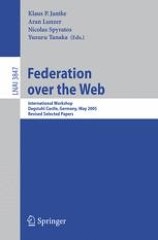
Federation over the Web ; International Workshop, Dagstuhl Castle, Germany, May 1-6, 2005, Revised Selected Papers
The lives of people all around the world, especially in industrialized nations, continue to be changed by the presence and growth of the Internet. Its in?uence is felt at scales ranging from private lifestyles to national economies, boosting thepaceatwhichmoderninformationandcommunicationtechnologiesin?uence personal choices along with business processes and scienti?c endeavors. In addition to its billions of HTML pages, the Web can now be seen as an open repository of computing resources. These resources provide access to computational services as well as data repositories, through a rapidly growing variety of Web applications and Web services.
