



Page 1
Page 1
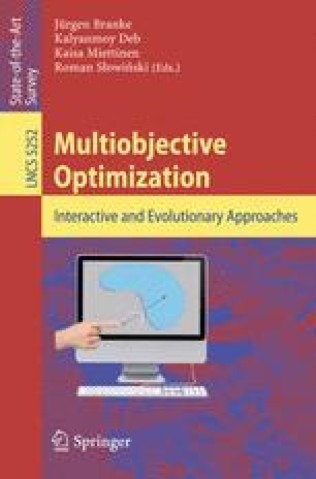
Multiobjective Optimization : Interactive and Evolutionary Approaches
Multiobjective optimization deals with solving problems having not only one, but multiple, often conflicting, criteria. Such problems can arise in practically every field of science, engineering and business, and the need for efficient and reliable solution methods is increasing. The task is challenging due to the fact that, instead of a single optimal solution, multiobjective optimization results in a number of solutions with different trade-offs among criteria, also known as Pareto optimal or efficient solutions. Hence, a decision maker is needed to provide additional preference information and to identify the most satisfactory solution. Depending on the paradigm used, such information may be introduced before, during, or after the optimization process. Clearly, research and application in multiobjective optimization involve expertise in optimization as well as in decision support.

Fundamentals of Artificial Intelligence
Fundamentals of Artificial Intelligence introduces the foundations of present day AI and provides coverage to recent developments in AI such as Constraint Satisfaction Problems, Adversarial Search and Game Theory, Statistical Learning Theory, Automated Planning, Intelligent Agents, Information Retrieval, Natural Language & Speech Processing, and Machine Vision. The book features a wealth of examples and illustrations, and practical approaches along with the theoretical concepts. It covers all major areas of AI in the domain of recent developments. The book is intended primarily for students who major in computer science at undergraduate and graduate level but will also be of interest as a foundation to researchers in the area of AI.
Finite model theory and its applications
This book gives a broad overview of core topics of finite model theory: expressive power, descriptive complexity, and zero-one laws, together with selected applications to database theory and artificial intelligence, especially, constraint databases and constraint satisfaction problems. The final chapter provides a concise modern introduction to modal logic, which emphasizes the continuity in spirit and technique with finite model theory. This underlying spirit involves the use of various fragments of, and hierarchies within, first order, second order, fixed point, and infinitary logics to gain insight into phenomena in complexity theory and combinatorics.

Evolutionary computation in combinatorial optimization ; Vol. 3448 ; 5th European Conference, EvoCOP 2005, Lausanne, Switzerland, March 30 - April 1, 2005, Proceedings
This volume contains the proceedings of EvoCOP 2005, the 5th European Conference on Evolutionary Computation in Combinatorial Optimization. It was held in Lausanne, Switzerland, on 30 March-1 April 2005

Constraint satisfaction techniques for agent-based reasoning
Constraint satisfaction problems are significant in the domain of automated reasoning for artificial intelligence. They can be applied to the modeling and solving of a wide range of combinatorial applications such as planning, scheduling and resource sharing in a variety of practical domains such as transportation, production, supply-chains, network management and human resource management. In this book we study new techniques for solving constraint satisfaction problems, with a special focus on solution adaptation applied to agent reasoning.
