



Page 1
Page 1
Complexity of Constraints : An Overview of Current Research Themes
This state-of-the-art survey contains the papers that were invited by the organizers after conclusion of an International Dagstuhl-Seminar on Complexity of Constraints, held in Dagstuhl Castle, Germany, in October 2006.
Autonomy oriented computing : From problem solving to complex systems modeling
Autonomy Oriented Computing explores the important theoretical and practical issues in AOC, by analyzing methodologies and presenting experimental case studies. The book serves as a comprehensive reference source for researchers, scientists, engineers, and professionals in all fields concerned with this promising new development in computer science. It can also be used as a main or supplementary text in graduate and undergraduate programs across a broad range of computer-related disciplines, including Robotics and Automation, Amorphous Computing, Image Processing and Computer Vision, Programming Paradigms, Computational Biology, and many others. The first part of the book, Fundamentals, describes the basic concepts and characteristics of an AOC system, and then it enumerates the critical design and engineering issues faced in AOC system development. The second part of the book, AOC in Depth, provides a detailed analysis of methodologies and case studies to evaluate the use of AOC in problem solving and complex system modeling. The final chapter reviews the essential features of the AOC paradigm and outlines a number of possibilities for future research and development.

Artificial intelligence and symbolic computation ; 8th International Conference, AISC 2006, Beijing, China, September 20-22, 2006, Proceedings
This book constitutes the refereed proceedings of the 8th International Conference on Artificial Intelligence and Symbolic Computation, AISC 2006, held in Beijing, China in September 2006. The 18 revised full papers presented together with 4 invited papers were carefully reviewed and selected from 39 submissions. Based on heuristics and mathematical algorithmics, artificial intelligence and symbolic computation are two views and approaches for automating (mathematical) problem solving. The papers address all current aspects in the area of symbolic computing and AI: mathematical foundations, implementations, and applications in industry and academia. The papers are organized in topical sections on artificial intelligence and theorem proving, symbolic computation, constraint satisfaction/solving, and mathematical knowledge management.

Artificial intelligence : Theories, models and applications ; 5th Hellenic Conference on AI, SETN 2008, Syros, Greece, October 2-4, 2008. Proceedings
This book constitutes the refereed proceedings of the 5th Hellenic Conference on Artificial Intelligence, SETN 2008, held at Syros, Greece in October 2008.
AI 2007: Advances in artificial intelligence ; 20th Australian Joint Conference on Artificial Intelligence, Gold Coast, Australia, December 2-6, 2007, Proceedings
The book is organized in topical sections on machine learning, neural networks, evolutionary computing, constraint satisfaction, satisfiability, automated reasoning, knowledge discovery, robotics, social intelligence, ontologies and semanti.
Advances in artificial intelligence ; Vol. 3501 ; 18th Conference of the Canadian Society for Computational Studies of Intelligence, Canadian AI 2005, Victoria, Canada, May 9-11, 2005, Proceedings
Contains the papers accepted and presented at 18th Conference of the Canadian Society for Computational Studies of Intelligence, Canadian AI 2005, Victoria, Canada 2005. The 18th conference of the Canadian Society for the Computational Study ofIntelligence (CSCSI) continued the success of its predecessors. This set of papers reflects the diversity of the Canadian AI community and its internationalpartners.AI 2005 attracted 135 high-quality submissions: 64 from Canada and 71 fromaround the world. Of these, eight were written in French. All submitted paperswere thoroughly reviewed by at least three members of the Program Committee.A total of 30 contributions, accepted as long papers, and 19 as short papers areincluded in this volume.
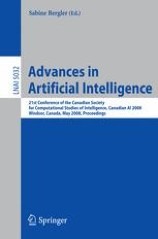
Advances in Artificial Intelligence ; 21st Conference of the Canadian Society for Computational Studies of Intelligence, Canadian AI 2008 Windsor, Canada, May 28-30, 2008 Proceedings
Constitutes the refereed proceedings of the 21st Conference of the Canadian Society for Computational Studies of Intelligence, Canadian AI 2008, held in Windsor, Canada, in May 2008.
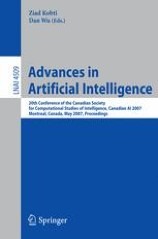
Advances in Artificial Intelligence ; 20th Conference of the Canadian Society for Computational Studies of Intelligence, Canadian AI 2007, Montreal, Canada, May 28-30, 2007, Proceedings
This book cover agents, bioinformatics, classification, constraint satisfaction, data mining, knowledge representation and reasoning, learning, natural language, and planning.
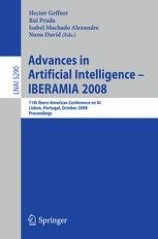
Advances in Artificial Intelligence - IBERAMIA 2008 ; 11th Ibero-American Conference on AI, Lisbon, Portugal, October 14-17, 2008. Proceedings
Constitutes the refereed proceedings of the 11th Ibero-American Conference on Artificial Intelligence, IBERAMIA 2008, held in Lisbon, Portugal, in October 2008.
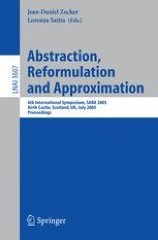
Abstraction, reformulation and approximation ; 6th International symposium, SARA 2005, Airth Castle, Scotland, UK, July 26-29, 2005, proceedings
This volume contains the proceedings of the 6th Symposium on Abstraction, Reformulation and Approximation (SARA 2005). the proceedings have been published in the LNAI series of Springer. Abstractions, reformulations and approximations (AR&A) have found app- cationsin avarietyofdisciplines andproblems, including constraintsatisfaction, design, diagnosis, machine learning, planning, qualitative reasoning, scheduling, resource allocation and theorem proving, but are also deeply rooted in philo- phy and cognitive science. The papers in this volume capture a cross-section of the various facets of the ?eld and of its applications. One of the primary uses of AR&A is oriented to overcome computational intractability. AR&A techniques, however, have also proved useful for knowledge acquisition, explanation and other applications.
