



Page 1
Page 1

OMDoc : An Open Markup Format for Mathematical Documents [version 1.2]
Computers arechanging the way wethink. Of course,nearly all desk-workers have access to computers and use them to email their colleagues, search the Web for information and prepare documents. But I’m not referring to that. I mean that people have begun to think about what they do in compu- tional terms and to exploit the power of computers to do things that would previously have been unimaginable. This observation is especially true of mathematicians.

Multi-Agent Systems and Applications V ; 5th International Central and Eastern European Conference on Multi-Agent Systems, CEEMAS 2007, Leipzig, Germany, September 25-27, 2007, Proceedings
The technical research paper section of the proceedingscontains pure - search papers as well as research results in application settings. The goal is to demonstrate the real-life value and commercial reality of multi-agent systems as well as to foster the communication between academia and industry in this eld.
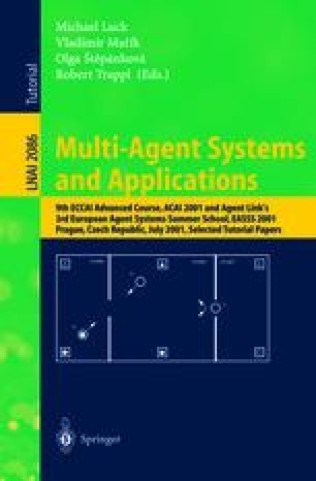
Multi-Agent Systems and Applications ; 9th ECCAI Advanced Course ACAI 2001 and Agent Link's 3rd European Agent Systems Summer School, EASSS 2001, Prague, Czech Republic, July 2-13, 2001. Selected Tutorial Papers
The Advanced Course on Artificial Intelligence ACAI 2001 with the subtitle M ulti- Agent Systems and Their Applications , held in Prague, Czech Republic, was a joint event of ECCAI (the European Coordinating Committee for Artificial Intelligence) and AgentLink, the European Network of Excellence for Agent-Based Computing. Whereas ECCAI organizes two-week ACAI courses on different topics every second year, AgentLink s European Agent Systems Summer School (EASSS) has been an annual event since 1999. This year, both of these important events were merged together, giving weight to the fact that multi-agent systems currently represent one of the hottest topics in AI research. The name, ACAI 2001 Summer School, is intended to emphasize that this event continues the tradition of regular ECCAI activities (ACAI), as well as the EASSS summer schools of AgentLink.

Multiagent System Technologies ; Vol. 4196 ; 4th German Conference, MATES 2006, Erfurt, Germany, September 19-20, 2006, Proceedings
This book constitutes the refereed proceedings of the 4th German Conference on Multiagent Systems Technologies, MATES 2006, co-located with Net.ObjectDays (NoDe 2006). The 15 revised full papers presented were carefully reviewed and selected from 52 submissions. The papers are organized in topical sections on agent communication and interaction, applications and simulation, agent planning, agent-oriented software engineering, as well as trust and security.

Multiagent System Technologies ; 5th German Conference, MATES 2007, Leipzig, Germany, September 24-26, 2007, Proceedings
The papers are organized in topical sections on engineering multi-agent systems, multi-agent planning and learning, multi-agent communication, interaction, and coordination, multi-agent resource allocation, multi-agent planning and simulation, as well as trust and reputation.

Innovative Concepts for Autonomic and Agent-Based Systems ; 2nd International Workshop on Radical Agent Concepts, WRAC 2005, Greenbelt, MD, USA, September 20-22, 2005, Revised Papers
This volume includes revised versions of papers presented at the workshop. The workshop was structured so as to allow adequate time for discussion and interaction, to exchange ideas and reflect on the motivations, scientific grounds and practical consequences of the concepts presented. Many of the ideas are truly “radical”, and so authors were given time to revise their papers to reflect further thoughts on the ideas presented and to reflect feedback received at the workshop. We are grateful to Jeff Kephart for a very interesting keynote speech describing IBM’s current and future work in this field, which fit very well with the aims and scope of the workshop.

Environments for Multi-Agent Systems III ; 3rd International Workshop, E4MAS 2006, Hakodate, Japan, May 8, 2006, Selected Revised and Invited Papers
This book are organized in topical sections on models, architecture, and design, mediated interaction and stigmery, governing environment, and applications.

Environments for Multi-Agent Systems II ; 2nd International Workshop, E4MAS 2005, Utrecht, The Netherlands, July 25, 2005, Selected Revised and Invited Papers
This book constitutes the thoroughly refereed post-proceedings of the Second International Workshop on Environments for Multiagent Systems, E4MAS 2005, held in July 2005. The 16 revised papers presented were carefully reviewed and selected from the lectures given at the workshop.
Environments for Multi-Agent Systems ; 1st International Workshop, E4MAS, 2004, New York, NY, July 19, 2004, Revised Selected Papers
The modern ?eld of multiagent systems has developed from two main lines of earlier research. Its practitioners generally regard it as a form of arti?cial intelligence (AI). Some of its earliest work was reported in a series of workshops in the US dating from1980,revealinglyentitled,“DistributedArti?cialIntelligence,”andpioneers often quoted a statement attributed to Nils Nilsson that “all AI is distributed. ” The locus of classical AI was what happens in the head of a single agent, and much MAS research re?ects this heritage with its emphasis on detailed modeling of the mental state and processes of individual agents. From this perspective, intelligenceisultimatelythepurviewofasinglemind,thoughitcanbeampli?ed by appropriate interactions with other minds. These interactions are typically mediated by structured protocols of various sorts, modeled on human conver- tional behavior. But the modern ?eld of MAS was not born of a single parent. A few - searchershavepersistentlyadvocatedideasfromthe?eldofarti?ciallife(ALife). These scientists were impressed by the complex adaptive behaviors of commu- ties of animals (often extremely simple animals, such as insects or even micro- ganisms). The computational models on which they drew were often created by biologists who used them not to solve practical engineering problems but to test their hypotheses about the mechanisms used by natural systems. In the ar- ?cial life model, intelligence need not reside in a single agent, but emerges at the level of the community from the nonlinear interactions among agents. - cause the individual agents are often subcognitive, their interactions cannot be modeled by protocols that presume linguistic competence.

Engineering Societies in the Agents World VIII ; 8th International Workshop, ESAW 2007, Athens, Greece, October 22-24, 2007, Revised Selected Papers
This book constitutes the thoroughly refereed post-conference proceedings of the 7th International Workshop on Engineering Societies in the Agents World, ESAW 2007, held in Athens, Greece, in October 2007. The 19 revised full papers were carefully reviewed and selected for inclusion in this book. The papers are organized in topical sections on electronic institutions, models of complex distributed systems with agents and societies; interaction in agent societies; engineering social intelligence in multi-agent systems; trust and reputation in agent societies; analysis, design and development of agent societies.

Engineering Societies in the Agents World VII ; 7th International Workshop, ESAW 2006 Dublin, Ireland, September 6-8, 2006 Revised Selected and Invited Papers
It cover main themes: Engineering multi-agent systems, Methodologies for analysis, design, development and verification of agent societies, Interaction and coordination in agent societies, Autonomic agent societies, Trust in agent societies For

Engineering Societies in the Agents World VI ; 6th International Workshop, ESAW 2005, Kusadasi, Turkey, October 26-28, 2005, Revised Selected and Invited Papers
ESAW 2005 took place at the Pine Bay Hotel in Kusadasi, Turkey at the end of the October 2005. It was organized as a stand-alone event as were ESAW 2004and ESAW 2003.Following the initial ESAW vision,which wasset in 1999, by the members of the working group on “Communication, Coordination and Collaboration” of Agentlink, ESAW 2005 continued to focus on the engineering of complex software systems in terms of multi-agent societies, especially the social and environmental aspects of such societies.
Declarative agent languages and technologiesV ; 5th International Workshop, DALT 2007, Honolulu, HI, USA, May 14, 2007, Revised Selected and Invited Papers
This book constitutes the thoroughly refereed post-workshop proceedings of the 5th International Workshop on Declarative Agent Languages and Technologies, DALT 2007, held in Honolulu, USA, in 2007.
Declarative agent languages and technologies IV ; 4th International Workshop, DALT 2006, Hakodate, Japan, May 8, 2006, Selected, Revised and Invited Papers
Constitutes the thoroughly refereed post-proceedings of the 4th International Workshop on Declarative Agent Languages and Technologies, DALT 2006, held in Japan in May 2006. This was an associated event of AAMAS 2006, the main international conference on autonomous agents and multi-agent systems. The 12 revised full papers presented together with one invited talk and three invited papers were carefully selected for inclusion in the book.

Declarative agent languages and technologies III ; 3rd International Workshop, DALT 2005, Utrecht, The Netherlands, July 25, 2005, Selected and Revised Papers
The workshop on Declarative Agent Languages and Technologies is a we- established venue for researchers interested in sharing their experiences in the areas of declarative and formal aspects of agents and multi-agent systems, and in engineering and technology. Today it is still a challenge to develop techno- gies that can satisfy the requirements of complex agent systems. The design and development of multi-agent systems still calls for models and technologies that ensure predictability, enable feature discovery, allow for the veri?cation of properties, and guarantee ?exibility. Declarative approaches are potentially a valuable means for satisfying the needs of multi-agent system developers and for specifying multi-agent systems.
Declarative agent languages and technologies II ; 2nd international workshop, DALT 2004, New York, NY, USA, July 19, 2004, revised selected papers
Nearly 40 research groups worldwide were motivated to contribute to this event by submitting their most recent research achievements, covering a wide variety of the topics listed in the call for papers. More than 30 top researchers agreed to join the Program Committee, which then collectively faced the hard task of selecting the one-day event program. The fact that research in multi-agent systems is no longer only a novel and promising research horizon at dawn is, in our opinion, the main reason behind DALT’s (still short) success story. On the one hand, agent theories and app- cations are mature enough to model complex domains and scenarios, and to successfully address a wide range of multifaceted problems, thus creating the urge to make the best use of this expressive and versatile paradigm, and also pro?t from all the important results achieved so far. On the other hand, bui- ing multi-agent systems still calls for models and technologies that could ensure system predictability, accommodate ?exibility, heterogeneity and openness, and enable system veri?cation.

Cooperative Information Agents XI ; Matthias Klusch, Koen V. Hindriks, Mike P. Papazoglou, Leon Sterling
In today’s world of ubiquitously connected heterogeneous information systems and computing devices, the intelligent coordination and provision of relevant added-value information at any time, anywhere is of key importance to a va- ety of applications. This challenge is envisioned to be coped with by means of appropriate intelligent and cooperative information agents. An information agent is a computational software entity that has access to one or multiple heterogeneous and geographically dispersed data and infor- tion sources. It pro-actively searches for and maintains information on behalf of its human users, or other agents preferably just in time. In other words, it is managing and overcoming the di?culties associated with information overload in open, pervasive information and service landscapes. Each component of a modern cooperative information system is represented by an appropriate intelligent information agent capable of resolving system and semantic heterogeneities in a given context on demand. Cooperative infor- tion agents are supposed to accomplish both individual and shared joint goals depending on the actual user preferences in line with given or deduced limits of time, budget and resources available.

Cooperative Information Agents X ; 10th International Workshop, CIA 2006, Edinburgh, UK, September 11-13, 2006, Proceedings
This book constitutes the refereed proceedings of the 10th International Workshop on Cooperative Information Agents, CIA 2006, held in Edinburgh, UK in September 2006. The 29 revised full papers presented together with four invited papers were carefully reviewed and selected from 58 submissions. The papers are organized in topical sections.

Computational logic in multi-agent systems ; Vol. 3900 ; 6th International Workshop, CLIMA VI, London, UK, June 27-29, 2005, Revised Selected and Invited Papers
The book presents 14 revised full technical papers, 4 contest papers, and 7 invited papers together with 1 invited article are organized in topical sections on foundational aspects of agency, agent programming, agent interaction and normative systems, the first CLIMA contest, and on the project report of the SOCS project.
Computational logic in multi-agent systems ; Vol. 3487 ; 5th International Workshop, CLIMA V, Lisbon, Portugal, September 29-30, 2004, Revised Selected and Invited Papers
The notion of agency has recently increased its in?uence in the research and - velopment of computational logic based systems, while at the same time sign- cantly gaining from decades of research in computational logic. Computational logic provides a well-de?ned, general, and rigorous framework for studying s- tax, semantics and procedures, for implementations, environments, tools, and standards, facilitating the ever important link between speci?cation and ver- cation of computational systems. The purpose of the Computational Logic in Multi-agent Systems (CLIMA) international workshop series is to discuss techniques, based on computational logic, for representing, programming, and reasoning about multi-agent systems in a formal way. Former CLIMA editions were conducted in conjunction with other major computational logic and AI events Thesubmittedpapersshowedthatthelogicalfoundationsofmulti-agent systems are felt by a large community to be a very important research topic, upon which classical AI and agent-related issues are to be addressed.
