



Page 74
Page 74
Certification and security in inter-organizational E-services ; IFIP 18th World Computer Congress, August 22-27, 2004, Toulouse, France
This collection of papers offers real-life application experiences, research results and methodological proposals of direct interest to systems experts and users in governmental, industrial and academic communities. This book also documents several important developments. The uptake of distributed computational infrastructure oriented to service provision, like Web-Services and Grid, is making C&S even more important. E-services based on legacy systems managed by autonomous and independent organizations, a common situation in the public administration sector, increase overall complexity. The increased presence and use of e-service IT-infrastructures depends on the critical ability required for all security issues, from the basic (availability, authentication, integrity, confidentiality) to the more complex (e.g. authorization, non-repudiation).
Central European Functional Programming School : 2nd Summer School, CEFP 2007, Cluj-Napoca, Romania, June 23-30, 2007, Revised Selected Lectures
This volume presents texts from selected lectures given by leading researchers at the Second Central European Functional Programming School, CEFP 2007, held in Cluj-Napoca, Romania, in June 2007.

Cellular Automata and Discrete Complex Systems ; 26th IFIP WG 1.5 International Workshop, AUTOMATA 2020, Stockholm, Sweden, August 10–12, 2020, Proceedings
This volume constitutes the refereed post-conference proceedings of the 26th IFIP WG 1.5 International Workshop on Cellular Automata and Discrete Complex Systems, AUTOMATA 2020, held in Stockholm, Sweden, in August 2020. The workshop was held virtually. The 11 full papers presented in this book were carefully reviewed and selected from a total of 21 submissions. The topics of the conference include dynamical, topological, ergodic and algebraic aspects of CA and DCS, algorithmic and complexity issues, emergent properties, formal languages, symbolic dynamics, tilings, models of parallelism and distributed systems, timing schemes, synchronous versus asynchronous models, phenomenological descriptions, scientific modeling, and practical applications.
Categories for software engineering
This book provides a gentle, software engineering oriented introduction to category theory. Assuming only a minimum of mathematical preparation, this book explores the use of categorical constructions from the point of view of the methods and techniques that have been proposed for the engineering of complex software systems: object-oriented development, software architectures, logical and algebraic specification techniques, models of concurrency, inter alia. After two parts in which basic and more advanced categorical concepts and techniques are introduced, the book illustrates their application to the semantics of CommUnity – a language for the architectural design of interactive systems. "For computer scientists, this unique book presents Category Theory in a manner tailored to their interests and with examples to which they can relate." Ira Forman, IBM "This book applies little-known yet quite powerful formal tools from category theory to software structures: designs, architectures, patterns, and styles. Rather than focus on issues at the level of computational models and semantics, it instead applies these tools to some of the problems facing the sophisticated software architect.
Case-based reasoning research and development ; 6th International conference on case-based reasoning, ICCBR 2005, Chicago, IL, USA, August 23-26, 2005, Proceedings
This book constitutes the refereed proceedings of the 6th International Conference on Case-Based Reasoning, ICCBR 2005, held in Chicago, IL, USA, in August 2005. The 19 revised full research papers and 26 revised poster papers presented together with the abstracts of 3 invited talks were carefully reviewed and selected from 74 submissions. The papers address all current foundational, theoretical and research aspects of case-based reasoning as well as advanced applications either with innovative commercial deployment or practical, social, environmental or economic significance.
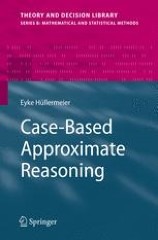
Case-Based Approximate Reasoning
Case-based reasoning (CBR) has received a great deal of attention in recent years and has established itself as a core methodology in the field of artificial intelligence. The key idea of CBR is to tackle new problems by referring to similar problems that have already been solved in the past. More precisely, CBR proceeds from individual experiences in the form of cases. The generalization beyond these experiences typically relies on a kind of regularity assumption demanding that 'similar problems have similar solutions'. Making use of different frameworks of approximate reasoning and reasoning under uncertainty, notably probabilistic and fuzzy set-based techniques, this book develops formal models of the above inference principle, which is fundamental to CBR. The case-based approximate reasoning methods thus obtained especially emphasize the heuristic nature of case-based inference and aspects of uncertainty in CBR. This way, the book contributes to a solid foundation of CBR which is grounded on formal concepts and techniques from the aforementioned fields. Besides, it establishes interesting relationships between CBR and approximate reasoning, which not only cast new light on existing methods but also enhance the development of novel approaches and hybrid systems.
Business process management Workshops ; Vol. 4103 : BPM 2006 International Workshops, BPD, BPI, ENEI, GPWW, DPM, semantics4ws, Vienna, Austria, September 4-7, 2006, Proceedings
BPM 2006 was the fourth in a conference series that provides a forum for - searchers and practitioners in all areas of business process management. In c- junction with BPM 2006, a series of workshops were held. They were meant to facilitate the exchange of ideas and experiences between active researchers, and to stimulate discussions on new and emerging topics in line with the conference topics. We see the workshops as a necessary extension to the main conference. BPM has established itself rapidly as a high quality conference with a highly competitive selection process.
Business process management Workshops ; Vol. 3812 : BPM 2005 International Workshops, BPI, BPD, ENEI, BPRM, WSCOBPM, BPS, Nancy, France, September 5, 2005. Revised Selected Papers
Six parallel Business Process Management workshops were held on September 5th, 2005,The topics of the workshops ranged from fundamental process modeling primitives to the recently emerged field of Web service choreography and orchestration, rep- sented in the “Workshop on Business Processes and Services” and the “Workshop on Web Service Choreography and Orchestration;” a topic which intersects the research fields of business process management and Web services.
Business process management Workshops ; BPM 2007 International Workshops, BPI, BPD, CBP, ProHealth, RefMod, semantics4ws, Brisbane, Australia, September 24, 2007, Revised Selected Papers
This book constitutes the thoroughly refereed post-workshop proceedings of 6 internationl workshops held in Brisbane, Australia, in conjunction with the 5th International Conference on Business Process Management, BPM 2007, in September 2007.

Business process management ; Vol. 4102 : 4th International Conference, BPM 2006, Vienna, Austria, September 5-7, 2006, Proceedings
This book constitutes the refereed proceedings of the 4th International Conference on Business Process Management, BPM 2006. The book presents 20 revised full papers, 5 industrial papers, and 15 short papers together with an invited paper and the abstract of an invited talk. The papers are organized in topical sections on monitoring and mining, service composition, process models and languages, dynamic process management, Web service composition, and applied business process management.
Business process management ; Vol. 3649 ; 3rd International Conference, BPM 2005, Nancy, France, September 5-8, 2005, Proceedings
This volume contains the proceedings of the 3rd International Conference on Business Process Management (BPM 2005), organized by LORIA in Nancy, France, 2005. This year, BPM included several innovations with respect to previous e- tions, most notably the addition of an industrial program and of co-located workshops. This was the logical result of the signi?cant (and still growing) - dustrial interest in the area and of the broadening of the research communities working on BPM topics, includ Information Systems Applications (incl. Internet) / Information Storage and Retrieval / User Interfaces and Human Computer Interaction / Computers and Society / Management of Computing and Information Systems / IT in Business

Business process management ; 6th International Conference, BPM 2008, Milan, Italy, September 2-4, 2008. Proceedings
This book constitutes the refereed proceedings of the 6th International Conference on Business Process Management, BPM 2008, held in Milan, Italy, in September 2008.
Business process management ; 5th International Conference, BPM 2007, Brisbane, Australia, September 24-28, 2007, Proceedings
This book includes business process maturity and performance, business process modeling, case studies, compliance and change, process configuration and execution, formal foundations of BPM, business process mining, and semantic issues in BPM.
Business process management : Concepts, languages, architectures
Business process management is usually treated from two different perspectives: business administration and computer science. While business administration professionals tend to consider information technology as a subordinate aspect for experts to handle, by contrast computer scientists often consider business goals and organizational regulations as terms that do not deserve much thought but require the appropriate level of abstraction.This textbook is ideally suited for classes on business process management, information systems architecture, and workflow management. It is also valuable for project managers and IT professionals working in business process management.

Business modeling and software design ; 10th International Symposium, BMSD 2020, Berlin, Germany, July 6-8, 2020, Proceedings
This book constitutes the refereed proceedings of the 10th International Symposium on Business Modeling and Software Design, BMSD 2020, which took place in Berlin, Germany, in July 2020. BMSD is a leading international forum that brings together researchers and practitioners interested in business modeling and its relation to software design. Particular areas of interest are: Business Processes and Enterprise Engineering; Business Models and Requirements; Business Models and Services; Business Models and Software; Information Systems Architectures and Paradigms; Data Aspects in Business Modeling and Software Development; Blockchain-Based Business Models and Information Systems; IoT and Implications for Enterprise Information Systems.
Business Information Systems ; 11th International Conference, BIS 2008, Innsbruck, Austria, May 5-7, 2008. Proceedings
This book contains the refereed proceedings of the 11th International Conference on Business Information Systems, BIS 2008, held in Innsbruck, Austria, in May 2008.

Business Information Systems ; 10th International Conference, BIS 2007, Poznan, Poland, April 25-27, 2007, Proceedings
This volume covers research trends as well as current achievements and cutting-edge developments in the area of modern business information systems. It contiants Business Process Management, Web Services, Ontologies, Information Retrieval, System Design, Agents and Mobile Applications, Decision Support, Social Issues, Specific MIS Issues.
Business agility and information technology diffusion ; IFIP TC8 WG 8.6 International working Conference, May 8-11, 2005, Atlanta, Georgia, USA
Addresses issues related to business agility and the diffusion of Information Technology (IT). Success, even survival, in today's business environment has been made complex and difficult by technologically-based competitive pressure. One promising strategy is to be agile and ready to adapt quickly to changes in the environment or market. Such strategy takes shape as an agile software development, agile manufacturing, agile modeling and agile iterations. In contrast, successful IT diffusion is known to be a process that takes time and careful effort. Many IT projects that succeeded in developing a product have subsequently failed in changing the behavior of the target group when diffusion just didn't happen. Therefore this volume responds to the question: What is the relationship between agility and IT diffusion? The book's scope will cover information systems and technology issues, as well as organizational and managerial issues, related to agility and IT diffusion. The planned perspectives include topics such as diffusion of agile methods, enabling business agility with IT, creating agile environments that facilitate diffusion of IT, theories and frameworks for understanding diffusion and agility issues, best practices relating to business agility and IT diffusion, software process improvement and agility, diffusion studies of specific agile technologies, and impacts of diffusion of IT agile methods.
Building XNA 2.0 Games : A Practical Guide for Independent Game Development
Building XNA 2.0 Games: A Practical Guide for Independent Game Development is written by James Silva, who recently won the prestigious Microsoft Dream Build Play game competition with his award–winning game, The Dishwasher: Dead Samurai. Building XNA 2.0 Games: A Practical Guide for Independent Game Development is an in–depth and exclusive look into the entire XNA game development process and includes the creation of a software game masterpiece. James Silva guides you through the process he took to build his award–winning title, from concept to reality. He reveals tips and techniques for creating a polished, high–quality game with very few resources, while bridging the gap between coding and art.

Building the Infrastructure for Cloud Security : A Solutions view
For cloud users and providers alike, security is an everyday concern, yet there are very few books covering cloud security as a main subject. This book will help address this information gap from an Information Technology solution and usage-centric view of cloud infrastructure security. The book highlights the fundamental technology components necessary to build and enable trusted clouds. Here also is an explanation of the security and compliance challenges organizations face as they migrate mission-critical applications to the cloud, and how trusted clouds, that have their integrity rooted in hardware, can address these challenges.
