



Page 67
Page 67

Machine learning for cyber-physical systems: selected papers from the international conference ML4CPS 2023
Contains selected papers from the international conference ML4CPS – Machine Learning for Cyber-Physical Systems, which was held in Hamburg (Germany), from 29 to 31 March 2023. Cyber-physical systems are adaptive and learning: they analyze their environment and, based on observations, learn patterns, associations and predictive models. Typical applications are condition monitoring, predictive maintenance, image processing and diagnostics. Machine learning is the key technology for these developments.

Machine learning for cyber security ; 3rd International Conference, ML4CS 2020, Guangzhou, China, October 8–10, 2020, Proceedings, Part III
Constitutes the proceedings of the Third International Conference on Machine Learning for Cyber Security, ML4CS 2020, held in Xi’an, China in October 2020. The 118 full papers and 40 short papers presented were carefully reviewed and selected from 360 submissions. The papers offer a wide range of the following subjects: Machine learning, security, privacy-preserving, cyber security, Adversarial machine Learning, Malware detection and analysis, Data mining, and Artificial Intelligence.

Machine Learning for Cyber Security ; 3rd International Conference, ML4CS 2020, Guangzhou, China, October 8–10, 2020, Proceedings, Part II
Constitutes the proceedings of the Third International Conference on Machine Learning for Cyber Security, ML4CS 2020, held in Xi’an, China in October 2020. The 118 full papers and 40 short papers presented were carefully reviewed and selected from 360 submissions. The papers offer a wide range of the following subjects: Machine learning, security, privacy-preserving, cyber security, Adversarial machine Learning, Malware detection and analysis, Data mining, and Artificial Intelligence.

Machine Learning for Cyber Security ; 3rd International Conference, ML4CS 2020, Guangzhou, China, October 8–10, 2020, Proceedings, Part I
Constitutes the proceedings of the Third International Conference on Machine Learning for Cyber Security, ML4CS 2020, held in Xi’an, China in October 2020. The 118 full papers and 40 short papers presented were carefully reviewed and selected from 360 submissions. The papers offer a wide range of the following subjects: Machine learning, security, privacy-preserving, cyber security, Adversarial machine Learning, Malware detection and analysis, Data mining, and Artificial Intelligence.
Machine Learning for Cyber Physical Systems : Selected papers from the International Conference ML4CPS 2020
Presents new approaches to Machine Learning for Cyber Physical Systems, experiences and visions. It contains selected papers from the fifth international Conference ML4CPS – Machine Learning for Cyber Physical Systems, which was held in Berlin, March 12-13, 2020.

Machine Learning for Cyber Physical Systems : Selected papers from the International Conference ML4CPS 2018
Presents new approaches to Machine Learning for Cyber Physical Systems, experiences and visions. Cyber Physical Systems are characterized by their ability to adapt and to learn: They analyze their environment and, based on observations, they learn patterns, correlations and predictive models. Typical applications are condition monitoring, predictive maintenance, image processing and diagnosis. Machine Learning is the key technology for these developments.

Machine Learning for Cyber Agents : Attack and Defence
The cyber world has been both enhanced and endangered by AI. On the one hand, the performance of many existing security services has been improved, and new tools created. On the other, it entails new cyber threats both through evolved attacking capacities and through its own imperfections and vulnerabilities. Moreover, quantum computers are further pushing the boundaries of what is possible, by making machine learning cyber agents faster and smarter.
Machine Learning for Computer Scientists and Data Analysts: From an Applied Perspective
Describes traditional as well as advanced machine learning algorithms / Enables students to learn which algorithm is most appropriate for the data being handled / Includes numerous, practical case-studies; implementation codes in Python available for readers

Machine Learning for Audio, Image and Video Analysis : Theory and Applications
The book is organized in four parts: The first focuses on technical aspects, basic mathematical notions and elementary machine learning techniques. The second provides an extensive survey of most relevant machine learning techniques for media processing, while the third part focuses on applications and shows how techniques are applied in actual problems. The fourth part contains detailed appendices that provide notions about the main mathematical instruments used throughout the text
Machine Learning and Probabilistic Graphical Models for Decision Support Systems
Presents recent advancements in research, a review of new methods and techniques, and applications in decision support systems (DSS) with Machine Learning and Probabilistic Graphical Models, which are very effective techniques in gaining knowledge from Big Data and in interpreting decisions. It explores Bayesian network learning, Control Chart, Reinforcement Learning for multicriteria DSS, Anomaly Detection in Smart Manufacturing with Federated Learning, DSS in healthcare, DSS for supply chain management, etc. Researchers and practitioners alike will benefit from this book to enhance the understanding of machine learning, Probabilistic Graphical Models, and their uses in DSS in the context of decision making with uncertainty. The real-world case studies in various fields with guidance and recommendations for the practical applications of these studies are introduced in each chapter.

Machine Learning and Knowledge Extraction ; 5th IFIP TC 5, TC 12, WG 8.4, WG 8.9, WG 12.9 International Cross-Domain Conference, CD-MAKE 2021, Virtual Event, August 17–20, 2021, Proceedings
Constitutes the refereed proceedings of the 5th IFIP TC 5, TC 12, WG 8.4, WG 8.9, WG 12.9 International Cross-Domain Conference, CD-MAKE 2021, held in virtually in August 2021. The 20 full papers and 2 short papers presented were carefully reviewed and selected from 48 submissions. The cross-domain integration and appraisal of different fields provides an atmosphere to foster different perspectives and opinions; it will offer a platform for novel ideas and a fresh look on the methodologies to put these ideas into business for the benefit of humanity.

Machine learning and data mining for sports analytics ; 7th international workshop, MLSA 2020, Co-located with ECML/PKDD 2020, Ghent, Belgium, September 14–18, 2020, Proceedings
Constitutes the refereed post-conference proceedings of the 7th International Workshop on Machine Learning and Data Mining for Sports Analytics, MLSA 2020, colocated with ECML/PKDD 2020, in Ghent, Belgium, in September 2020. The 11 papers presented were carefully reviewed and selected from 22 submissions. The papers present a variety of topics within the area of sports analytics, including tactical analysis, outcome predictions, data acquisition, performance optimization, and player evaluation.
Machine Learning and Cognitive Computing for Mobile Communications and Wireless Networks
Communication and network technology has witnessed recent rapid development and numerous information services and applications have been developed globally. These technologies have high impact on society and the way people are leading their lives. The advancement in technology has undoubtedly improved the quality of service and user experience yet a lot needs to be still done. Some areas that still need improvement include seamless wide-area coverage, high-capacity hot-spots, low-power massive-connections, low-latency and high-reliability and so on. Thus, it is highly desirable to develop smart technologies for communication to improve the overall services and management of wireless communication. Machine learning and cognitive computing have converged to give some groundbreaking solutions for smart machines. With these two technologies coming together, the machines can acquire the ability to reason similar to the human brain. The research area of machine learning and cognitive computing cover many fields like psychology, biology, signal processing, physics, information theory, mathematics, and statistics that can be used effectively for topology management. Therefore, the utilization of machine learning techniques like data analytics and cognitive power will lead to better performance of communication and wireless systems.
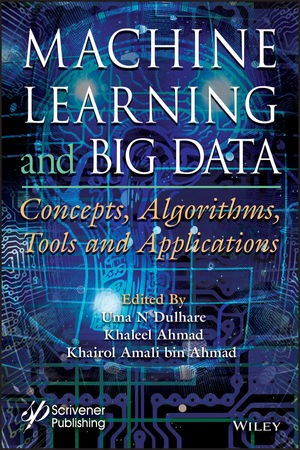
Machine learning and big data : Concepts, algorithms, tools and applications
Showcase novel use-cases and applications, present empirical research results from user-centered qualitative and quantitative experiments of these new applications, and facilitate a discussion forum to explore the latest trends in big data and machine learning by providing algorithms which can be trained to perform interdisciplinary techniques such as statistics, linear algebra, and optimization and also create automated systems that can sift through large volumes of data at high speed to make predictions or decisions without human intervention

Machine Learning : ECML 2005 ; 16th European Conference on Machine Learning, Porto, Portugal, October 3-7, 2005, Proceedings
The European Conference on Machine Learning (ECML) and the European Conference on Principles and Practice of Knowledge Discovery in Databases (PKDD) were jointly organized this year for the ?fth time in a row, after some years of mutual independence before. After Freiburg (2001), Helsinki (2002), Cavtat (2003) and Pisa (2004), Porto received the 16th edition of ECML and the 9th PKDD in October 3–7. Having the two conferences together seems to be working well: 585 di?erent paper submissions were received for both events, which maintains the high s- mission standard of last year. Of these, 335 were submitted to ECML only, 220 to PKDD only and 30 to both. Such a high volume of scienti?c work required a tremendous e?ort from Area Chairs, Program Committee members and some additional reviewers. On average, PC members had 10 papers to evaluate, and Area Chairs had 25 papers to decide upon. We managed to have 3 highly qualified independent reviews per paper (with very few exceptions) and one additional overall input from one of the Area Chairs. After the authors’ responses and the online discussions for many of the papers, we arrived at the ?nal selection of 40 regular papers for ECML and 35 for PKDD. Besides these, 32 others were accepted as short papers for ECML and 35 for PKDD. This represents a joint acceptance rate of around 13% for regular papers and 25% overall.

Machine Intelligence and Big Data Analytics for Cybersecurity Applications
Presents the latest advances in machine intelligence and big data analytics to improve early warning of cyber-attacks, for cybersecurity intrusion detection and monitoring, and malware analysis. Cyber-attacks have posed real and wide-ranging threats for the information society. Detecting cyber-attacks becomes a challenge, not only because of the sophistication of attacks but also because of the large scale and complex nature of today’s IT infrastructures. It discusses novel trends and achievements in machine intelligence and their role in the development of secure systems and identifies open and future research issues related to the application of machine intelligence in the cybersecurity field.

Machine Ethics : From Machine Morals to the Machinery of Morality
Offers the first systematic guide to machine ethics, bridging between computer science, social sciences and philosophy. Based on a dialogue between an AI scientist and a novelist philosopher, the book discusses important findings on which moral values machines can be taught and how. In turn, it investigates what kind of artificial intelligence (AI) people do actually want.

Mac OS X Leopard : Beyond the Manual
Good computer books make assumptions about the reader: what they do and don't know when they pick up the book, and what they want to know when they put it down. For each reader this could be very different; therefore, a book that suits one person may not be the best for another. Mac OS X Leopard: Beyond the Manual makes some assumptions too, ones that tend to differ from other Mac OS X books. First of all, we assume that you have used a computer in that past: that you know how to use a mouse and you know the proper place to stick a DVD to get it to play in your computer. We won't be showing you these things. (We will, however, demonstrate to our Mac converts how to “right click” on a trackpad with only one button!).

Long-Term Preservation of Digital Documents : Principles and Practices
Key to our culture is that we can disseminate information, and then maintain and access it over time. While we are rapidly advancing from vulnerable physical solutions to superior, digital media, preserving and using data over the long term involves complicated research challenges and organization efforts. Uwe Borghoff and his coauthors address the problem of storing, reading, and using digital data for periods longer than 50 years. They briefly describe several markup and document description languages like TIFF, PDF, HTML, and XML, explain the most important techniques such as migration and emulation, and present the OAIS (Open Archival Information System) Reference Model. To complement this background information on the technology issues the authors present the most relevant international preservation projects, such as the Dublin Core Metadata Initiative, and experiences from sample projects run by the Cornell University Library and the National Library of the Netherlands. A rated survey list of available systems and tools completes the book.

Logics in Artificial Intelligence ; 11th European Conference, JELIA 2008, Dresden, Germany, September 28-October 1, 2008. Proceedings
Constitutes the refereed proceedings of the 11th European Conference on Logics in Artificial Intelligence, JELIA 2008, held in Dresden, Germany, Liverpool, in September/October 2008.The 32 revised full papers presented together with 2 invited talks were carefully reviewed and selected from 98 submissions. The papers cover a broad range of topics including belief revision, description logics, non-monotonic reasoning, multi-agent systems, probabilistic logic, and temporal logic.
